pirate vessel
4 vessels
Black Pearl
Before 2003, the pirate movie was a dead genre. After Pirates of the Caribbean, every kid in America wanted a ship with black sails. The Black Pearl did for pirate vessels what the Millennium Falcon did for spaceships. It made the vehicle a character. The ship represents freedom in its purest cinematic form. Jack Sparrow doesn't want gold or power. He wants his ship back. That's it. The entire first film is a man trying to reclaim the one thing that makes him who he is. The Black Pearl isn't transportation. It's identity. Johnny Depp's performance gets the credit, and it should. But the ship sells the fantasy. The black sails against a Caribbean sunset. The ragged rigging. The impossible speed. You believe this ship is alive because the movie treats it like one. The prop was built on a steel barge called the Sunset, dressed with a full wooden superstructure. Additional ships were constructed for later films, and digital effects expanded the Pearl's capabilities well beyond anything that floats.
Queen Anne's Revenge
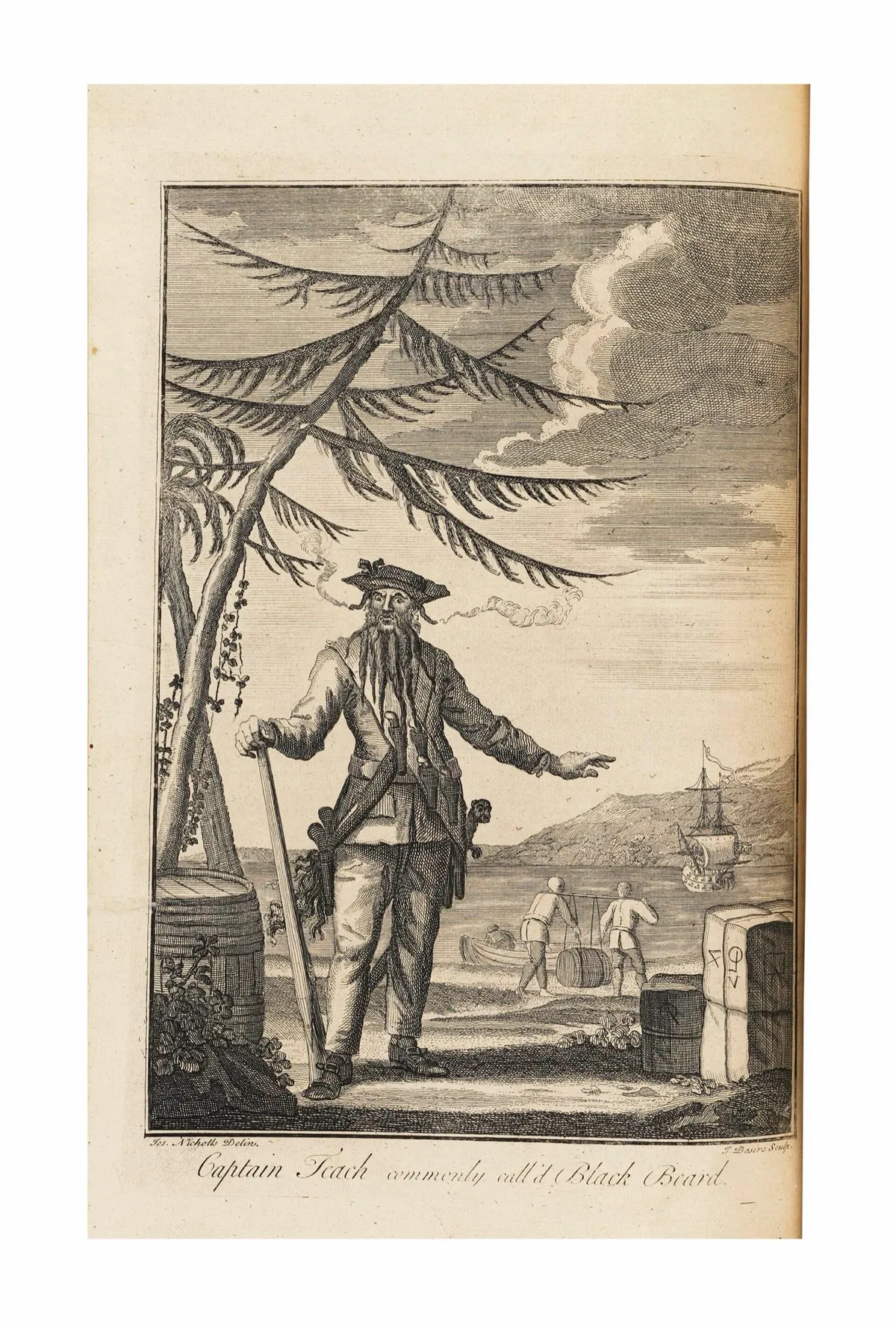
Queen Anne's Revenge started life as La Concorde, a French slave ship working the triangle trade between Nantes, West Africa, and the Caribbean. Edward Teach, who the world would remember as Blackbeard, captured her near Martinique in November 1717. He renamed her, stuffed her with cannons, and turned a vessel built to transport human misery into a floating fortress of a different kind. For about six months, she was the most feared ship in the Atlantic. Blackbeard used her to blockade the port of Charleston, South Carolina in May 1718. He held the entire city hostage for a week, capturing ships in the harbor and demanding a chest of medicine as ransom. Charleston paid. The blockade worked not because of superior firepower but because of reputation. Nobody wanted to find out if the stories were true. Then Blackbeard did something nobody expected. He ran Queen Anne's Revenge aground at Beaufort Inlet, North Carolina, in June 1718. The official story was an accident. The real story, most historians believe, was deliberate. Blackbeard marooned most of his crew on a sandbar, took the loot and his closest allies, and sailed off in a smaller sloop. It was a heist within a heist. Blackbeard didn't last long after that. Lt. Robert Maynard of the Royal Navy found him anchored at Ocracoke Inlet on November 22, 1718. The fight was vicious. Blackbeard took five musket balls and twenty sword cuts before he finally dropped. They cut off his head and hung it from the bowsprit. The ship matters because it connects the slave trade, piracy, and colonial politics in ways that are uncomfortable and honest. La Concorde carried enslaved Africans. Queen Anne's Revenge carried pirates, many of whom were formerly enslaved or pressed sailors who chose piracy over legitimate service. The line between legal and illegal cruelty was thinner than anyone wanted to admit.
Royal Fortune
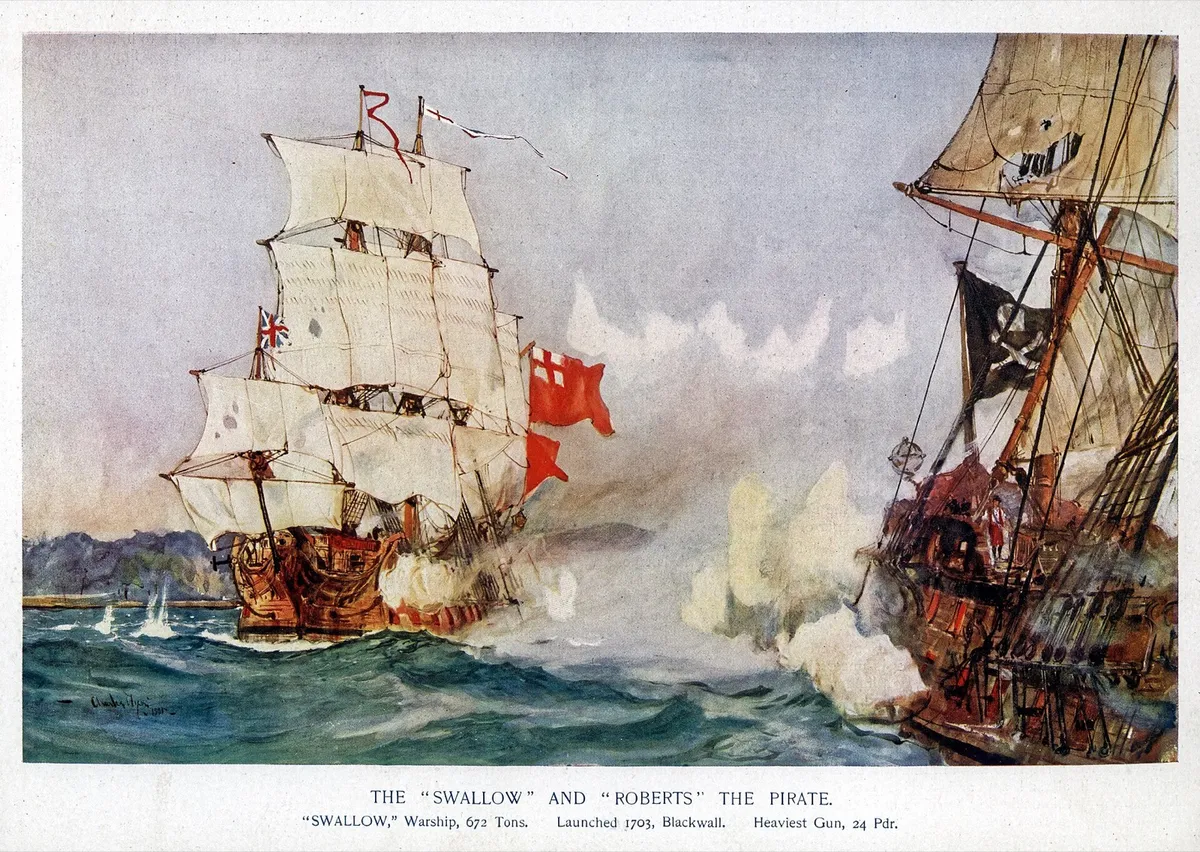
Bartholomew Roberts, "Black Bart," captured over 400 ships in three years. That number is not a typo. Four hundred. No pirate before or since came close. He operated from Newfoundland to Brazil to West Africa, and every navy in the Atlantic wanted him dead. The final Royal Fortune was his last and largest flagship, a 52-gun warship that could go toe-to-toe with anything the Royal Navy sent after him. Roberts is the pirate who actually wrote the code. Not the Hollywood version. Real articles of agreement that his crew signed. Lights out at eight. No gambling for money aboard. Every man gets a vote. Every man gets a share. If you lose your right arm in battle, you get 600 pieces of eight in compensation. If you desert during a fight, the punishment is death or marooning. It was a constitution for thieves, and it worked better than most legitimate governments of the era. The man himself was a contradiction. He dressed extravagantly, wearing crimson damask waistcoats and diamond crosses. He never drank anything stronger than tea. He was Welsh, deeply religious by pirate standards, and reportedly furious about being forced into piracy when his merchant ship was captured. He turned out to be spectacularly good at it. Roberts went through multiple ships named Royal Fortune, trading up as he captured better vessels. The final one was a French warship he took off the African coast. He refitted her, loaded her with guns, and sailed her for roughly two years. She was the most heavily armed pirate ship of the Golden Age. It ended on February 10, 1722, off Cape Lopez in present-day Gabon. HMS Swallow, a Royal Navy warship under Captain Chaloner Ogle, caught Roberts at anchor. Roberts dressed in his finest clothes and sailed out to fight. A blast of grapeshot hit him in the throat. He was dead before he hit the deck. His crew, following his standing orders, threw his body overboard in full dress before the Navy could take it as a trophy. The sea got him. Nobody else did.
Whydah Gally
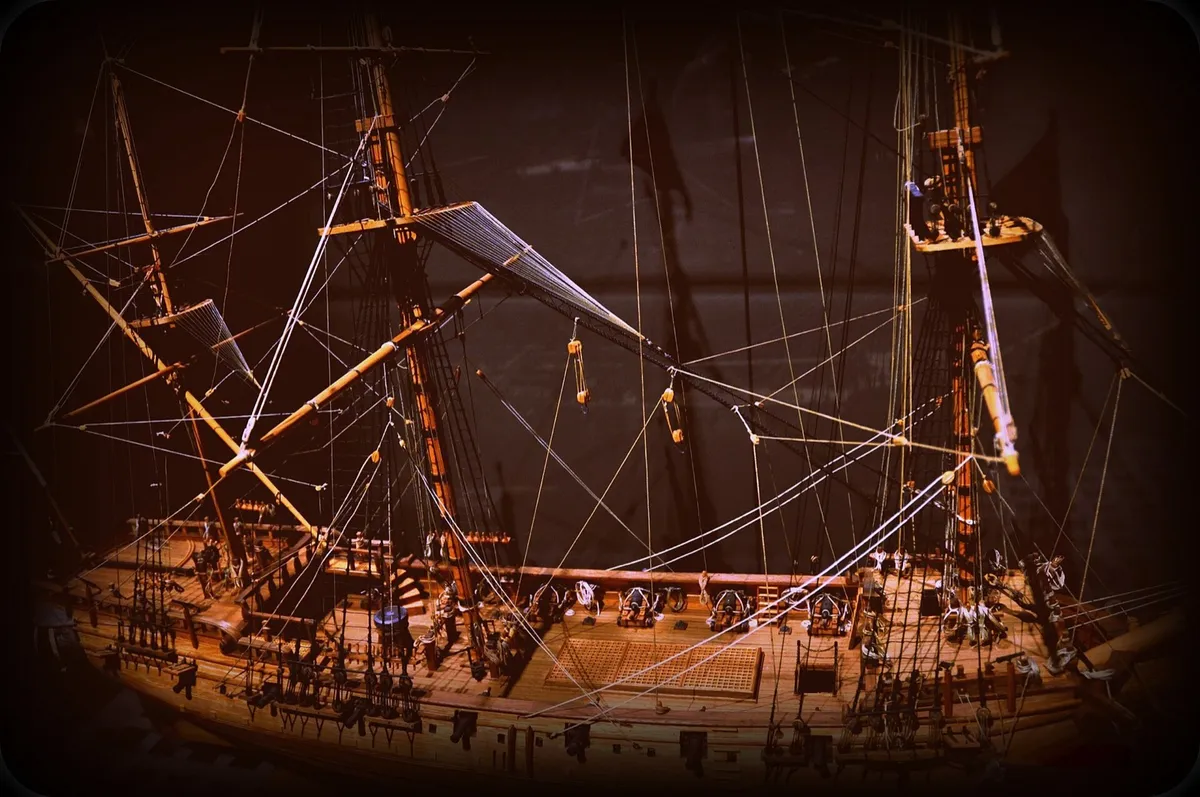
The Whydah (pronounced "WID-uh") is the only verified pirate shipwreck in the world. Every other supposed pirate wreck is a guess, a legend, or a tourism pitch. The Whydah has a ship's bell with the name on it. That's authentication you can't argue with. She was built in London around 1715 as a slave ship, purpose-built for speed. The triangle trade demanded fast hulls. You loaded trade goods in England, exchanged them for enslaved people in West Africa, crossed the Atlantic as quickly as possible because your cargo was dying every day, sold the survivors in the Caribbean, then loaded sugar and headed home. The Whydah made at least one full circuit before Captain Sam Bellamy took her. Bellamy captured the Whydah in February 1717 near the Bahamas. He was 28 years old, handsome, and reportedly refused to wear wigs, earning him the name "Black Sam." He'd been a pirate for about a year. When he took the Whydah, she was carrying the profits of her slave voyage: indigo, sugar, gold, silver, and ivory. Bellamy kept the cargo, transferred his crew aboard, and made her his flagship. For two months, Bellamy terrorized the Atlantic coast. He captured over 50 ships. By the time the Whydah went down, she was carrying an estimated 4.5 tons of gold and silver, the plunder of dozens of vessels. Bellamy was, by some calculations, the wealthiest pirate in recorded history. He just didn't get to spend any of it. On April 26, 1717, a nor'easter caught the Whydah off the coast of Cape Cod near Wellfleet, Massachusetts. The storm drove her onto a sandbar. The masts snapped. The hull broke apart. Bellamy and 143 of his 146 crew drowned. Two survivors washed ashore. The whole career, start to finish, lasted about fourteen months.