Black Pearl
Why it matters
Before 2003, the pirate movie was a dead genre. After Pirates of the Caribbean, every kid in America wanted a ship with black sails. The Black Pearl did for pirate vessels what the Millennium Falcon did for spaceships. It made the vehicle a character.
The ship represents freedom in its purest cinematic form. Jack Sparrow doesn't want gold or power. He wants his ship back. That's it. The entire first film is a man trying to reclaim the one thing that makes him who he is. The Black Pearl isn't transportation. It's identity.
Johnny Depp's performance gets the credit, and it should. But the ship sells the fantasy. The black sails against a Caribbean sunset. The ragged rigging. The impossible speed. You believe this ship is alive because the movie treats it like one.
The prop was built on a steel barge called the Sunset, dressed with a full wooden superstructure. Additional ships were constructed for later films, and digital effects expanded the Pearl's capabilities well beyond anything that floats.
What it was like
Life aboard the Black Pearl depends entirely on who's captaining her, and that changes roughly every forty minutes of screen time.
Under Jack Sparrow, the ship runs on improvisation, rum, and whatever plan Jack cooked up three steps ahead of everyone including himself. Discipline is optional. Navigation is intuitive. The crew tolerates Jack because he has an uncanny ability to not die, and because the alternative captains are worse.
Under Barbossa, the Pearl was a proper terror. Crew discipline, ruthless boarding tactics, and a captain who actually knew how to run a ship. Of course, the crew was also cursed, undead, and unable to enjoy food, drink, or moonlight. So there were trade-offs.
Below deck, the Pearl is cramped, dark, and perpetually damp. The brig sees a lot of use. The rum supply is a strategic concern.
The crew
Captain (Jack Sparrow)
Captain Jack Sparrow. Captain. He's very particular about that. A man who treats his ship the way some people treat religion, except with more rum and fewer rules. He lost the Pearl, got it back, lost it again, got it back again. The ship is the only thing he's ever been loyal to, and even that relationship is complicated. He once traded it to Davy Jones. He got it back. He always gets it back.
Captain (Hector Barbossa)
Barbossa mutinied, took the Pearl, got cursed, got killed, got resurrected, took the Pearl again, lost a leg, gained a magical sword, and died again. Twice. He's arguably a better sailor than Jack and definitely a better captain in any traditional sense. The Black Pearl under Barbossa was feared across the Caribbean. Under Jack, she was mostly just confusing.
First Mate (Joshamee Gibbs)
The only man who's served under both captains and survived with his sanity mostly intact. Gibbs is a superstitious old sailor who believes in signs, omens, and the importance of a good first mate keeping the captain from doing anything catastrophically stupid. His success rate on that last point hovers around 40%.
Crew (Will Turner)
A blacksmith's apprentice who ended up on the Pearl because he was chasing a girl. Will is the straight man in a world of lunatics. He can fight, he can sail well enough, and he has the moral compass the rest of the crew collectively lost years ago. He eventually became captain of the Flying Dutchman, which is a lateral move at best.
Patina notes
The Black Pearl's look is deliberate decay elevated to aesthetic. The black sails are tattered. The rigging is held together with faith and barnacles. The hull is scarred from cannonballs and krakens.
This is a ship that's been cursed, sunk, shrunk to fit in a bottle, and sailed to the literal edge of the world. She looks it. The production design team created one of the most recognizable silhouettes in film by making the ship look like it should have sunk a hundred years ago but simply refused.
The real prop ships weathered naturally during filming in the Caribbean. Salt air, sun, and seawater did to the set what the art department intended. Sometimes reality is the best special effect.
Preservation reality
The primary prop ship (built on the barge Sunset) was used across multiple films. Between productions, the vessel was stored at various locations. Additional Pearl replicas were built for the sequels as the action demanded more ships in more places.
As of the last public reports, at least one Pearl prop was moored near Kualoa Ranch in Hawaii, though its current condition and accessibility vary. Disney has not established a permanent public display for the ship.
The Black Pearl exists most durably in theme parks. Pirates of the Caribbean rides at Disney parks worldwide feature Pearl imagery, and the franchise's cultural footprint ensures the ship will outlast any physical prop.
Related vessels
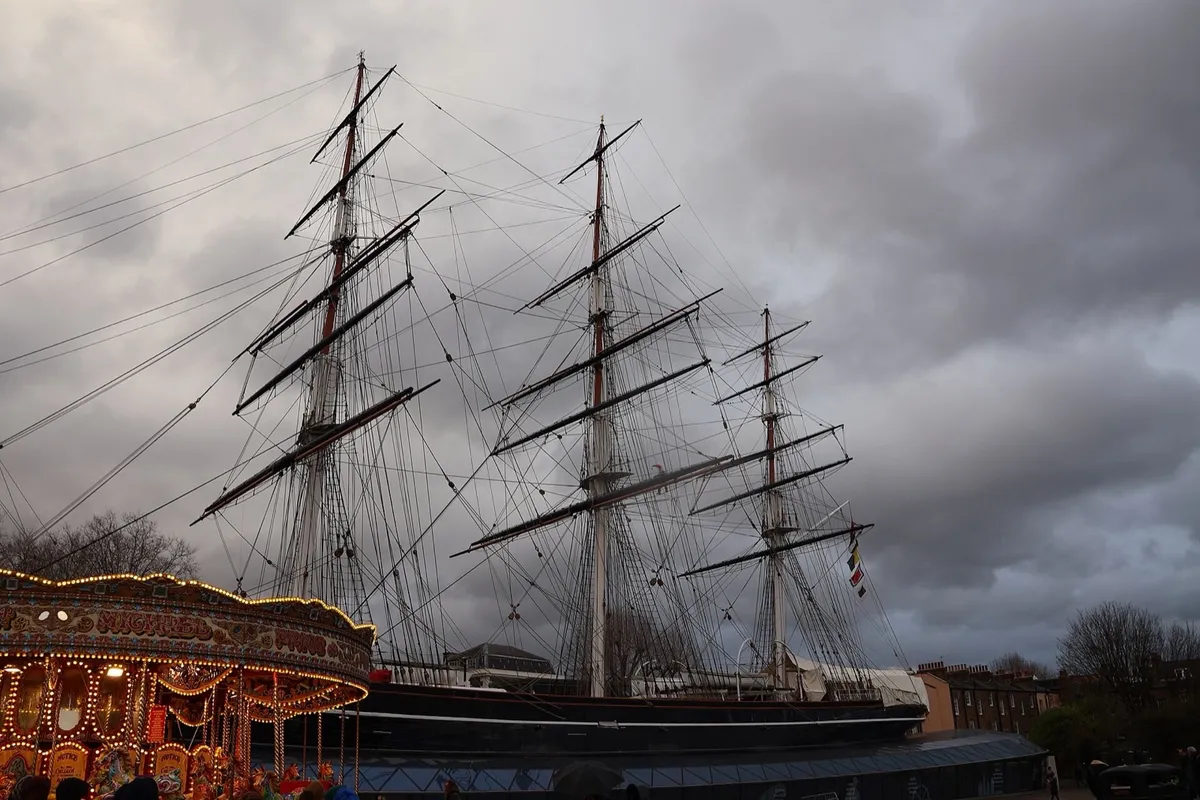
Cutty Sark
The Cutty Sark was born obsolete. She launched in 1869, the same year the Suez Canal opened and killed the tea clipper trade in a single stroke. Steam ships could use the canal. Sailing ships couldn't. The entire economic logic that justified building a vessel optimized for speed from China to London evaporated before she'd completed her first season. That's either terrible timing or a fitting monument to an era that was already dead. She raced in the tea trade anyway for a few seasons, most famously against the clipper Thermopylae in 1872. Cutty Sark was winning when she lost her rudder in a gale and had to jury-rig a replacement from spare spars. She still finished the voyage, arriving in London only a week behind Thermopylae. That tells you everything about the ship and the men who sailed her. Her second life was in the Australian wool trade, and this is where she finally proved herself. Under Captain Richard Woodget (1885-1895), she became the fastest wool clipper afloat, consistently making the passage from Sydney to London in under 80 days. She'd load over 5,000 bales of wool, drive south into the roaring forties, and run her easting down at speeds that left every other sailing vessel behind. Woodget was the captain she deserved. The name comes from Robert Burns's 1791 poem "Tam o' Shanter." Tam, drunk and riding home, watches witches dance and shouts in admiration at a young witch wearing a cutty sark, a short nightgown. She chases him. He barely escapes. The ship's figurehead is the witch Nannie, reaching forward with arm outstretched. It's a perfect name for a ship that was always chasing something just out of reach. After the wool trade declined, she was sold to a Portuguese company, renamed Ferreira, and spent decades hauling cargo in the South Atlantic. A retired sea captain named Wilfred Dowman found her in a Portuguese port in 1922, recognized what she was, bought her, and brought her home to England. Without Dowman, she would have been broken up. She is the only clipper ship that survives.
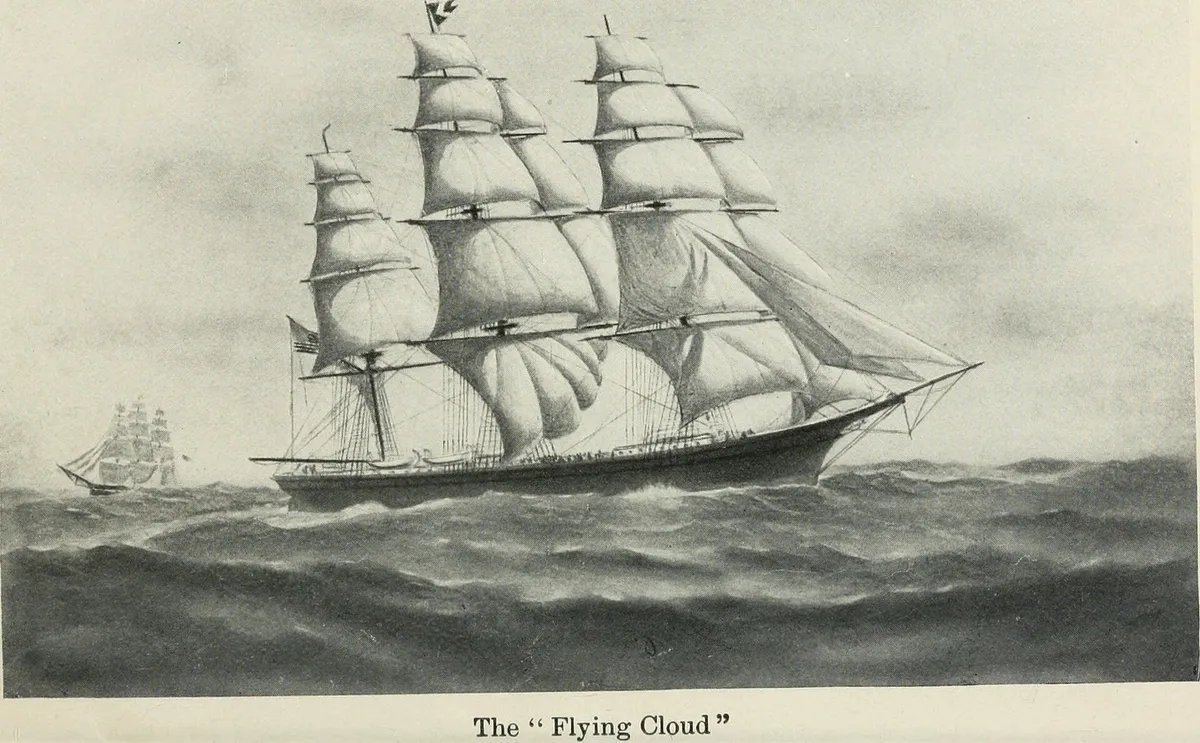
Flying Cloud
Flying Cloud was the fastest sailing vessel of her era, and her speed record from New York to San Francisco stood for over 100 years. She made the passage around Cape Horn in 89 days and 8 hours in 1854, a mark no commercial sailing vessel would beat until 1989. To put that in perspective: a record set before the Civil War survived the invention of the telephone, the automobile, both World Wars, and the moon landing. She was built by Donald McKay in East Boston, the best clipper ship designer who ever lived, at the peak of the California Gold Rush. Speed was money. Every day shaved off the passage to San Francisco meant earlier access to cargo rates that could pay for the ship in a single voyage. Owners drove these ships hard, and captains who delivered fast passages became celebrities. Josiah Perkins Creesy commanded Flying Cloud, but the secret weapon was his wife. Eleanor Creesy was the ship's navigator. She plotted the courses, read the currents, and made the decisions about when to press south into the roaring forties and when to hold off. Her work with Matthew Fontaine Maury's wind and current charts was masterful. She found favorable currents and winds that other navigators missed. On the record-setting 1854 voyage, she navigated through a cracked mainmast and a near-mutiny. She never held an official rank, was never paid, and appears in most histories as a footnote to her husband. She was one of the best navigators in the world. The clipper ship era lasted barely 15 years. Steam was already winning when Flying Cloud launched. These ships were profitable only because the Gold Rush created insane demand for fast passage to California, and the tea trade paid premiums for early-season delivery. Once the transcontinental railroad was completed in 1869 and the Suez Canal opened the same year, clippers were obsolete overnight. Beautiful, fast, and suddenly pointless. Flying Cloud herself was worked to death. After her glory years on the California run, she was sold to British owners who used her in the timber trade. She was condemned and burned for her copper fastenings at St. John, New Brunswick in 1874. She was 23 years old. Clipper ships were built for speed, not longevity, and hard driving wore them out fast. The hull that could do 18 knots was also a hull that was being slowly torn apart by the forces that made it fast.
Flying Dutchman
The Flying Dutchman is the oldest ghost ship legend that still has teeth. It predates every haunted house, every campfire story, every horror franchise. Sailors were telling this story in the 1700s, and it spooked people who had genuinely hard lives on genuinely dangerous oceans. The core legend is simple. A Dutch captain, usually named Hendrick van der Decken, tried to round the Cape of Good Hope in a storm. He swore an oath that he would round the Cape if it took him until Judgment Day. God, or the Devil, or the sea itself took him at his word. The ship sails forever, never making port, its crew aging without dying. The legend persists because it speaks to something real about the ocean. The sea doesn't care about your schedule, your cargo, or your oath. It will take your ship and your life with equal indifference. The Flying Dutchman is what happens when human stubbornness meets a force that has no concept of surrender. Wagner wrote an opera about it in 1843. Coleridge riffed on it in The Rime of the Ancient Mariner. Disney put it in Pirates of the Caribbean. Spongebob Squarepants lives near one. The legend adapts to every era because the fear it represents never goes away. The ocean is still out there, and it's still bigger than you are.