Royal Fortune
Why it matters
Bartholomew Roberts, "Black Bart," captured over 400 ships in three years. That number is not a typo. Four hundred. No pirate before or since came close. He operated from Newfoundland to Brazil to West Africa, and every navy in the Atlantic wanted him dead. The final Royal Fortune was his last and largest flagship, a 52-gun warship that could go toe-to-toe with anything the Royal Navy sent after him.
Roberts is the pirate who actually wrote the code. Not the Hollywood version. Real articles of agreement that his crew signed. Lights out at eight. No gambling for money aboard. Every man gets a vote. Every man gets a share. If you lose your right arm in battle, you get 600 pieces of eight in compensation. If you desert during a fight, the punishment is death or marooning. It was a constitution for thieves, and it worked better than most legitimate governments of the era.
The man himself was a contradiction. He dressed extravagantly, wearing crimson damask waistcoats and diamond crosses. He never drank anything stronger than tea. He was Welsh, deeply religious by pirate standards, and reportedly furious about being forced into piracy when his merchant ship was captured. He turned out to be spectacularly good at it.
Roberts went through multiple ships named Royal Fortune, trading up as he captured better vessels. The final one was a French warship he took off the African coast. He refitted her, loaded her with guns, and sailed her for roughly two years. She was the most heavily armed pirate ship of the Golden Age.
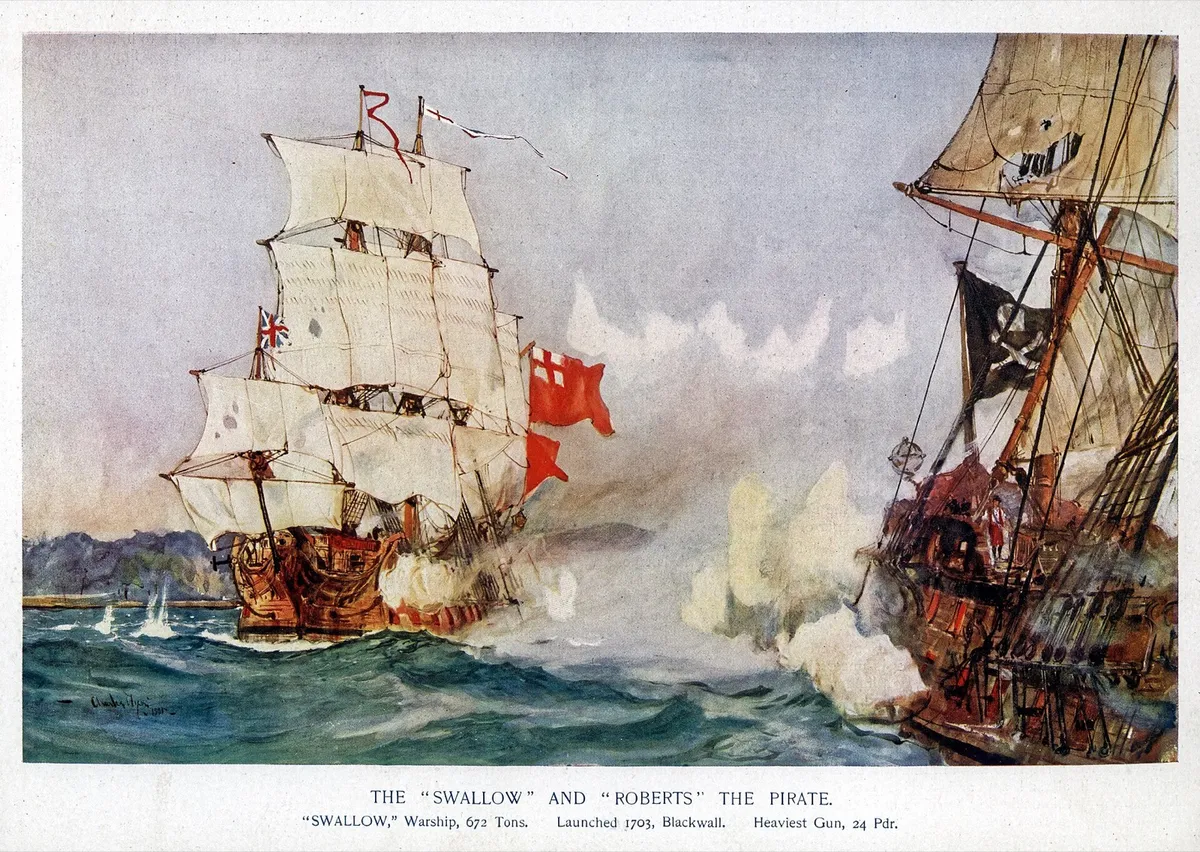
It ended on February 10, 1722, off Cape Lopez in present-day Gabon. HMS Swallow, a Royal Navy warship under Captain Chaloner Ogle, caught Roberts at anchor. Roberts dressed in his finest clothes and sailed out to fight. A blast of grapeshot hit him in the throat. He was dead before he hit the deck. His crew, following his standing orders, threw his body overboard in full dress before the Navy could take it as a trophy. The sea got him. Nobody else did.
What it was like
Roberts ran a tight ship. Absurdly tight for a pirate. The articles banned dice and cards for money. Musicians got Sundays off but could be required to play any other day. Candles and lamps went out at eight in the evening. If you wanted to keep drinking after eight, you did it on deck in the dark. Every man kept his weapons clean and ready for service. Slacking got you punished by vote of the crew.
The crew was enormous. Over 200 men on the final Royal Fortune, plus consort vessels. Roberts organized them like a navy because at that scale, chaos gets people killed. Gun crews drilled. Watches rotated. The quartermaster enforced the articles, and the articles had teeth. Desertion in battle was a death sentence.
Daily life was the usual misery of any 18th century sailing vessel, amplified by the paranoia of being hunted by every navy on earth. You ate salt pork, hardtack, and whatever fresh provisions were taken from the last capture. Water went foul in the barrels after weeks at sea. The African coast added heat, malaria, and dysentery to the standard package. Roberts lost more men to disease than combat.
The crew
Captain
Bartholomew Roberts. Immaculate dresser, tea drinker, iron disciplinarian. He didn't choose piracy but became the best at it. His crew respected him because he made them rich and kept them alive.
Quartermaster
The enforcer of the articles. On Roberts' ship, this wasn't ceremonial. The articles were specific, written, and enforced. Disputes went to the quartermaster first and the crew vote second.
Musicians
Roberts' articles specifically mention musicians. They were required to play on demand six days a week. Only Sundays off. Music kept morale up and intimidated targets. A ship bearing down on you with drums and fiddles playing was psychological warfare.
Gun Crews
Fifty-two guns needed roughly 200 men to operate at full capacity. Each gun crew of four worked in coordinated fire, loading and running out heavy iron cannons in a choreography that had to be perfect or the gun killed you instead of the enemy.
African Crew Members
Roberts captured numerous slave ships off the African coast and gave enslaved people the choice to join. Many did. At the time of his death, roughly 70 of his crew were of African descent. At the trial at Cape Coast Castle, the court separated defendants by race. The African crew members were returned to slavery. The white crew members were tried. Fifty-two were hanged.
Patina notes
The Royal Fortune was never found. After Roberts' death, the crew surrendered to HMS Swallow. Captain Ogle's men stripped the ship of valuables and then, by most accounts, she was either burned or broken up.
Roberts' body went into the Atlantic in his crimson waistcoat and diamond cross. No grave, no monument, no wreck site. The ship exists now only in trial transcripts, Captain Charles Johnson's "A General History of the Pyrates" (1724), and the logs of HMS Swallow.
The physical evidence of Roberts' entire career is effectively zero. Three years, 400 captures, and nothing you can touch.
Preservation reality
There is no wreck to visit. The Royal Fortune was likely destroyed after Roberts' capture in 1722. What survives is paper. The trial records from Cape Coast Castle, Ghana, are the most detailed account of a pirate crew ever recorded.
264 men were tried. The transcripts include testimony about daily life, the articles of agreement, and the crew's organization. Captain Charles Johnson's 1724 book, likely drawing on these records, gave Roberts the longest chapter of any pirate.
The National Archives in London hold the Admiralty records. Cape Coast Castle itself still stands in Ghana and is a UNESCO World Heritage Site, though it's primarily remembered as a slave trading fort, not for the pirate trial held there.
Where to see one
- • Cape Coast Castle, Ghana — site of the 1722 pirate trial, UNESCO World Heritage Site
- • The National Archives, Kew, London — Admiralty trial records and HMS Swallow logs
Preservation organizations
- • The National Archives (UK)
- • Ghana Museums and Monuments Board
- • National Maritime Museum, Greenwich
Sources
- Captain Charles Johnson — A General History of the Pyrates (1724) (2026-03-05)
- Encyclopedia Britannica — Bartholomew Roberts (2026-03-05)
- National Maritime Museum — Pirates (2026-03-05)
Related vessels
Black Pearl
Before 2003, the pirate movie was a dead genre. After Pirates of the Caribbean, every kid in America wanted a ship with black sails. The Black Pearl did for pirate vessels what the Millennium Falcon did for spaceships. It made the vehicle a character. The ship represents freedom in its purest cinematic form. Jack Sparrow doesn't want gold or power. He wants his ship back. That's it. The entire first film is a man trying to reclaim the one thing that makes him who he is. The Black Pearl isn't transportation. It's identity. Johnny Depp's performance gets the credit, and it should. But the ship sells the fantasy. The black sails against a Caribbean sunset. The ragged rigging. The impossible speed. You believe this ship is alive because the movie treats it like one. The prop was built on a steel barge called the Sunset, dressed with a full wooden superstructure. Additional ships were constructed for later films, and digital effects expanded the Pearl's capabilities well beyond anything that floats.
Cutty Sark
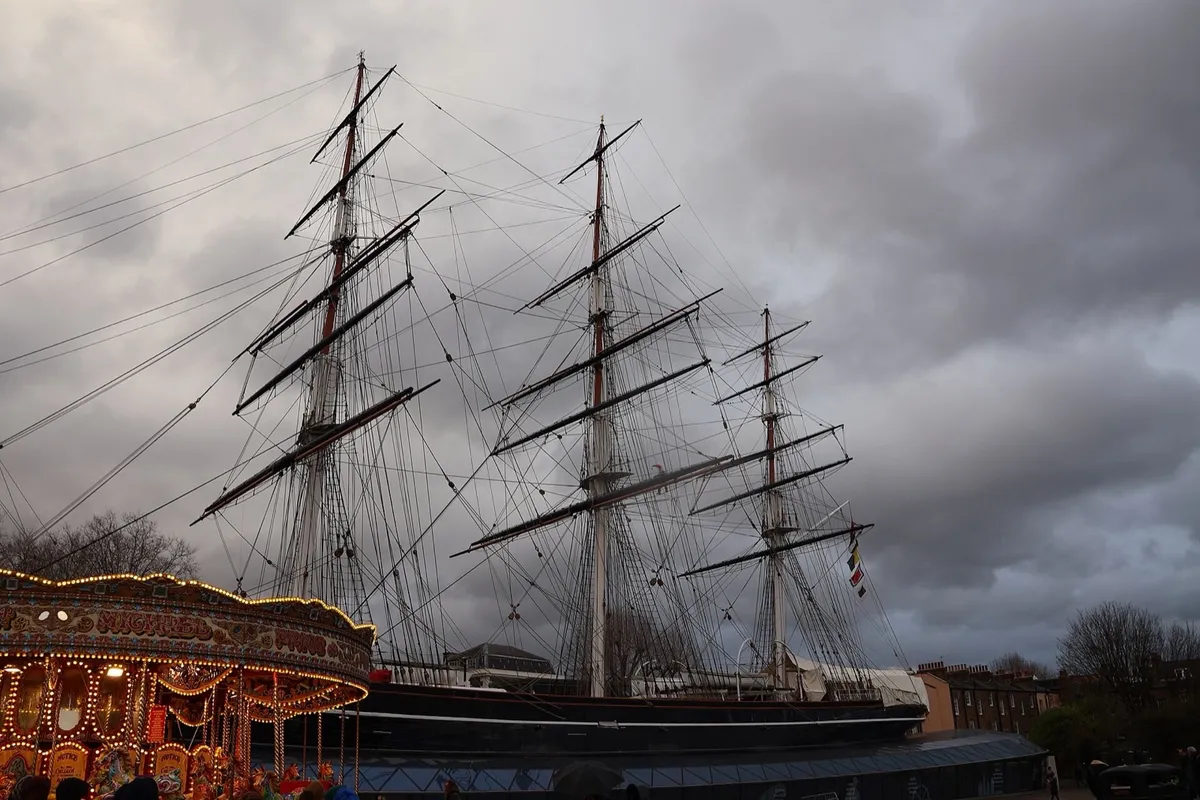
The Cutty Sark was born obsolete. She launched in 1869, the same year the Suez Canal opened and killed the tea clipper trade in a single stroke. Steam ships could use the canal. Sailing ships couldn't. The entire economic logic that justified building a vessel optimized for speed from China to London evaporated before she'd completed her first season. That's either terrible timing or a fitting monument to an era that was already dead. She raced in the tea trade anyway for a few seasons, most famously against the clipper Thermopylae in 1872. Cutty Sark was winning when she lost her rudder in a gale and had to jury-rig a replacement from spare spars. She still finished the voyage, arriving in London only a week behind Thermopylae. That tells you everything about the ship and the men who sailed her. Her second life was in the Australian wool trade, and this is where she finally proved herself. Under Captain Richard Woodget (1885-1895), she became the fastest wool clipper afloat, consistently making the passage from Sydney to London in under 80 days. She'd load over 5,000 bales of wool, drive south into the roaring forties, and run her easting down at speeds that left every other sailing vessel behind. Woodget was the captain she deserved. The name comes from Robert Burns's 1791 poem "Tam o' Shanter." Tam, drunk and riding home, watches witches dance and shouts in admiration at a young witch wearing a cutty sark, a short nightgown. She chases him. He barely escapes. The ship's figurehead is the witch Nannie, reaching forward with arm outstretched. It's a perfect name for a ship that was always chasing something just out of reach. After the wool trade declined, she was sold to a Portuguese company, renamed Ferreira, and spent decades hauling cargo in the South Atlantic. A retired sea captain named Wilfred Dowman found her in a Portuguese port in 1922, recognized what she was, bought her, and brought her home to England. Without Dowman, she would have been broken up. She is the only clipper ship that survives.
Flying Cloud
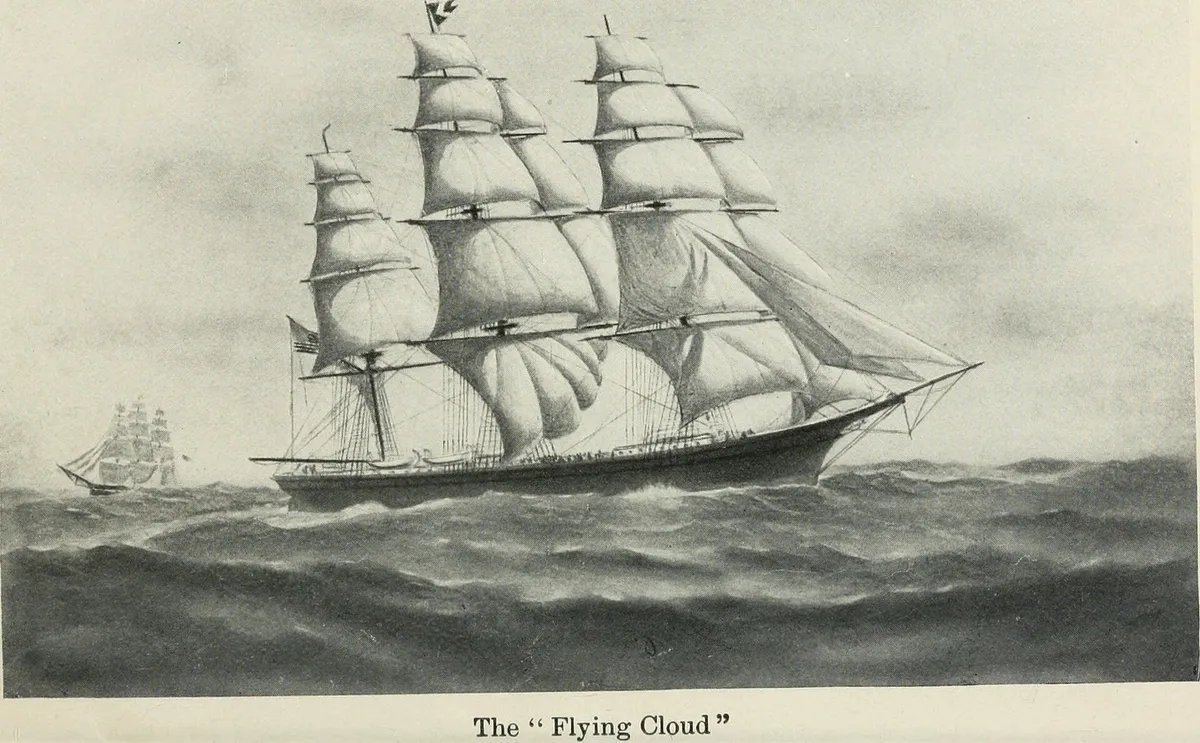
Flying Cloud was the fastest sailing vessel of her era, and her speed record from New York to San Francisco stood for over 100 years. She made the passage around Cape Horn in 89 days and 8 hours in 1854, a mark no commercial sailing vessel would beat until 1989. To put that in perspective: a record set before the Civil War survived the invention of the telephone, the automobile, both World Wars, and the moon landing. She was built by Donald McKay in East Boston, the best clipper ship designer who ever lived, at the peak of the California Gold Rush. Speed was money. Every day shaved off the passage to San Francisco meant earlier access to cargo rates that could pay for the ship in a single voyage. Owners drove these ships hard, and captains who delivered fast passages became celebrities. Josiah Perkins Creesy commanded Flying Cloud, but the secret weapon was his wife. Eleanor Creesy was the ship's navigator. She plotted the courses, read the currents, and made the decisions about when to press south into the roaring forties and when to hold off. Her work with Matthew Fontaine Maury's wind and current charts was masterful. She found favorable currents and winds that other navigators missed. On the record-setting 1854 voyage, she navigated through a cracked mainmast and a near-mutiny. She never held an official rank, was never paid, and appears in most histories as a footnote to her husband. She was one of the best navigators in the world. The clipper ship era lasted barely 15 years. Steam was already winning when Flying Cloud launched. These ships were profitable only because the Gold Rush created insane demand for fast passage to California, and the tea trade paid premiums for early-season delivery. Once the transcontinental railroad was completed in 1869 and the Suez Canal opened the same year, clippers were obsolete overnight. Beautiful, fast, and suddenly pointless. Flying Cloud herself was worked to death. After her glory years on the California run, she was sold to British owners who used her in the timber trade. She was condemned and burned for her copper fastenings at St. John, New Brunswick in 1874. She was 23 years old. Clipper ships were built for speed, not longevity, and hard driving wore them out fast. The hull that could do 18 knots was also a hull that was being slowly torn apart by the forces that made it fast.