ocean liner
4 vessels
Pacific Princess
The Love Boat didn't just use the Pacific Princess as a backdrop. It created a $50 billion industry. Before the show premiered in 1977, cruises were for wealthy retirees and European aristocrats. The average American had never considered stepping on a cruise ship. By the time the show ended in 1986, Princess Cruises had gone from a small regional operator to a household name, and the entire cruise industry had pivoted to marketing toward middle-class American families. Aaron Spelling understood something the cruise lines hadn't figured out: people don't buy a vacation. They buy a fantasy. Three interconnected love stories per episode, a celebrity guest star, and the Pacific Princess gleaming in tropical sunlight. The ship was the promise that romance happens to ordinary people if they just get on the boat. Princess Cruises leaned into it completely. They gave the show access to a working vessel during real passenger cruises. Actual paying passengers appeared as extras. The crew uniforms on screen matched real Princess Cruises uniforms. The line between show and advertisement dissolved so thoroughly that it didn't matter. The Pacific Princess was a real, working cruise ship that carried real passengers to real ports. She also happened to be the most effective marketing campaign in maritime history.
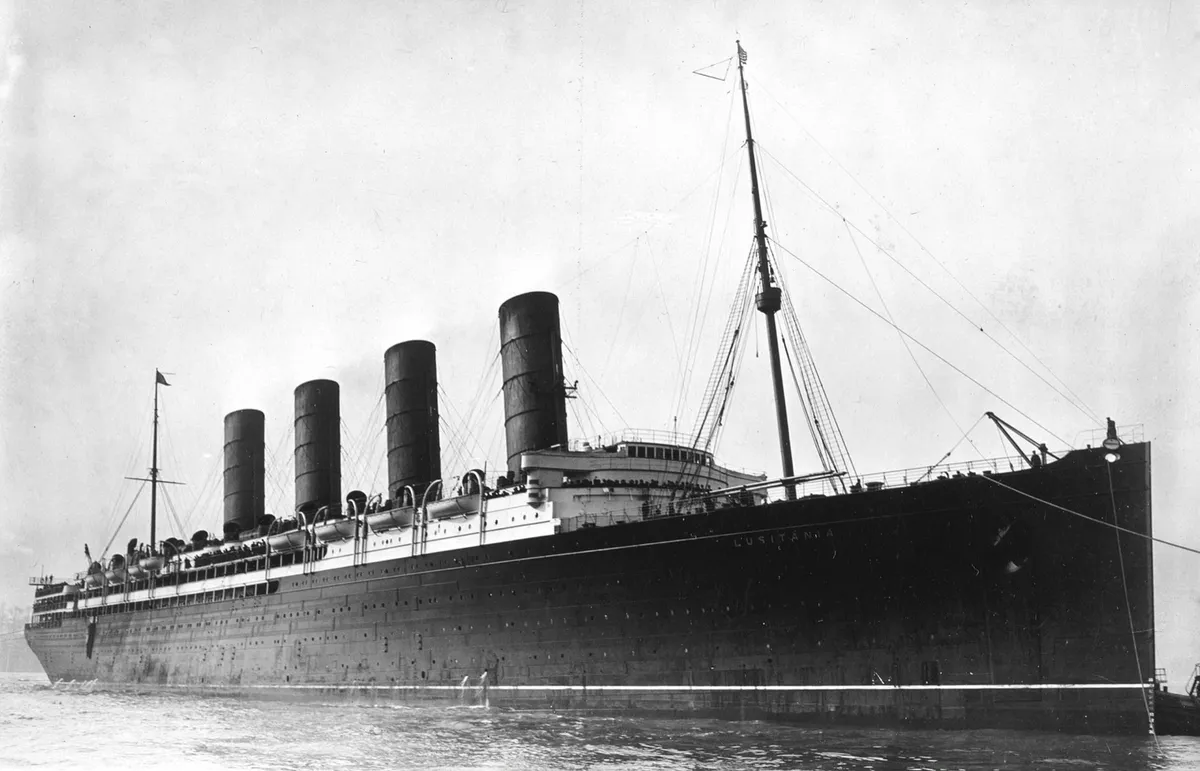
RMS Lusitania
The Lusitania was the fastest thing on the Atlantic when she launched. She took the Blue Riband in 1907 and held it for two years, crossing at an average of 25 knots. She was also a quiet instrument of British naval policy. The Admiralty subsidized her construction on the condition that she could be converted to an armed merchant cruiser in wartime. Whether she was actually carrying war materiel on her final voyage is still debated, and probably always will be. On the morning of May 7, 1915, the German Embassy published a warning in American newspapers telling passengers that ships flying the British flag in the war zone around the British Isles were "liable to destruction." Most passengers ignored it. That afternoon, Kapitanleutnant Walther Schwieger of U-20 fired a single torpedo into Lusitania's starboard side off the Old Head of Kinsale, Ireland. One torpedo hit. Then a second, much larger explosion ripped through the ship. The cause of that second blast is the argument that won't die. Coal dust in the nearly empty bunkers. Steam line rupture. Or the 4.2 million rounds of Remington .303 cartridges listed on the cargo manifest. The ship's longitudinal bulkheads, designed to contain flooding, instead created an immediate list to starboard so severe that the lifeboats on the port side couldn't be launched at all. She sank in 18 minutes. 1,198 people died, including 128 American citizens. Germany called it a legitimate act of war against a vessel carrying contraband. The British called it murder. American public opinion lurched toward intervention. It took two more years, but the Lusitania was one of the weights on the scale that pulled the United States into World War I. The irony is thick. A ship built with Admiralty money, possibly carrying Admiralty cargo, was sent through a known submarine zone without escort. The cruiser HMS Juno had been recalled from the area the day before. The Admiralty knew U-boats were active in those waters. Nobody warned Captain Turner to zigzag.
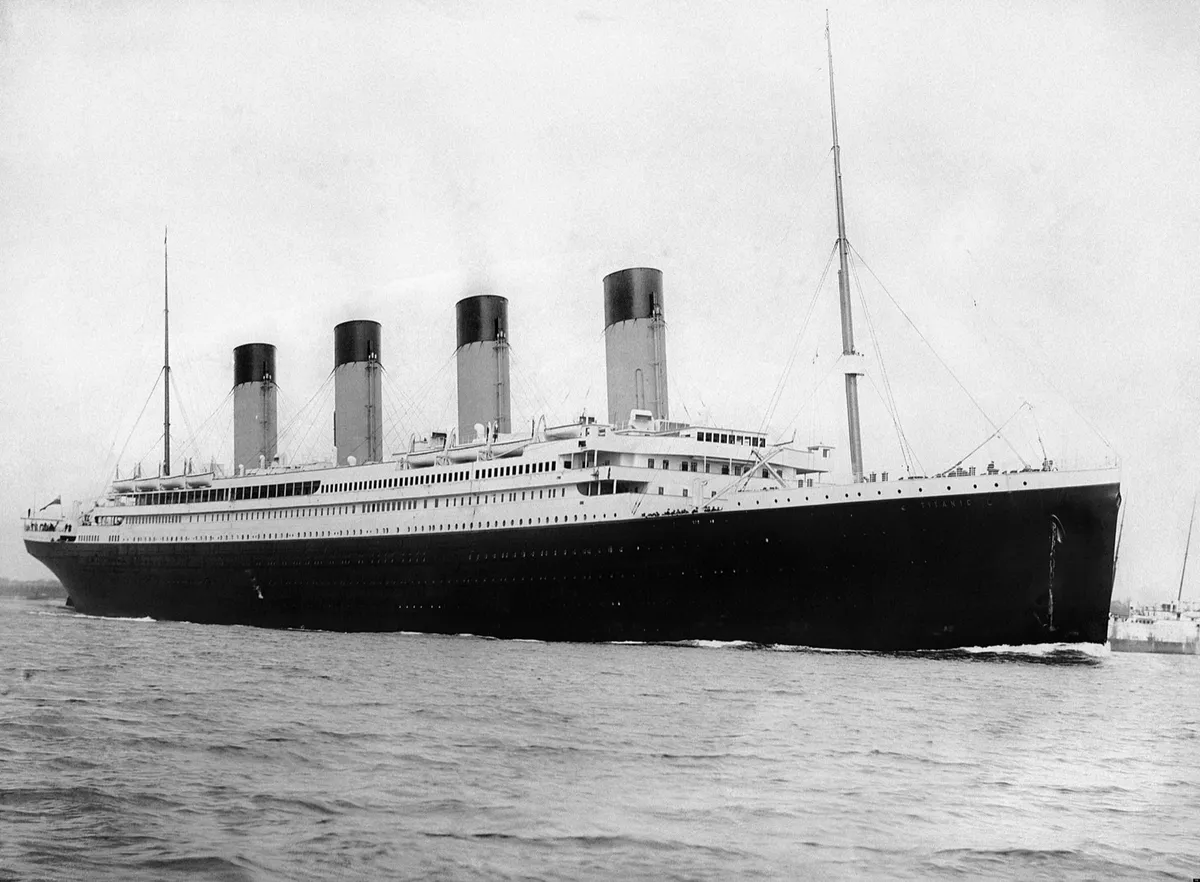
RMS Titanic
The Titanic story has been told so many times it's become wallpaper. Strip away the romance and you're left with something uglier: a ship built to showcase wealth, operated with criminal negligence, and sunk in a way that killed people along class lines. She hit an iceberg at 11:40 PM on April 14, 1912, about 370 miles south of Newfoundland. The berg opened a 300-foot gash along the starboard side, flooding five forward compartments. Thomas Andrews, the ship's designer, calculated she had maybe two hours. He was off by about 40 minutes. The lifeboats launched half-empty. Not because people refused to board them, but because the crew was poorly trained and the officers on the port side interpreted "women and children first" as "women and children only." Lifeboat 1 left with 12 people. It could hold 40. Meanwhile, third-class passengers found gates locked between decks. Some were held back by crew. The survival rate in first class was 62%. In third class it was 25%. 1,517 people died. Most of them didn't drown. The North Atlantic was 28 degrees Fahrenheit that night. People in life jackets floated alive for ten to fifteen minutes before cardiac arrest from hypothermia. The sounds carried for almost an hour. The survivors in the lifeboats listened. The disaster did accomplish something. The International Convention for the Safety of Life at Sea followed in 1914, mandating lifeboat capacity for every person aboard and 24-hour radio watches. It took 1,517 deaths to establish what should have been obvious.
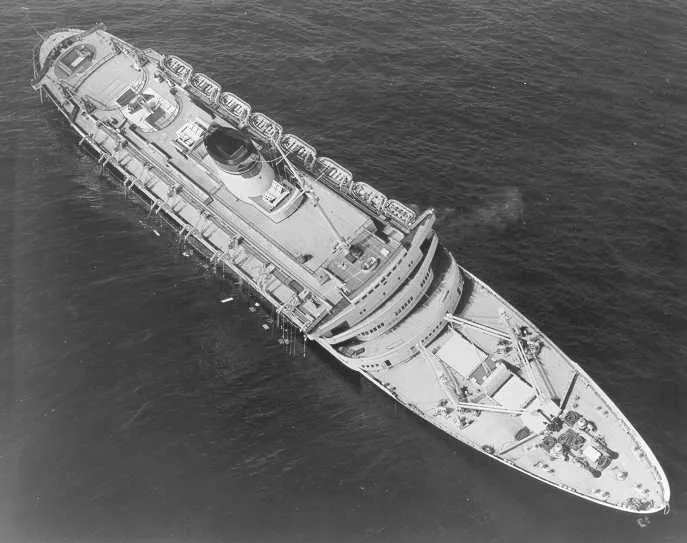
SS Andrea Doria
The Andrea Doria was Italy's postwar pride, a floating declaration that the country had rebuilt itself after the devastation of World War II. She was fast, gorgeous, and loaded with contemporary Italian art. For three years she was the most glamorous way to cross the Atlantic, and Italians treated her like a national monument that happened to move. On the night of July 25, 1956, she collided with the Swedish liner MS Stockholm in dense fog south of Nantucket. Stockholm's reinforced ice-breaking bow punched deep into Andrea Doria's starboard side. The Italian ship began listing almost immediately, and the list was so severe that the lifeboats on the port side couldn't be launched. Half the escape capacity was gone in minutes. Forty-six people died, most of them in the initial impact. But 1,660 were saved in one of the most remarkable rescues in maritime history. The French liner Ile de France turned around and steamed back into the fog to pull survivors off the listing deck. Other ships converged from across the shipping lanes. Andrea Doria held on through the night, and the next morning she rolled over and sank on live television. The whole country watched. The wreck sits at 250 feet off Nantucket, and divers started calling it the Everest of wreck diving almost immediately. The comparison is accurate in the worst way. Multiple divers have died on the wreck over the decades. Nitrogen narcosis at that depth turns experienced divers into confused amateurs. The ship is collapsing under its own weight, creating new traps every season. The collision also exposed an uncomfortable truth about maritime technology. Both ships had radar. Neither captain used it correctly. The Andrea Doria turned to port when she should have turned to starboard, and the Stockholm was navigating at full speed in fog. Radar gave them the illusion of safety and they drove straight into each other.