Queen Anne's Revenge
Why it matters
Queen Anne's Revenge started life as La Concorde, a French slave ship working the triangle trade between Nantes, West Africa, and the Caribbean. Edward Teach, who the world would remember as Blackbeard, captured her near Martinique in November 1717. He renamed her, stuffed her with cannons, and turned a vessel built to transport human misery into a floating fortress of a different kind.
For about six months, she was the most feared ship in the Atlantic. Blackbeard used her to blockade the port of Charleston, South Carolina in May 1718. He held the entire city hostage for a week, capturing ships in the harbor and demanding a chest of medicine as ransom. Charleston paid. The blockade worked not because of superior firepower but because of reputation. Nobody wanted to find out if the stories were true.
Then Blackbeard did something nobody expected. He ran Queen Anne's Revenge aground at Beaufort Inlet, North Carolina, in June 1718. The official story was an accident. The real story, most historians believe, was deliberate. Blackbeard marooned most of his crew on a sandbar, took the loot and his closest allies, and sailed off in a smaller sloop. It was a heist within a heist.
Blackbeard didn't last long after that. Lt. Robert Maynard of the Royal Navy found him anchored at Ocracoke Inlet on November 22, 1718. The fight was vicious. Blackbeard took five musket balls and twenty sword cuts before he finally dropped. They cut off his head and hung it from the bowsprit.
The ship matters because it connects the slave trade, piracy, and colonial politics in ways that are uncomfortable and honest. La Concorde carried enslaved Africans. Queen Anne's Revenge carried pirates, many of whom were formerly enslaved or pressed sailors who chose piracy over legitimate service. The line between legal and illegal cruelty was thinner than anyone wanted to admit.
What it was like
Three hundred men on a hundred-foot ship. You do the math on personal space. Below decks smelled like bilge water, gunpowder, unwashed bodies, and whatever was rotting in the hold. The crew slept in shifts because there wasn't room for everyone to lie down at once. Rats were roommates you stopped noticing after a week.
Blackbeard ran a loose ship by navy standards but a tight one by pirate standards. Decisions were voted on. Loot was divided by shares. The quartermaster handled disputes. If you got injured in battle, there was a compensation schedule written into the articles. Lose an eye, get extra shares. Lose a limb, get more. It was crude worker's comp two centuries before the concept existed.
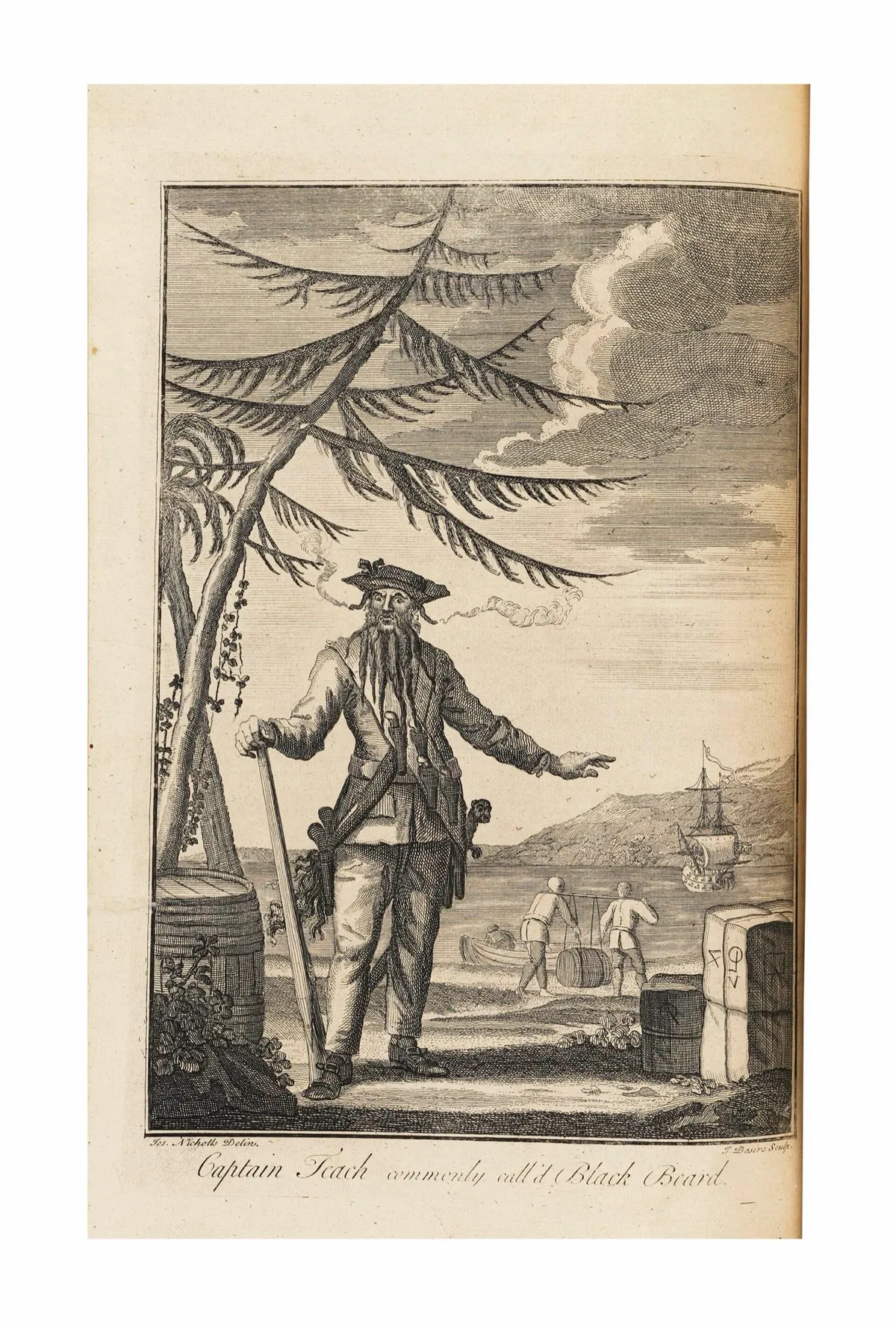
The guns were the constant. Drilling, loading, cleaning, repositioning. A 6-pounder cannon weighs about 1,200 pounds and needs a crew of four to operate. When those guns fired, the concussion rattled your teeth and the smoke made you blind for seconds that felt much longer. Most fights ended before they started, though. Blackbeard lit slow fuses in his beard during battle, wreathing his face in smoke. Pure theater. And it worked.
The crew
Captain
Blackbeard himself. Elected by the crew, technically removable by vote. His authority came from fear, charisma, and results. He cultivated his demonic image deliberately.
Quartermaster
The crew's representative. Handled discipline, divided loot, settled arguments. Had more day-to-day power than the captain outside of battle.
Gunner
Managed the ship's oversized arsenal. Queen Anne's Revenge carried more guns than ships twice her size, which meant the gunner was constantly juggling powder stores and shot placement to keep her from becoming top-heavy.
Carpenter
Kept a modified slave ship seaworthy. La Concorde wasn't designed for the extra gun ports Blackbeard cut into her hull. The carpenter's job was an endless argument with structural integrity.
Surgeon
A syringe recovered from the wreck suggests someone aboard was treating syphilis with mercury injections. The surgeon dealt with everything from battle wounds to venereal disease with tools that would make a modern dentist faint.
Formerly Enslaved Crew
An estimated 60 or more crew members were formerly enslaved Africans. Some joined voluntarily when Blackbeard captured slave ships. Pirate ships were among the few places in the 18th century Atlantic where Black men could be armed and paid.
Patina notes
Queen Anne's Revenge spent 278 years on the bottom of Beaufort Inlet before anyone found her. The hull is gone. Wood doesn't survive centuries in salt water and shifting sand.
What survived is metal and stone: cannons, anchors, cannonballs, lead shot, brass hardware, and ballast stones. The site is a debris field more than a wreck.
Storms and currents scattered artifacts across the seafloor for nearly three centuries. Iron concretions, hunks of corroded metal fused with sand and shell, hide smaller artifacts inside them. Conservators at the ECU conservation lab have been carefully chipping away at these concretions for decades, finding surprises inside: gold dust, glass beads, a pewter syringe, fragments of sword blades.
Preservation reality
The wreck site was discovered in 1996 by Intersal, Inc. near Beaufort, North Carolina. The North Carolina Department of Natural and Cultural Resources has led excavation since 1997.
Over 400,000 artifacts have been recovered, making it one of the most productive underwater archaeological sites in the Western Hemisphere. Conservation happens at East Carolina University's maritime conservation lab.
The anchor and several cannons have been conserved and are on display at the North Carolina Museum of History in Raleigh. The process is painfully slow.
Desalinating a single cannon can take years. The state of North Carolina owns the wreck and its contents. A legal battle with Intersal over salvage rights dragged on for over a decade before being settled. The full artifact collection won't be conserved for years to come.
Where to see one
- • North Carolina Museum of History, Raleigh, NC — anchor, cannons, and rotating artifact displays
- • Beaufort Historic Site, Beaufort, NC — local exhibits and proximity to the wreck site
- • QAR Conservation Lab at East Carolina University, Greenville, NC — active conservation, sometimes open to visitors
Preservation organizations
- • North Carolina Department of Natural and Cultural Resources
- • Queen Anne's Revenge Shipwreck Project
- • East Carolina University Maritime Studies Program
Sources
- Queen Anne's Revenge Shipwreck Project (2026-03-05)
- NC Museum of History — Blackbeard's Queen Anne's Revenge (2026-03-05)
- Smithsonian Magazine — Blackbeard's Ship (2026-03-05)
Related vessels
Black Pearl
Before 2003, the pirate movie was a dead genre. After Pirates of the Caribbean, every kid in America wanted a ship with black sails. The Black Pearl did for pirate vessels what the Millennium Falcon did for spaceships. It made the vehicle a character. The ship represents freedom in its purest cinematic form. Jack Sparrow doesn't want gold or power. He wants his ship back. That's it. The entire first film is a man trying to reclaim the one thing that makes him who he is. The Black Pearl isn't transportation. It's identity. Johnny Depp's performance gets the credit, and it should. But the ship sells the fantasy. The black sails against a Caribbean sunset. The ragged rigging. The impossible speed. You believe this ship is alive because the movie treats it like one. The prop was built on a steel barge called the Sunset, dressed with a full wooden superstructure. Additional ships were constructed for later films, and digital effects expanded the Pearl's capabilities well beyond anything that floats.
Cutty Sark
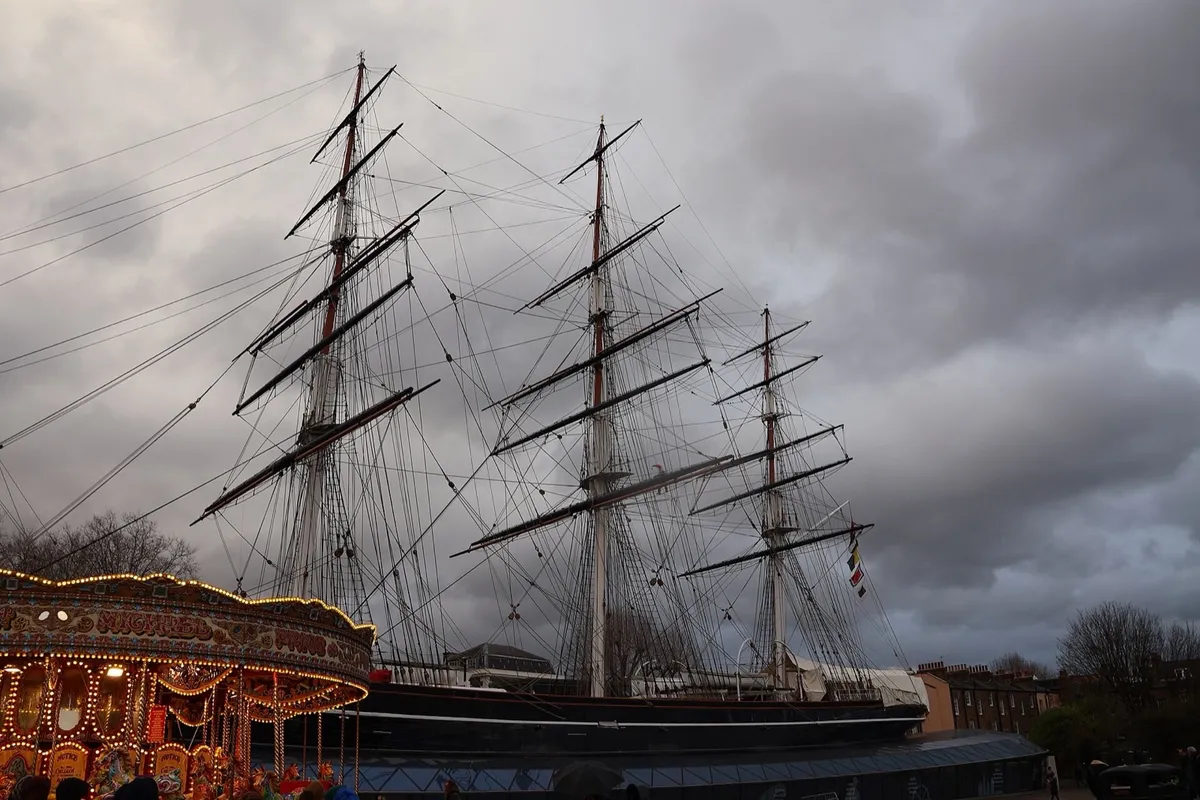
The Cutty Sark was born obsolete. She launched in 1869, the same year the Suez Canal opened and killed the tea clipper trade in a single stroke. Steam ships could use the canal. Sailing ships couldn't. The entire economic logic that justified building a vessel optimized for speed from China to London evaporated before she'd completed her first season. That's either terrible timing or a fitting monument to an era that was already dead. She raced in the tea trade anyway for a few seasons, most famously against the clipper Thermopylae in 1872. Cutty Sark was winning when she lost her rudder in a gale and had to jury-rig a replacement from spare spars. She still finished the voyage, arriving in London only a week behind Thermopylae. That tells you everything about the ship and the men who sailed her. Her second life was in the Australian wool trade, and this is where she finally proved herself. Under Captain Richard Woodget (1885-1895), she became the fastest wool clipper afloat, consistently making the passage from Sydney to London in under 80 days. She'd load over 5,000 bales of wool, drive south into the roaring forties, and run her easting down at speeds that left every other sailing vessel behind. Woodget was the captain she deserved. The name comes from Robert Burns's 1791 poem "Tam o' Shanter." Tam, drunk and riding home, watches witches dance and shouts in admiration at a young witch wearing a cutty sark, a short nightgown. She chases him. He barely escapes. The ship's figurehead is the witch Nannie, reaching forward with arm outstretched. It's a perfect name for a ship that was always chasing something just out of reach. After the wool trade declined, she was sold to a Portuguese company, renamed Ferreira, and spent decades hauling cargo in the South Atlantic. A retired sea captain named Wilfred Dowman found her in a Portuguese port in 1922, recognized what she was, bought her, and brought her home to England. Without Dowman, she would have been broken up. She is the only clipper ship that survives.
Flying Cloud
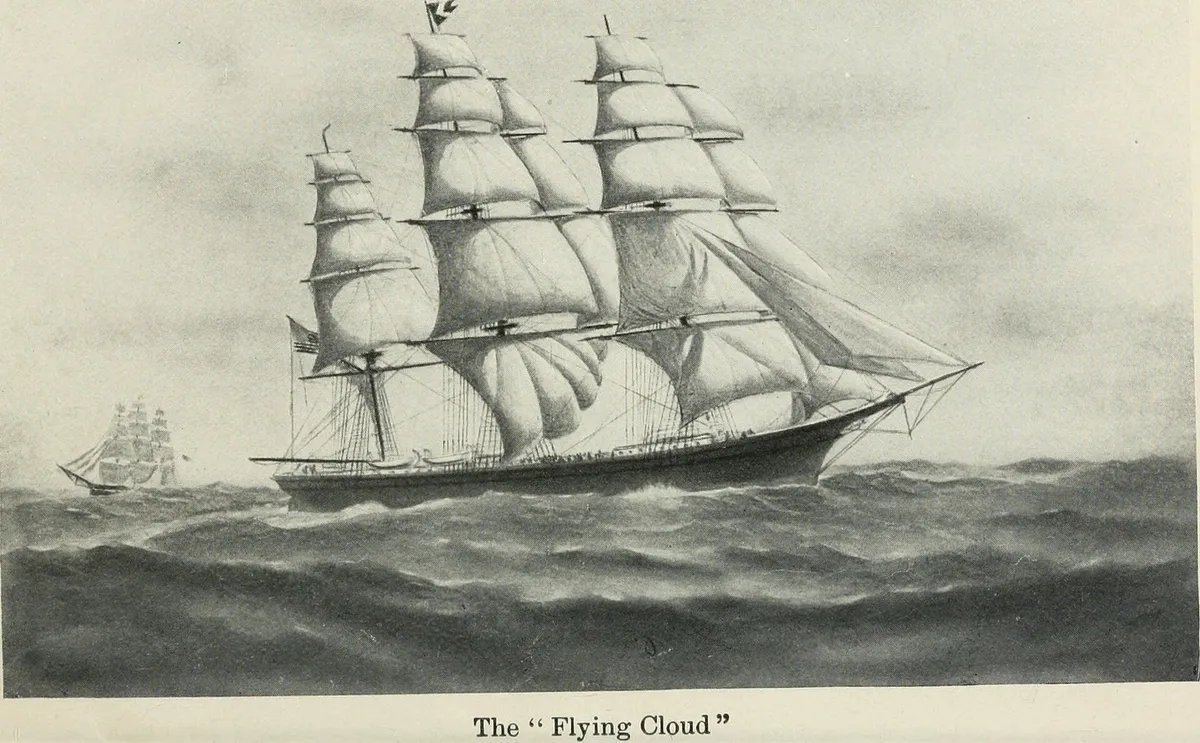
Flying Cloud was the fastest sailing vessel of her era, and her speed record from New York to San Francisco stood for over 100 years. She made the passage around Cape Horn in 89 days and 8 hours in 1854, a mark no commercial sailing vessel would beat until 1989. To put that in perspective: a record set before the Civil War survived the invention of the telephone, the automobile, both World Wars, and the moon landing. She was built by Donald McKay in East Boston, the best clipper ship designer who ever lived, at the peak of the California Gold Rush. Speed was money. Every day shaved off the passage to San Francisco meant earlier access to cargo rates that could pay for the ship in a single voyage. Owners drove these ships hard, and captains who delivered fast passages became celebrities. Josiah Perkins Creesy commanded Flying Cloud, but the secret weapon was his wife. Eleanor Creesy was the ship's navigator. She plotted the courses, read the currents, and made the decisions about when to press south into the roaring forties and when to hold off. Her work with Matthew Fontaine Maury's wind and current charts was masterful. She found favorable currents and winds that other navigators missed. On the record-setting 1854 voyage, she navigated through a cracked mainmast and a near-mutiny. She never held an official rank, was never paid, and appears in most histories as a footnote to her husband. She was one of the best navigators in the world. The clipper ship era lasted barely 15 years. Steam was already winning when Flying Cloud launched. These ships were profitable only because the Gold Rush created insane demand for fast passage to California, and the tea trade paid premiums for early-season delivery. Once the transcontinental railroad was completed in 1869 and the Suez Canal opened the same year, clippers were obsolete overnight. Beautiful, fast, and suddenly pointless. Flying Cloud herself was worked to death. After her glory years on the California run, she was sold to British owners who used her in the timber trade. She was condemned and burned for her copper fastenings at St. John, New Brunswick in 1874. She was 23 years old. Clipper ships were built for speed, not longevity, and hard driving wore them out fast. The hull that could do 18 knots was also a hull that was being slowly torn apart by the forces that made it fast.