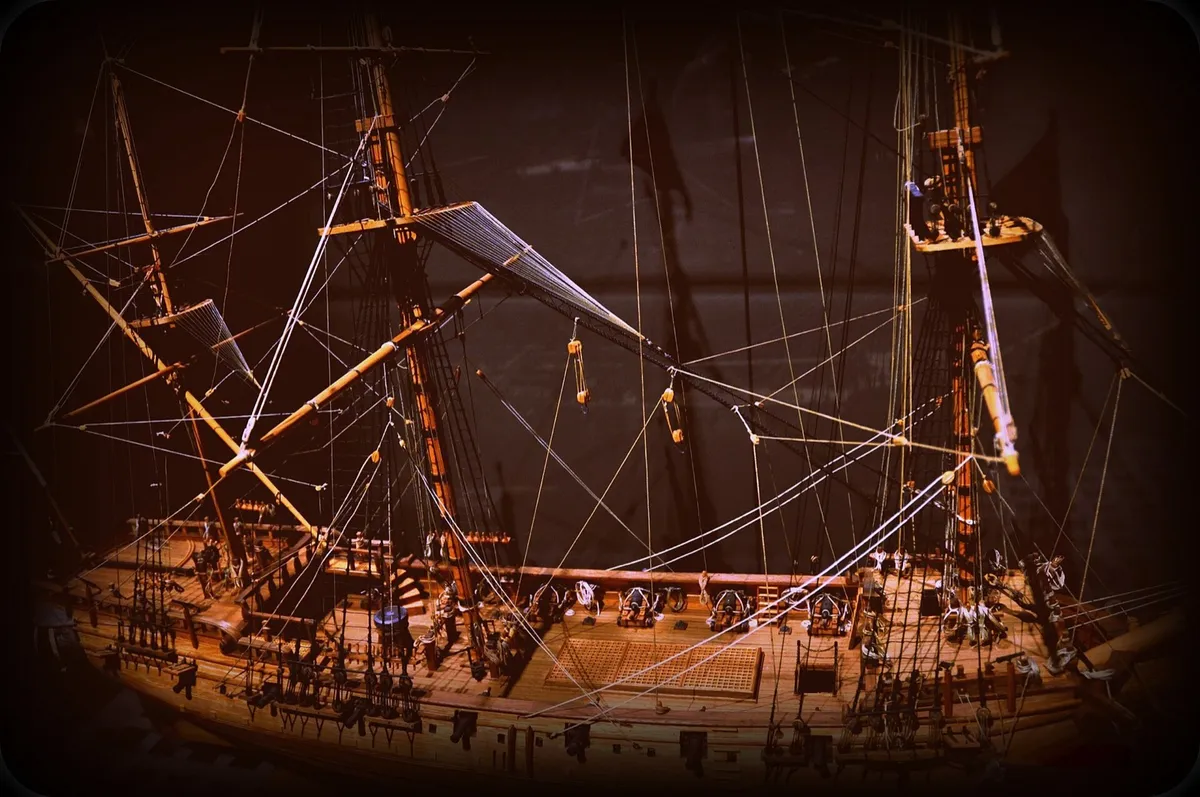
Whydah Gally
Why it matters
The Whydah (pronounced "WID-uh") is the only verified pirate shipwreck in the world. Every other supposed pirate wreck is a guess, a legend, or a tourism pitch. The Whydah has a ship's bell with the name on it. That's authentication you can't argue with.
She was built in London around 1715 as a slave ship, purpose-built for speed. The triangle trade demanded fast hulls. You loaded trade goods in England, exchanged them for enslaved people in West Africa, crossed the Atlantic as quickly as possible because your cargo was dying every day, sold the survivors in the Caribbean, then loaded sugar and headed home. The Whydah made at least one full circuit before Captain Sam Bellamy took her.
Bellamy captured the Whydah in February 1717 near the Bahamas. He was 28 years old, handsome, and reportedly refused to wear wigs, earning him the name "Black Sam." He'd been a pirate for about a year. When he took the Whydah, she was carrying the profits of her slave voyage: indigo, sugar, gold, silver, and ivory. Bellamy kept the cargo, transferred his crew aboard, and made her his flagship.
For two months, Bellamy terrorized the Atlantic coast. He captured over 50 ships. By the time the Whydah went down, she was carrying an estimated 4.5 tons of gold and silver, the plunder of dozens of vessels. Bellamy was, by some calculations, the wealthiest pirate in recorded history. He just didn't get to spend any of it.
On April 26, 1717, a nor'easter caught the Whydah off the coast of Cape Cod near Wellfleet, Massachusetts. The storm drove her onto a sandbar. The masts snapped. The hull broke apart. Bellamy and 143 of his 146 crew drowned. Two survivors washed ashore. The whole career, start to finish, lasted about fourteen months.
What it was like
Bellamy ran what historians call one of the more democratic pirate ships of the era. The crew voted on destinations, divided loot according to written articles, and elected their officers. The Whydah's crew included English sailors, formerly enslaved Africans who joined voluntarily, Native Americans, and at least one boy named John King who was eleven years old. King had been a passenger on a captured ship and reportedly threatened to kill himself if they didn't let him join. They let him join. He died in the wreck.
Life aboard was crowded, wet, and relentless. A galley-type hull rolls differently than a deep-keeled warship. You learned to sleep braced against the motion or you didn't sleep. The speed that made the Whydah valuable also made her uncomfortable. Below decks, you lived with the smell of tar, salt pork, and 146 men who hadn't bathed in weeks. Fresh water was rationed. Rum was not.
The guns required constant maintenance in salt air. Powder had to stay dry or you were floating furniture. When a fight started, you worked your gun crew in choking smoke, half-deaf from the concussion, feet sliding on wet planking. Most ships surrendered on sight. When they didn't, it got ugly fast.
The crew
Captain
Sam Bellamy. Young, charismatic, reportedly gave speeches about social justice to his captured victims. Called himself a 'free prince' and the rich merchants 'villains.' Whether he believed it or was performing is a question nobody can answer.
Sailing Master
Paul Williams, Bellamy's closest ally and second-in-command. Sailed alongside in a consort vessel. He survived the wreck only because he was in a different ship that night.
Navigator
Responsible for the single hardest job on a pirate ship. No GPS, no reliable charts of the New England coast. The Whydah was navigating unfamiliar waters in a storm when she went down. Whether the navigator was already dead by then, nobody knows.
Formerly Enslaved Crew
At least 25-30 crew members were of African descent, many formerly enslaved people from captured slave ships. They served as full crew, not subordinates. The archaeological evidence shows no spatial segregation aboard.
John King, Age 11
A passenger on a captured merchant ship who demanded to join the pirates. His remains were identified in the wreck by a silk stocking and a small shoe. He's the youngest known pirate in the Golden Age.
Patina notes
The Whydah hit a sandbar in 30 feet of water and broke apart immediately. The wreck site isn't a ship. It's a debris field spread across the ocean floor, buried under layers of sand that shift with every storm.
The hull timbers are mostly gone. What survived: cannons, cannonballs, coins (thousands of them), gold bars, African jewelry, pistols, navigation instruments, and human bones.
The ship's bell, inscribed "THE WHYDAH GALLY 1716," was recovered in 1985 and is the artifact that confirmed the identification. Coins fuse together in salt water, forming concretions that have to be carefully separated. Some artifacts are so corroded they're unrecognizable until X-rayed.
Preservation reality
Barry Clifford found the wreck in 1984 off Marconi Beach in Wellfleet, Cape Cod. He'd been looking for it since 1982, working from colonial court records that described the wreck location.
The discovery was confirmed by the ship's bell in 1985. Excavation has continued in phases for four decades. Over 200,000 artifacts have been recovered.
The Whydah Pirate Museum in West Yarmouth, Massachusetts displays a rotating selection of artifacts including cannons, coins, weapons, and the bell. A second collection travels as a touring exhibit.
The site is still being excavated. Clifford's organization, Expedition Whydah, manages the project. The Commonwealth of Massachusetts has jurisdiction. There's an ongoing effort to identify and repatriate human remains found at the site, including those of the African crew members.
Where to see one
- • Whydah Pirate Museum, West Yarmouth, MA — primary artifact collection and ship's bell
- • Expedition Whydah Sea Lab & Learning Center, Provincetown, MA — conservation lab and exhibits
Preservation organizations
- • Expedition Whydah
- • Whydah Pirate Museum
- • National Geographic (documentary partnerships)
Sources
- Whydah Pirate Museum (2026-03-05)
- National Geographic — Real Pirates (2026-03-05)
- Encyclopedia Britannica — Whydah (2026-03-05)
Related vessels
Black Pearl
Before 2003, the pirate movie was a dead genre. After Pirates of the Caribbean, every kid in America wanted a ship with black sails. The Black Pearl did for pirate vessels what the Millennium Falcon did for spaceships. It made the vehicle a character. The ship represents freedom in its purest cinematic form. Jack Sparrow doesn't want gold or power. He wants his ship back. That's it. The entire first film is a man trying to reclaim the one thing that makes him who he is. The Black Pearl isn't transportation. It's identity. Johnny Depp's performance gets the credit, and it should. But the ship sells the fantasy. The black sails against a Caribbean sunset. The ragged rigging. The impossible speed. You believe this ship is alive because the movie treats it like one. The prop was built on a steel barge called the Sunset, dressed with a full wooden superstructure. Additional ships were constructed for later films, and digital effects expanded the Pearl's capabilities well beyond anything that floats.
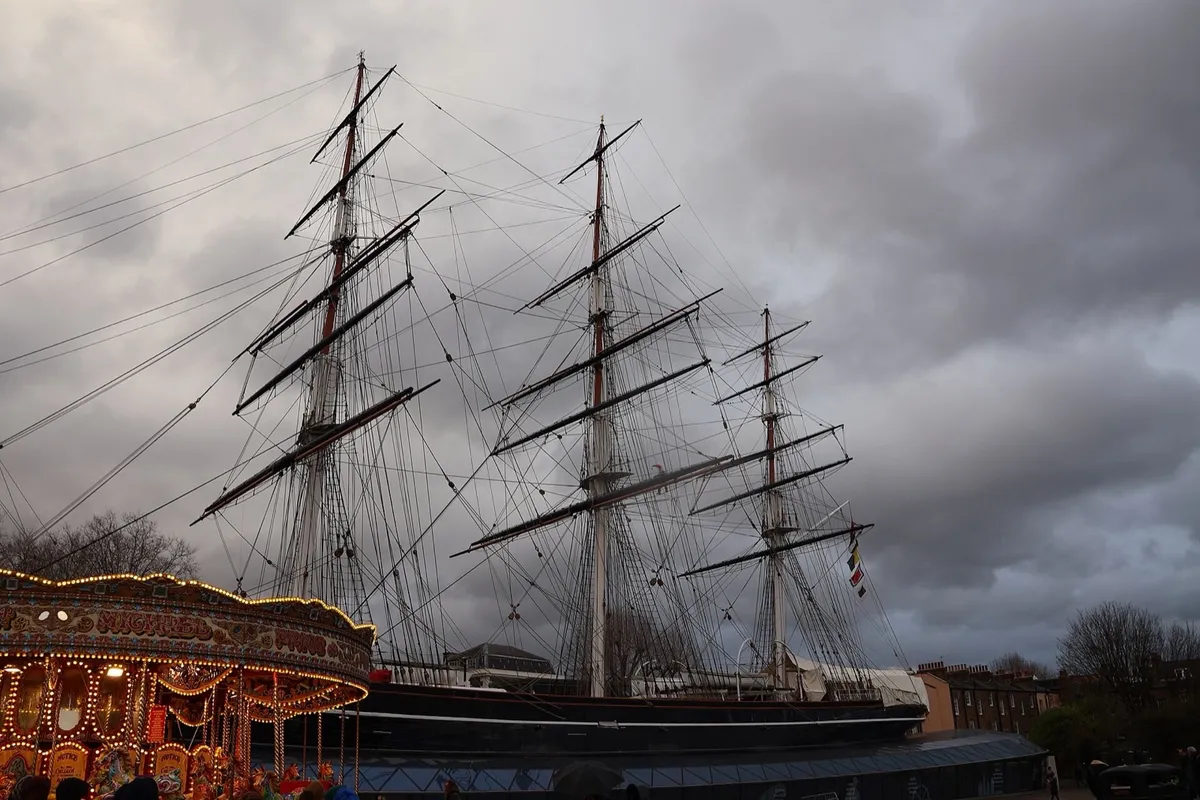
Cutty Sark
The Cutty Sark was born obsolete. She launched in 1869, the same year the Suez Canal opened and killed the tea clipper trade in a single stroke. Steam ships could use the canal. Sailing ships couldn't. The entire economic logic that justified building a vessel optimized for speed from China to London evaporated before she'd completed her first season. That's either terrible timing or a fitting monument to an era that was already dead. She raced in the tea trade anyway for a few seasons, most famously against the clipper Thermopylae in 1872. Cutty Sark was winning when she lost her rudder in a gale and had to jury-rig a replacement from spare spars. She still finished the voyage, arriving in London only a week behind Thermopylae. That tells you everything about the ship and the men who sailed her. Her second life was in the Australian wool trade, and this is where she finally proved herself. Under Captain Richard Woodget (1885-1895), she became the fastest wool clipper afloat, consistently making the passage from Sydney to London in under 80 days. She'd load over 5,000 bales of wool, drive south into the roaring forties, and run her easting down at speeds that left every other sailing vessel behind. Woodget was the captain she deserved. The name comes from Robert Burns's 1791 poem "Tam o' Shanter." Tam, drunk and riding home, watches witches dance and shouts in admiration at a young witch wearing a cutty sark, a short nightgown. She chases him. He barely escapes. The ship's figurehead is the witch Nannie, reaching forward with arm outstretched. It's a perfect name for a ship that was always chasing something just out of reach. After the wool trade declined, she was sold to a Portuguese company, renamed Ferreira, and spent decades hauling cargo in the South Atlantic. A retired sea captain named Wilfred Dowman found her in a Portuguese port in 1922, recognized what she was, bought her, and brought her home to England. Without Dowman, she would have been broken up. She is the only clipper ship that survives.
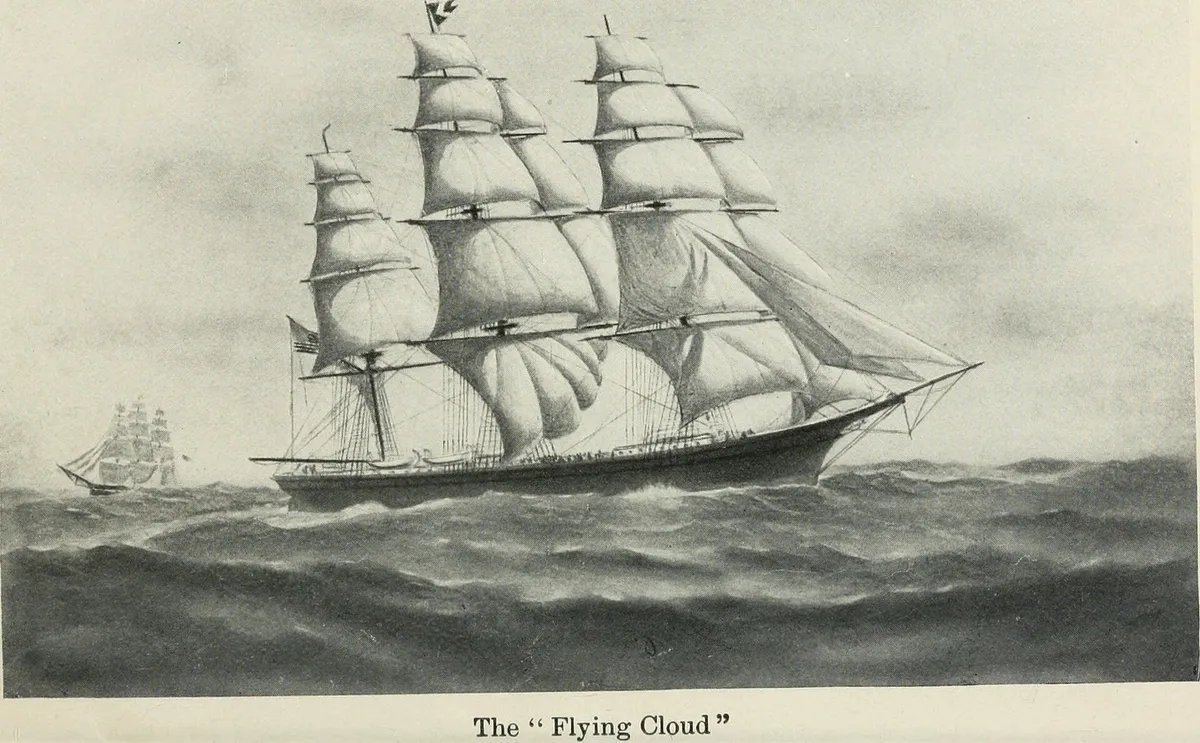
Flying Cloud
Flying Cloud was the fastest sailing vessel of her era, and her speed record from New York to San Francisco stood for over 100 years. She made the passage around Cape Horn in 89 days and 8 hours in 1854, a mark no commercial sailing vessel would beat until 1989. To put that in perspective: a record set before the Civil War survived the invention of the telephone, the automobile, both World Wars, and the moon landing. She was built by Donald McKay in East Boston, the best clipper ship designer who ever lived, at the peak of the California Gold Rush. Speed was money. Every day shaved off the passage to San Francisco meant earlier access to cargo rates that could pay for the ship in a single voyage. Owners drove these ships hard, and captains who delivered fast passages became celebrities. Josiah Perkins Creesy commanded Flying Cloud, but the secret weapon was his wife. Eleanor Creesy was the ship's navigator. She plotted the courses, read the currents, and made the decisions about when to press south into the roaring forties and when to hold off. Her work with Matthew Fontaine Maury's wind and current charts was masterful. She found favorable currents and winds that other navigators missed. On the record-setting 1854 voyage, she navigated through a cracked mainmast and a near-mutiny. She never held an official rank, was never paid, and appears in most histories as a footnote to her husband. She was one of the best navigators in the world. The clipper ship era lasted barely 15 years. Steam was already winning when Flying Cloud launched. These ships were profitable only because the Gold Rush created insane demand for fast passage to California, and the tea trade paid premiums for early-season delivery. Once the transcontinental railroad was completed in 1869 and the Suez Canal opened the same year, clippers were obsolete overnight. Beautiful, fast, and suddenly pointless. Flying Cloud herself was worked to death. After her glory years on the California run, she was sold to British owners who used her in the timber trade. She was condemned and burned for her copper fastenings at St. John, New Brunswick in 1874. She was 23 years old. Clipper ships were built for speed, not longevity, and hard driving wore them out fast. The hull that could do 18 knots was also a hull that was being slowly torn apart by the forces that made it fast.