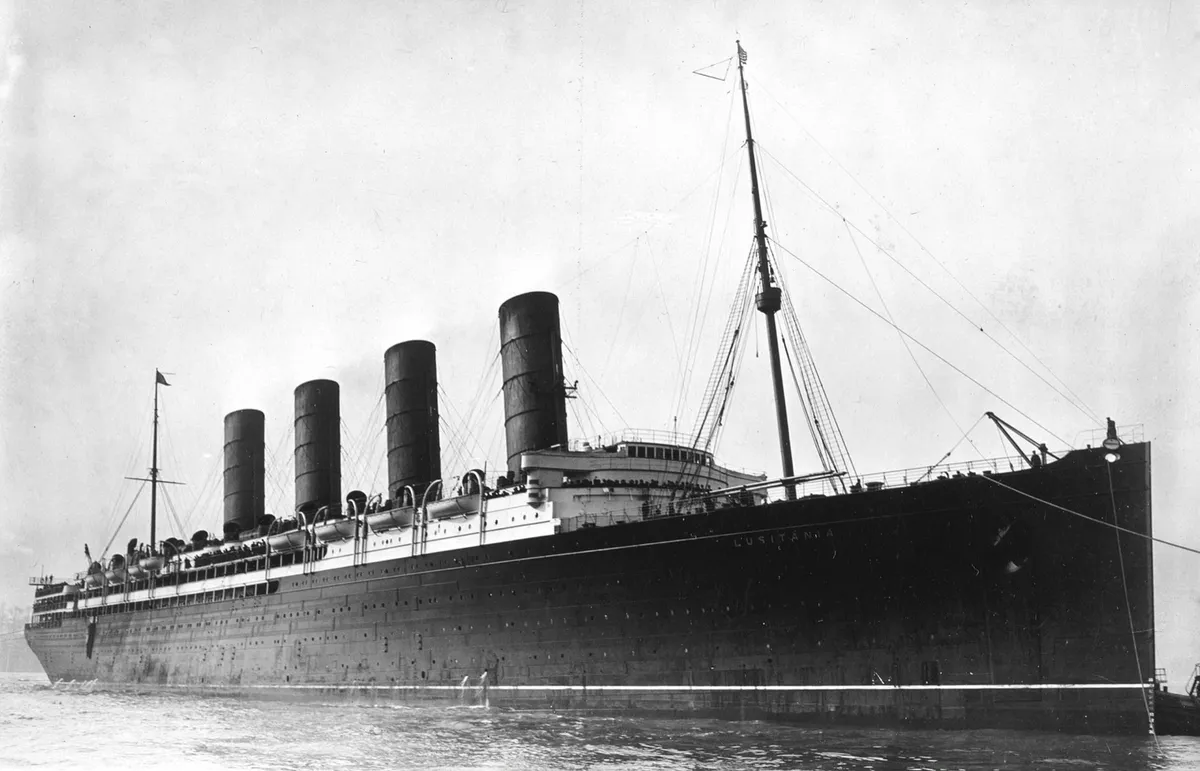
RMS Lusitania
Why it matters
The Lusitania was the fastest thing on the Atlantic when she launched. She took the Blue Riband in 1907 and held it for two years, crossing at an average of 25 knots. She was also a quiet instrument of British naval policy. The Admiralty subsidized her construction on the condition that she could be converted to an armed merchant cruiser in wartime. Whether she was actually carrying war materiel on her final voyage is still debated, and probably always will be.
On the morning of May 7, 1915, the German Embassy published a warning in American newspapers telling passengers that ships flying the British flag in the war zone around the British Isles were "liable to destruction." Most passengers ignored it. That afternoon, Kapitanleutnant Walther Schwieger of U-20 fired a single torpedo into Lusitania's starboard side off the Old Head of Kinsale, Ireland.
One torpedo hit. Then a second, much larger explosion ripped through the ship. The cause of that second blast is the argument that won't die. Coal dust in the nearly empty bunkers. Steam line rupture. Or the 4.2 million rounds of Remington .303 cartridges listed on the cargo manifest. The ship's longitudinal bulkheads, designed to contain flooding, instead created an immediate list to starboard so severe that the lifeboats on the port side couldn't be launched at all.
She sank in 18 minutes. 1,198 people died, including 128 American citizens. Germany called it a legitimate act of war against a vessel carrying contraband. The British called it murder. American public opinion lurched toward intervention. It took two more years, but the Lusitania was one of the weights on the scale that pulled the United States into World War I.
The irony is thick. A ship built with Admiralty money, possibly carrying Admiralty cargo, was sent through a known submarine zone without escort. The cruiser HMS Juno had been recalled from the area the day before. The Admiralty knew U-boats were active in those waters. Nobody warned Captain Turner to zigzag.
What it was like
Lusitania's engine rooms were a cathedral of noise. The four Parsons turbines produced 76,000 shaft horsepower and the vibration was constant, a deep hum that passengers in first class barely noticed but that the engine crew lived inside. The 25 boilers consumed about 1,000 tons of coal per day at full speed, and by 1915 coal rationing meant she was running on reduced boilers. The No. 1 boiler room was shut down entirely, which cut her top speed to around 21 knots.
When the torpedo hit, the engineering spaces flooded fast. The second explosion blew through the lower decks. Steam lines ruptured. Men in the engine and boiler rooms either drowned, were scalded to death by superheated steam, or were killed by the blast itself. The lights went out almost immediately. The ship's electrical dynamos were in the flooded compartments.
On deck, the list made everything worse. Lifeboats on the starboard side swung out over the water and crashed into passengers as they lowered. Port-side boats couldn't clear the deck because of the angle. People slid down the tilting deck into the railings and each other. The whole thing, from torpedo to gone, was 18 minutes. Many passengers never made it topside.
The crew
Trimmer
Moved coal from bunkers to the furnace plates where firemen could shovel it. On Lusitania's last voyage, the nearly empty longitudinal bunkers may have been filled with coal dust, which some researchers believe caused the devastating secondary explosion.
Lookout
The ship had lookouts posted but no binoculars available to them. The periscope of U-20 was spotted less than a minute before the torpedo hit. There was no time to turn. The lookout's warning reached the bridge just as the torpedo struck.
Steward
The 306 stewards and stewardesses were responsible for passengers during the evacuation. Many helped people into life jackets and toward the boat deck. With the severe list and 18-minute sinking time, stewards working in below-deck cabins had almost no chance. Staff casualties were disproportionately high.
Patina notes
Lusitania lies on her starboard side in about 300 feet of water off the Old Head of Kinsale, County Cork, Ireland. Unlike Titanic's deep-ocean preservation, the relatively shallow depth means she's been subjected to tidal currents, marine growth, fishing nets, and decades of salvage attempts.
The hull is heavily collapsed. The superstructure is largely gone. Depth charges dropped by the Royal Navy in the 1950s (reportedly to destroy evidence of munitions) further damaged the wreck.
The bow section is the most recognizable portion. The propellers are partially buried in silt. Visibility at the site is often poor, with strong currents making diving dangerous.
Preservation reality
The wreck is privately owned. American investor Gregg Bemis purchased the salvage rights in 1968 and the wreck itself in 1982. Before his death in 2022, he funded multiple expeditions to settle the munitions debate.
Ireland declared a 50-meter exclusion zone around the wreck, and diving requires a license from the Irish government. There is no museum ship and never will be.
The most significant Lusitania artifacts are at the Lusitania Museum in Kinsale, housed in the Old Courthouse where the inquest was held. The Merseyside Maritime Museum in Liverpool also holds a collection. The debate about what she carried will outlive everyone reading this.
Where to see one
- • Lusitania Museum & Old Courthouse, Kinsale, Ireland
- • Merseyside Maritime Museum, Liverpool, England
- • Old Head of Kinsale Signal Tower, Cork, Ireland
Preservation organizations
- • Lusitania Museum Kinsale
- • National Maritime Museum of Ireland
Sources
- Dead Wake: The Last Crossing of the Lusitania by Erik Larson (2026-03-05)
- National Geographic - Lusitania (2026-03-05)
- Lusitania Resource & Research (2026-03-05)
Related vessels
Carroll A. Deering
On January 31, 1921, the Carroll A. Deering ran aground on Diamond Shoals off Cape Hatteras, North Carolina, with all sails set. The Coast Guard reached her four days later. The lifeboats were gone. The crew's personal belongings were gone. But dinner was being prepared in the galley, the tables were set, and the ship's cats were still aboard. Eleven men had vanished from a brand-new, well-found schooner in one of the most heavily trafficked shipping lanes on the East Coast. No bodies were ever recovered. No lifeboat was ever found. The investigation pulled in five government agencies, and the deeper they dug, the stranger it got. The ship's logs were missing. The steering gear had been deliberately smashed. Navigation equipment was gone. Two anchors had been dropped, with their chains hanging over the bow in a way that suggested the ship had been anchored and then cut loose. Someone had wrecked the ship's ability to navigate and steer, then left. On January 29, two days before the grounding, a lightship keeper at Cape Lookout reported that a crewman on the Deering had hailed him through a megaphone, saying the ship had lost her anchors. The man on the megaphone was not an officer. That detail haunted investigators. Theories ranged from mutiny to rum-running pirates to Soviet agents. The Deering's first mate, Charles McLellan, had openly clashed with the original captain (who fell ill and was replaced before the final voyage). The replacement captain, W.B. Wormell, was 66 years old and may not have had full control of his crew. At least nine other vessels disappeared in the same area around the same time, leading some to call it an early "Bermuda Triangle" cluster. The FBI, the State Department, and the Department of Commerce all investigated. None of them solved it. The case files were sealed, then lost, then partially recovered decades later. Herbert Hoover, then Secretary of Commerce, personally oversaw the investigation and came away frustrated. Whatever happened aboard the Carroll A. Deering, eleven men took the answer with them.
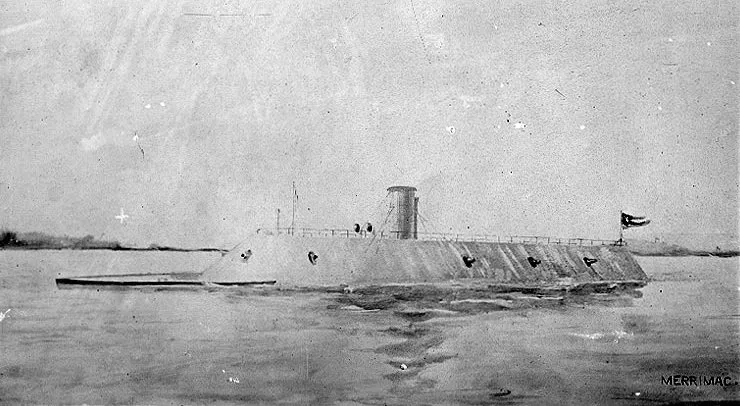
CSS Virginia
The CSS Virginia was born from desperation and scrap metal. When Union forces abandoned the Norfolk Navy Yard in April 1861, they burned the steam frigate USS Merrimack to the waterline and sank her. The Confederacy raised the hull, found the engines salvageable (barely), and built an armored casemate on top. Four inches of iron plate bolted over 24 inches of oak and pine, sloped at 36 degrees to deflect shot. She looked like a barn roof floating on a raft. She was the most dangerous warship in the Western Hemisphere. On March 8, 1862, Virginia steamed into Hampton Roads and attacked the Union blockading squadron. She rammed and sank the USS Cumberland, a 24-gun sloop that went down with 121 of her crew still fighting. Her guns couldn't hurt Virginia. The frigate USS Congress surrendered after Virginia's shells set her ablaze. Another 120 men died. The wooden warships USS Minnesota, USS Roanoke, and USS St. Lawrence all ran aground trying to escape. If Virginia had returned the next morning unopposed, she could have broken the Union blockade. But Monitor was waiting. The four-hour engagement the next day proved that the age of wooden warships was finished. Virginia landed dozens of hits on Monitor without breaking through. Monitor's Dahlgrens cracked Virginia's armor in places but couldn't penetrate. Virginia tried to ram but Monitor was too nimble. It was the first battle between ironclad warships, and it ended with both sides claiming victory and neither ship sunk. Virginia fought in the area for two more months but never left the Roads. Her 21-foot draft meant she could only navigate deep channels, and her engines, already condemned before the war started, could barely push her at walking speed. When Union forces advanced on Norfolk in May 1862, the crew tried to lighten her enough to escape upriver. They couldn't. On May 11, her crew set her afire and she exploded when the flames reached the magazine. Nothing of the ship survived.
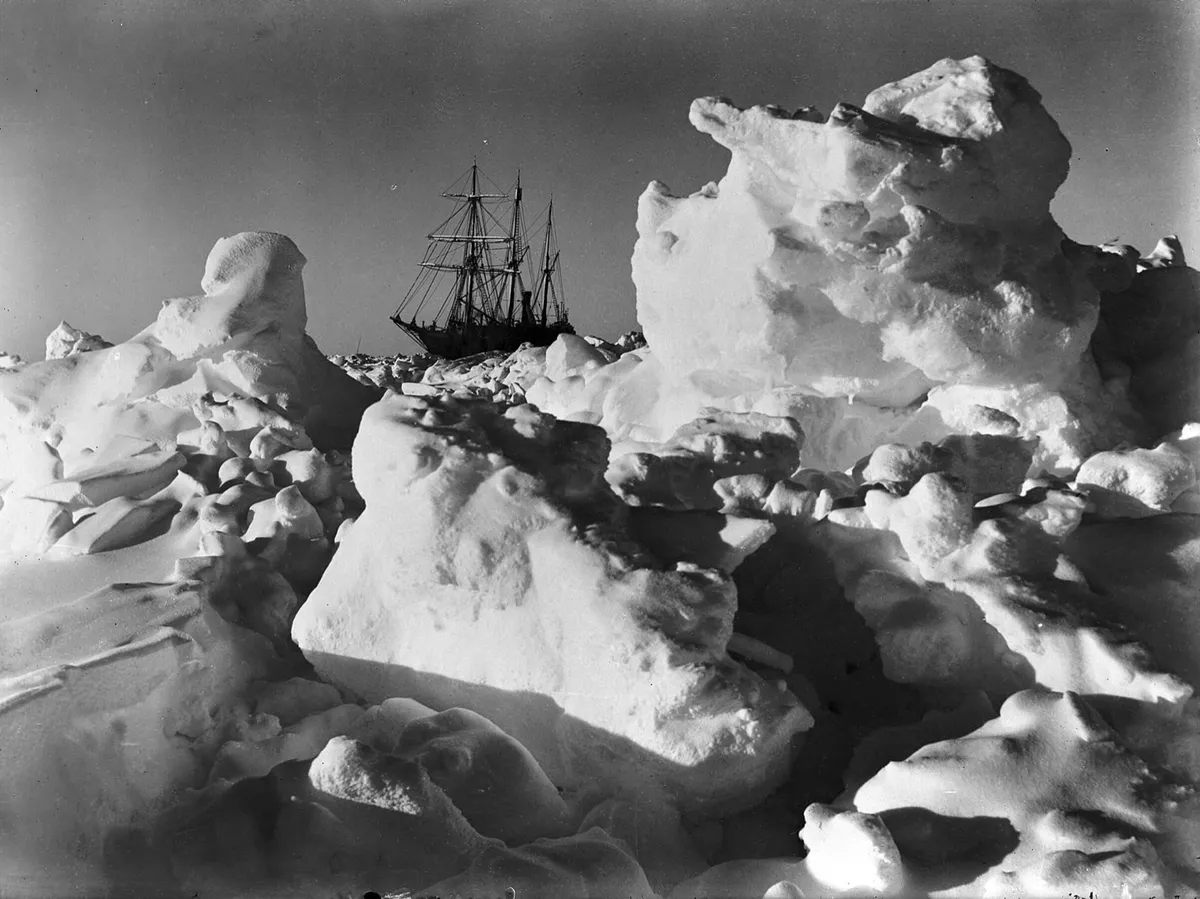
Endurance
Endurance never reached Antarctica. That's the first thing to understand. Shackleton's Imperial Trans-Antarctic Expedition was supposed to cross the continent from the Weddell Sea to the Ross Sea, roughly 1,800 miles over the pole. They didn't make it to shore. Endurance entered the Weddell Sea pack ice in December 1914 and became trapped on January 19, 1915. For ten months the crew lived aboard while the ice slowly crushed the ship around them. Frank Hurley's photographs show the hull buckling, the deck timbers splintering, the masts leaning at impossible angles. On October 27, 1915, Shackleton ordered the crew onto the ice. Endurance sank on November 21. What followed is the greatest survival story in the history of exploration. Twenty-eight men camped on drifting ice floes for five months, eating seals and penguins, watching the floe they lived on crack and shrink. When the ice broke up in April 1916, they launched three salvaged lifeboats and sailed through open Antarctic seas to Elephant Island, a desolate rock at the tip of the Antarctic Peninsula. It was the first time they'd stood on solid ground in 497 days. Shackleton then took five men in the 22-foot James Caird and sailed 800 miles across the Southern Ocean to South Georgia Island. The Drake Passage is the most violent stretch of open water on earth. The boat was open. They navigated by dead reckoning and occasional sun sights through storm clouds. They made landfall on the wrong side of the island and Shackleton, Worsley, and Crean then crossed South Georgia's unmapped mountain range on foot to reach the whaling station at Stromness. Not a single man died. All 28 survived. The Trans-Antarctic Expedition was a complete failure by its stated objective and an absolute triumph of leadership. Shackleton brought everybody home. The wreck was found in March 2022 by the Endurance22 expedition at a depth of 10,000 feet in the Weddell Sea. The ship is upright, intact, with the name "ENDURANCE" still clearly visible on the stern. The cold, low-oxygen water preserved her like no one expected.