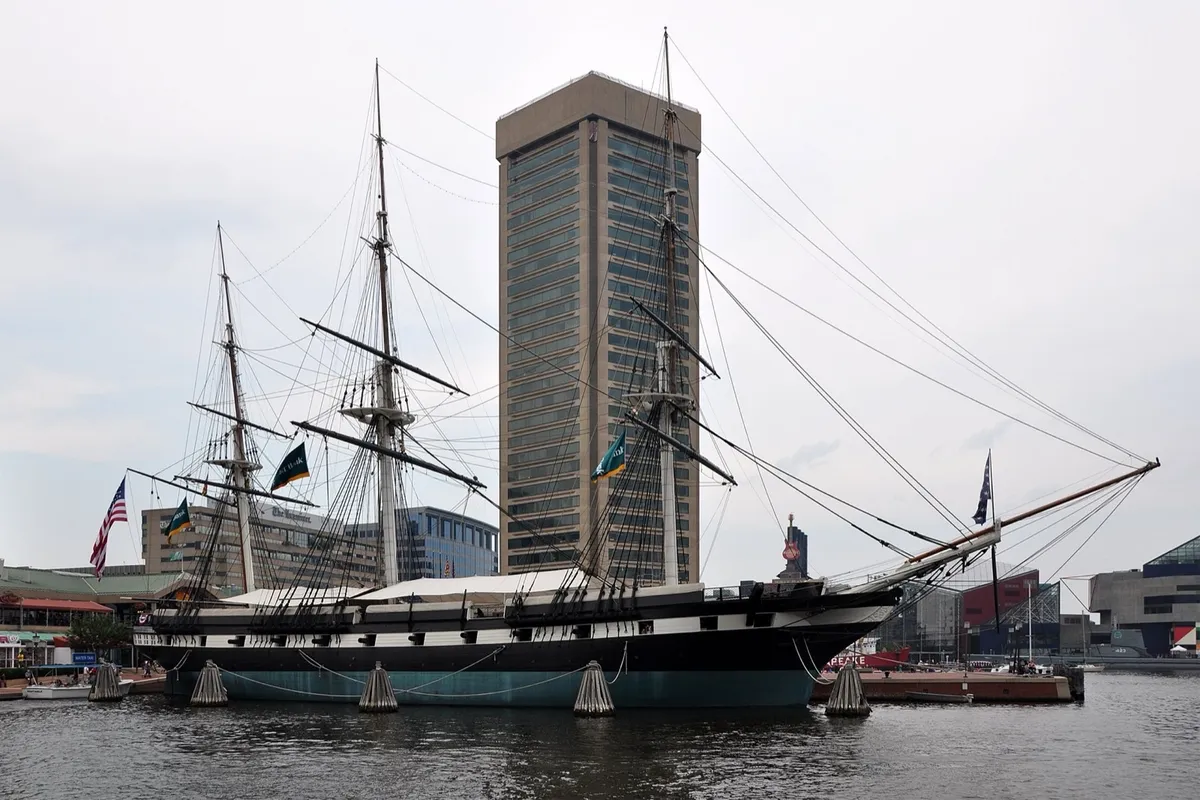
USS Constellation
Why it matters
The USS Constellation in Baltimore Harbor is a beautiful ship with an identity crisis. For decades, the Navy and the city of Baltimore claimed she was the original 1797 frigate, one of the first six frigates authorized by Congress, the first U.S. Navy warship to put to sea, sister to the USS Constitution. That story is almost certainly wrong.
The scholarly consensus, led by naval historian Dana Wegner's 1991 study, is that the ship in Baltimore is the 1854 sloop-of-war. A different vessel. The original 1797 frigate was broken up at the Gosport Navy Yard in Norfolk, and the 1854 ship was built using some of the old timbers but on a completely different design. She's a sloop-of-war, not a frigate. Different hull shape, different gun arrangement, different dimensions. The Navy muddied the waters by giving her the same name and claiming continuity for budget reasons. It was cheaper to "rebuild" an existing ship than to fund a new one from Congress.
This matters because the truth is more interesting than the myth. The 1854 Constellation served in the Africa Squadron, intercepting slave ships during the illegal transatlantic slave trade. In 1858, she captured the slaver Cora with 705 enslaved Africans aboard. In 1860, she captured three more ships. These were real operations with real consequences. The people freed from those ships were taken to Liberia. Whether that constituted rescue is its own complicated question.
She served as a training ship at the Naval Academy during the Civil War, then spent decades in various roles before being brought to Baltimore in 1955 as a museum ship. The restoration work assumed she was the 1797 vessel and added frigate-style gun ports that the 1854 sloop never had. So the ship you see today is a 19th-century sloop wearing an 18th-century frigate costume.
Baltimore has largely stopped making the 1797 claim, though the debate still generates heat. The ship is worth visiting on her own merits. She's the last surviving Civil War-era naval vessel and one of the oldest ships in the Navy's inventory, even without the frigate pedigree.
What it was like
A 300-man crew on a sloop-of-war lived in a world organized around the gun deck. Hammocks were slung between the cannons at night and stowed by morning. Everything happened in the same space: eating, sleeping, fighting. The ventilation below decks in tropical waters off the African coast was essentially nonexistent. Heat, humidity, and the smell of 300 men who bathed when it rained.
Africa Squadron duty was grueling and unpopular. The coast of West Africa was ridden with malaria and yellow fever. Ships would cruise for weeks without action, then suddenly have to chase, board, and process a slave ship. The conditions on captured slavers were beyond description. Crew members who boarded these vessels wrote about the stench reaching them from a quarter mile downwind. The enslaved people found aboard were often dying. Constellation's sailors had to provide food, water, and medical care they barely had for themselves.
The work was morally clear and physically brutal. Sailors died of tropical disease at rates that made combat look safe. The Africa Squadron was underfunded, undermanned, and operating thousands of miles from home port with no reliable supply chain.
The crew
Gun Captain
Responsible for a single cannon and its crew of 6-8 men. On the Africa Squadron, the guns were rarely fired in anger. The slavers they chased were fast but lightly armed. Most captures involved a warning shot and boarding. The gun captain's real job was keeping his piece clean and ready in salt air that corroded everything. A neglected cannon could burst on firing, killing its own crew.
Ship's Surgeon
The most overworked man aboard during Africa Squadron duty. Malaria, dysentery, yellow fever, and the general toll of tropical service kept the sick bay full. When a slaver was captured, the surgeon had to assess hundreds of enslaved people in conditions that would challenge a modern hospital. His tools were quinine, laudanum, the saw, and whatever folk remedies the crew brought aboard. The mortality rate among naval surgeons on the African station was notably high.
Marine Sentry
Marines aboard stood guard, maintained order, and formed boarding parties. When Constellation intercepted a slave ship, marines went across first. They secured the crew, assessed threats, and held the vessel while sailors transferred the enslaved people. This was close-quarters work on ships that were often in terrible condition, with desperate crews who faced hanging if convicted. The marines also enforced discipline aboard Constellation herself, standing watch at the captain's door and the spirit room.
Patina notes
The Constellation has been repaired, rebuilt, and restored so many times that defining what's "original" is philosophical as much as practical. The 1990s restoration attempted to return her to the 1854 sloop-of-war configuration, removing the fake frigate gun ports added in the 1960s.
Her hull is a patchwork of original live oak, replacement timber, and modern structural steel reinforcement. The wood above the waterline has been replaced multiple times.
Below the waterline, some of the oldest timbers survive, protected by copper sheathing. She sits in salt water in Baltimore's Inner Harbor, which is not kind to wooden ships.
Constant maintenance keeps her afloat. The iron hardware has been replaced or conserved. What you see is a ship that has been kept alive through continuous intervention, like a living thing on life support.
Preservation reality
USS Constellation is a museum ship at Pier 1 in Baltimore's Inner Harbor, operated by Historic Ships in Baltimore. You can board her and walk the gun deck, berth deck, and weather deck.
The restoration to her 1854 configuration is well done, though budget constraints mean ongoing maintenance is a constant battle. The ship draws about 100,000 visitors a year.
She's part of a collection that includes the submarine USS Torsk and the lightship Chesapeake. Admission is reasonable and the docents know their history.
The identity debate is addressed honestly in the onboard exhibits. If you go, understand you're seeing an 1854 sloop-of-war that did real, important work. That's enough.
Where to see one
- • Pier 1, Baltimore Inner Harbor, Maryland
Preservation organizations
- • Historic Ships in Baltimore
Sources
- Dana Wegner, Fouled Anchors: The Constellation Question Answered (2026-03-05)
- Historic Ships in Baltimore (2026-03-05)
- Naval History and Heritage Command - USS Constellation (2026-03-05)
Related vessels
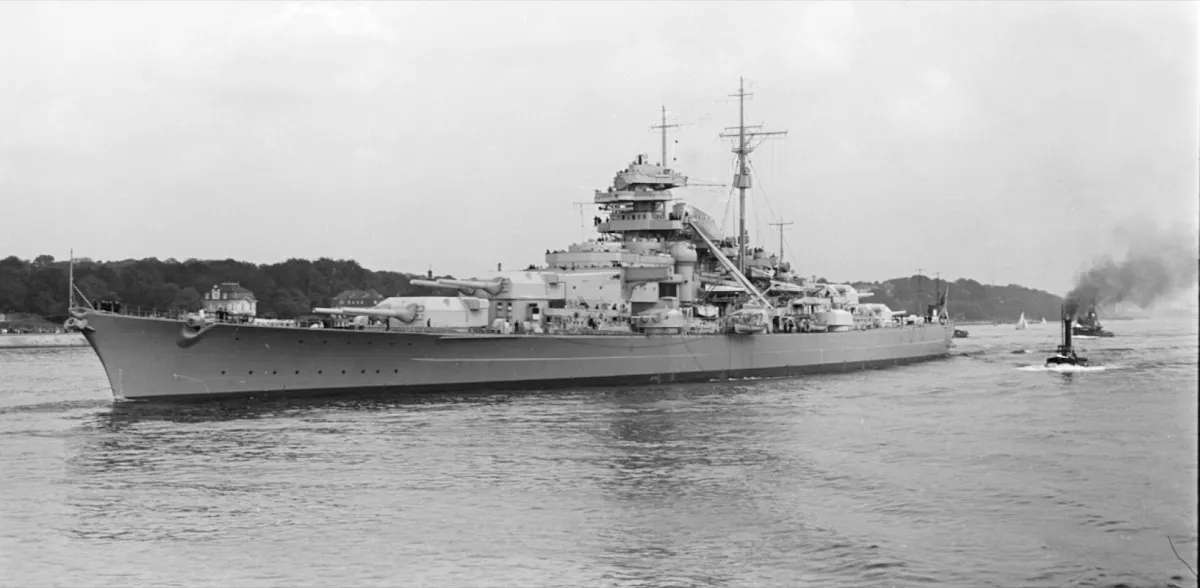
Bismarck
Bismarck's operational career lasted eight days. In that time, she became the most famous warship of the twentieth century. On May 24, 1941, she engaged HMS Hood and HMS Prince of Wales in the Denmark Strait. A shell from Bismarck penetrated Hood's magazine. The explosion broke Hood in half. She sank in three minutes. Of 1,418 crew, three survived. Hood was the pride of the Royal Navy. Churchill's order was immediate and absolute: sink the Bismarck. The Royal Navy sent everything. Battleships, carriers, cruisers, destroyers. Swordfish torpedo bombers — fabric-covered biplanes that looked like they belonged in the previous war — scored the hit that jammed Bismarck's rudder. She could only steam in circles. The next morning, King George V and Rodney pounded her for ninety minutes. Bismarck's crew scuttled her. Of 2,065 men, 114 survived.
Black Pearl
Before 2003, the pirate movie was a dead genre. After Pirates of the Caribbean, every kid in America wanted a ship with black sails. The Black Pearl did for pirate vessels what the Millennium Falcon did for spaceships. It made the vehicle a character. The ship represents freedom in its purest cinematic form. Jack Sparrow doesn't want gold or power. He wants his ship back. That's it. The entire first film is a man trying to reclaim the one thing that makes him who he is. The Black Pearl isn't transportation. It's identity. Johnny Depp's performance gets the credit, and it should. But the ship sells the fantasy. The black sails against a Caribbean sunset. The ragged rigging. The impossible speed. You believe this ship is alive because the movie treats it like one. The prop was built on a steel barge called the Sunset, dressed with a full wooden superstructure. Additional ships were constructed for later films, and digital effects expanded the Pearl's capabilities well beyond anything that floats.
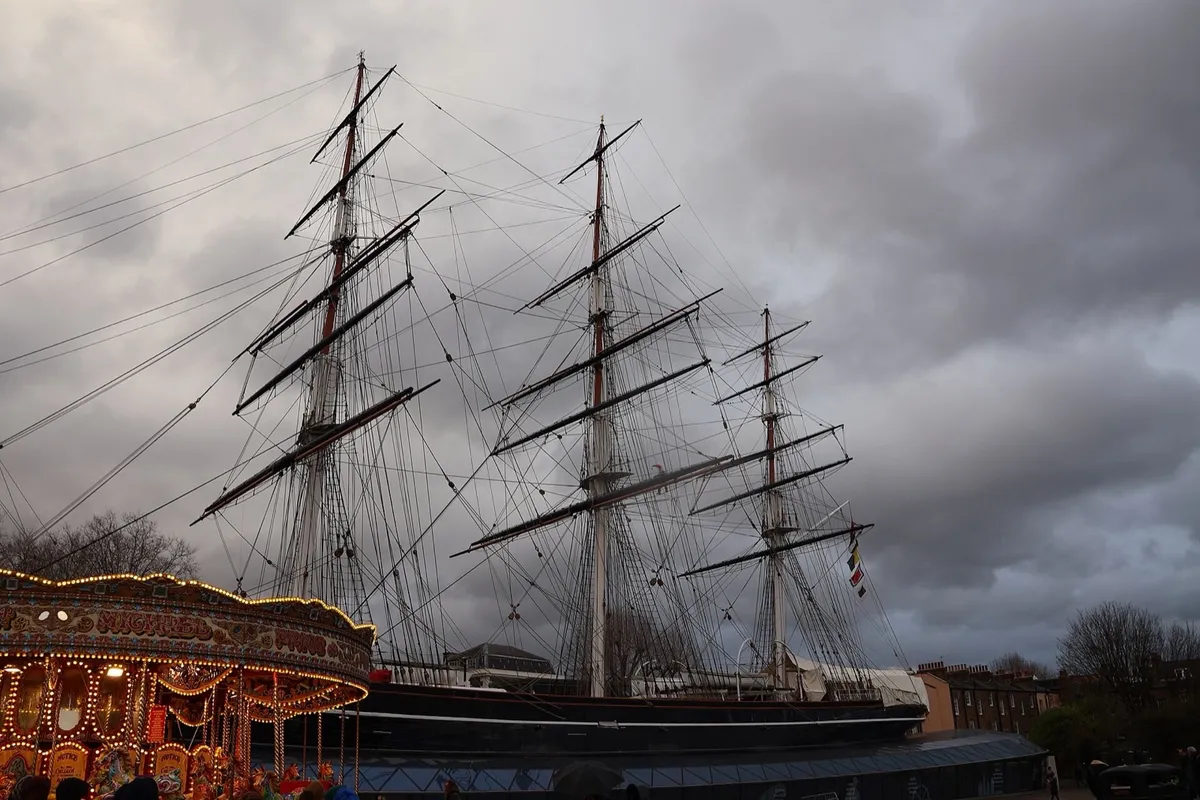
Cutty Sark
The Cutty Sark was born obsolete. She launched in 1869, the same year the Suez Canal opened and killed the tea clipper trade in a single stroke. Steam ships could use the canal. Sailing ships couldn't. The entire economic logic that justified building a vessel optimized for speed from China to London evaporated before she'd completed her first season. That's either terrible timing or a fitting monument to an era that was already dead. She raced in the tea trade anyway for a few seasons, most famously against the clipper Thermopylae in 1872. Cutty Sark was winning when she lost her rudder in a gale and had to jury-rig a replacement from spare spars. She still finished the voyage, arriving in London only a week behind Thermopylae. That tells you everything about the ship and the men who sailed her. Her second life was in the Australian wool trade, and this is where she finally proved herself. Under Captain Richard Woodget (1885-1895), she became the fastest wool clipper afloat, consistently making the passage from Sydney to London in under 80 days. She'd load over 5,000 bales of wool, drive south into the roaring forties, and run her easting down at speeds that left every other sailing vessel behind. Woodget was the captain she deserved. The name comes from Robert Burns's 1791 poem "Tam o' Shanter." Tam, drunk and riding home, watches witches dance and shouts in admiration at a young witch wearing a cutty sark, a short nightgown. She chases him. He barely escapes. The ship's figurehead is the witch Nannie, reaching forward with arm outstretched. It's a perfect name for a ship that was always chasing something just out of reach. After the wool trade declined, she was sold to a Portuguese company, renamed Ferreira, and spent decades hauling cargo in the South Atlantic. A retired sea captain named Wilfred Dowman found her in a Portuguese port in 1922, recognized what she was, bought her, and brought her home to England. Without Dowman, she would have been broken up. She is the only clipper ship that survives.