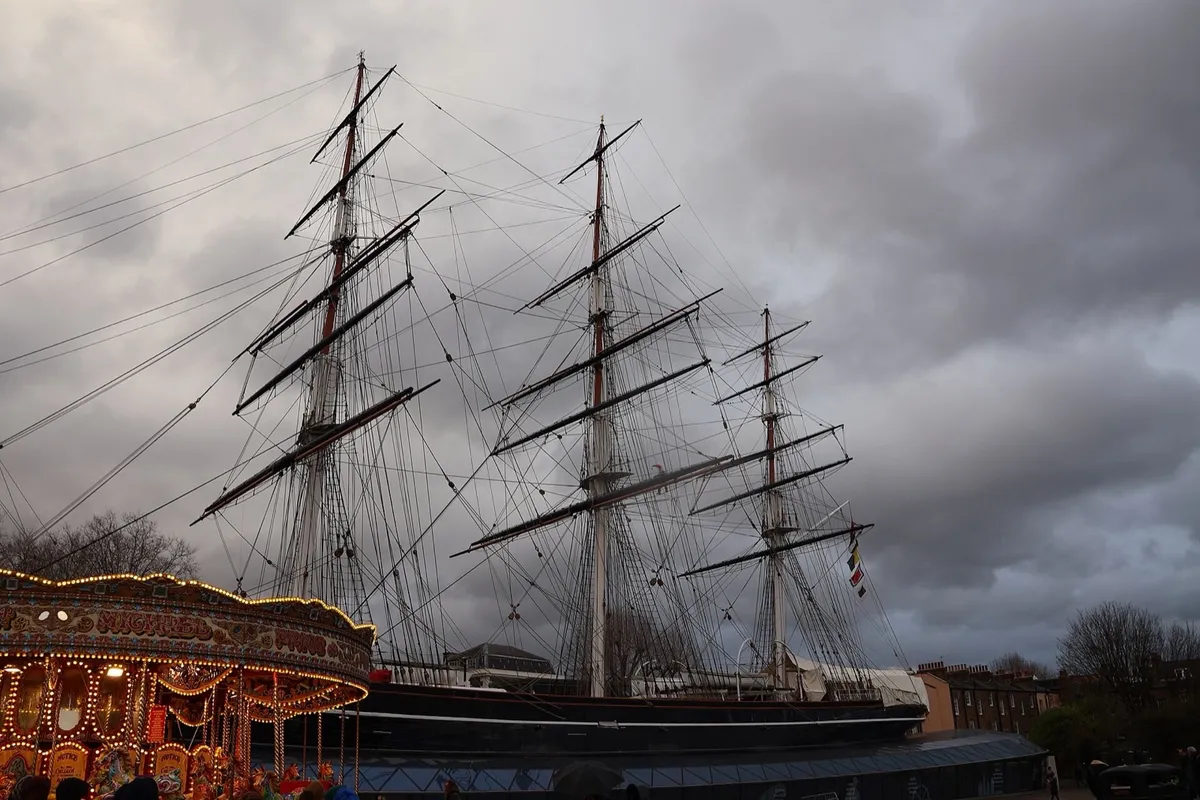
Cutty Sark
Why it matters
The Cutty Sark was born obsolete. She launched in 1869, the same year the Suez Canal opened and killed the tea clipper trade in a single stroke. Steam ships could use the canal. Sailing ships couldn't. The entire economic logic that justified building a vessel optimized for speed from China to London evaporated before she'd completed her first season. That's either terrible timing or a fitting monument to an era that was already dead.
She raced in the tea trade anyway for a few seasons, most famously against the clipper Thermopylae in 1872. Cutty Sark was winning when she lost her rudder in a gale and had to jury-rig a replacement from spare spars. She still finished the voyage, arriving in London only a week behind Thermopylae. That tells you everything about the ship and the men who sailed her.
Her second life was in the Australian wool trade, and this is where she finally proved herself. Under Captain Richard Woodget (1885-1895), she became the fastest wool clipper afloat, consistently making the passage from Sydney to London in under 80 days. She'd load over 5,000 bales of wool, drive south into the roaring forties, and run her easting down at speeds that left every other sailing vessel behind. Woodget was the captain she deserved.
The name comes from Robert Burns's 1791 poem "Tam o' Shanter." Tam, drunk and riding home, watches witches dance and shouts in admiration at a young witch wearing a cutty sark, a short nightgown. She chases him. He barely escapes. The ship's figurehead is the witch Nannie, reaching forward with arm outstretched. It's a perfect name for a ship that was always chasing something just out of reach.
After the wool trade declined, she was sold to a Portuguese company, renamed Ferreira, and spent decades hauling cargo in the South Atlantic. A retired sea captain named Wilfred Dowman found her in a Portuguese port in 1922, recognized what she was, bought her, and brought her home to England. Without Dowman, she would have been broken up. She is the only clipper ship that survives.
What it was like
A crew of 28 to 35 men worked a ship carrying over 32,000 square feet of canvas. That's a brutal ratio. Every man had to be able to work aloft, and in the Southern Ocean, "aloft" meant climbing frozen ratlines to yards 150 feet above a deck that was rolling through 40-foot swells. The wind down in the roaring forties didn't just blow. It screamed. Men shouted into each other's ears and couldn't be heard.
The wool run was the hardest sailing on earth. The route from Sydney to London ran south to pick up the westerlies, then east across the Southern Ocean, around Cape Horn, and north through the Atlantic. Weeks of unbroken gales, freezing spray, and grey skies. The ship would heel until the lee rail was underwater, and the watch on deck worked in water up to their knees. Below decks was marginally drier but the motion was violent enough to throw men from their hammocks.
The small crew meant long watches and no rest during heavy weather. When all hands were called, every man went on deck regardless of whether he'd slept. Injuries were constant: rope burns, crushed fingers from blocks, broken ribs from falls. The food was adequate but monotonous. Captain Woodget was a fair commander who kept his crew fed and didn't drive them past the breaking point, which is why he kept the same men voyage after voyage. Good captains were remembered by their crews. Bad ones were remembered differently.
The crew
Master (Captain Woodget)
Richard Woodget commanded Cutty Sark from 1885 to 1895, her golden decade. He was a farm boy from Norfolk who went to sea as a teenager and worked his way up. He understood the ship's limits and pushed right to the edge without crossing over. He also kept a collie dog aboard and took photographs, which is how we have images of life on the ship during the wool run. He treated his crew well enough that men specifically requested to sail with him.
Sailmaker
On a clipper ship, the sailmaker was never idle. The canvas took constant punishment from wind and chafe, and the sailmaker spent every daylight hour repairing tears, re-roping edges, and stitching reinforcement patches. In the Southern Ocean, sails blew out regularly. The sailmaker would work on the pitching deck with a palm, needle, and twine, repairing a sail that weighed hundreds of pounds while the ship drove on under reduced canvas. A good sailmaker kept the ship moving. A bad one cost days.
Ordinary Seaman
The youngest and least experienced crew members, usually teenagers on their first or second deep-water voyage. They did the worst jobs: cleaning, hauling, tarring, and going aloft in conditions that terrified experienced men. The Cutty Sark was a finishing school that either made sailors or broke them. An ordinary seaman who survived two wool runs was ready for anything the ocean could throw at him. Some of them were 15 years old.
Patina notes
Cutty Sark's composite construction tells a complicated preservation story. The iron frames are original but have been extensively treated for corrosion.
The teak planking is a mix of original and replacement timber. The copper sheathing below the waterline has been stripped and conserved. The ship spent decades in salt water at Greenwich before being placed in permanent dry dock in 1954, which slowed but didn't stop deterioration.
The 2007 arson fire during restoration was devastating, burning through much of the surviving original planking above the waterline. The rebuilders used the fire as an opportunity to do structural work that would have been impossible otherwise.
About 90% of the original iron framing survived the fire. The ship you see today is real but restored, a 157-year-old vessel that has been rebuilt enough times to trigger the ship of Theseus question.
Preservation reality
Cutty Sark sits in permanent dry dock at Greenwich, London, under a dramatic glass canopy that lets you walk beneath her copper-clad hull. The restoration after the 2007 fire cost over £50 million and took five years.
The ship was raised 11 feet above the dock floor, creating a museum space underneath where you can look up at the hull lines that made her fast. The interior is restored to the wool-trade era under Captain Woodget.
You can walk the main deck, look into the crew quarters, and stand at the wheel. The collection of merchant ship figureheads in the lower hold is the largest in the world.
It's the best-preserved clipper ship on earth because it's the only one. Admission is about £18. The gift shop is predictable. Go anyway. Stand under that hull and understand that this thing went around the world.
Where to see one
- • Cutty Sark, Greenwich, London, England
Preservation organizations
- • Royal Museums Greenwich
- • Cutty Sark Trust
Sources
- Basil Lubbock, The Log of the Cutty Sark (1924) (2026-03-05)
- Royal Museums Greenwich - Cutty Sark (2026-03-05)
- Eric Kentley, The Cutty Sark: The Last of the Tea Clippers (2026-03-05)
Related vessels
Black Pearl
Before 2003, the pirate movie was a dead genre. After Pirates of the Caribbean, every kid in America wanted a ship with black sails. The Black Pearl did for pirate vessels what the Millennium Falcon did for spaceships. It made the vehicle a character. The ship represents freedom in its purest cinematic form. Jack Sparrow doesn't want gold or power. He wants his ship back. That's it. The entire first film is a man trying to reclaim the one thing that makes him who he is. The Black Pearl isn't transportation. It's identity. Johnny Depp's performance gets the credit, and it should. But the ship sells the fantasy. The black sails against a Caribbean sunset. The ragged rigging. The impossible speed. You believe this ship is alive because the movie treats it like one. The prop was built on a steel barge called the Sunset, dressed with a full wooden superstructure. Additional ships were constructed for later films, and digital effects expanded the Pearl's capabilities well beyond anything that floats.
Flying Cloud
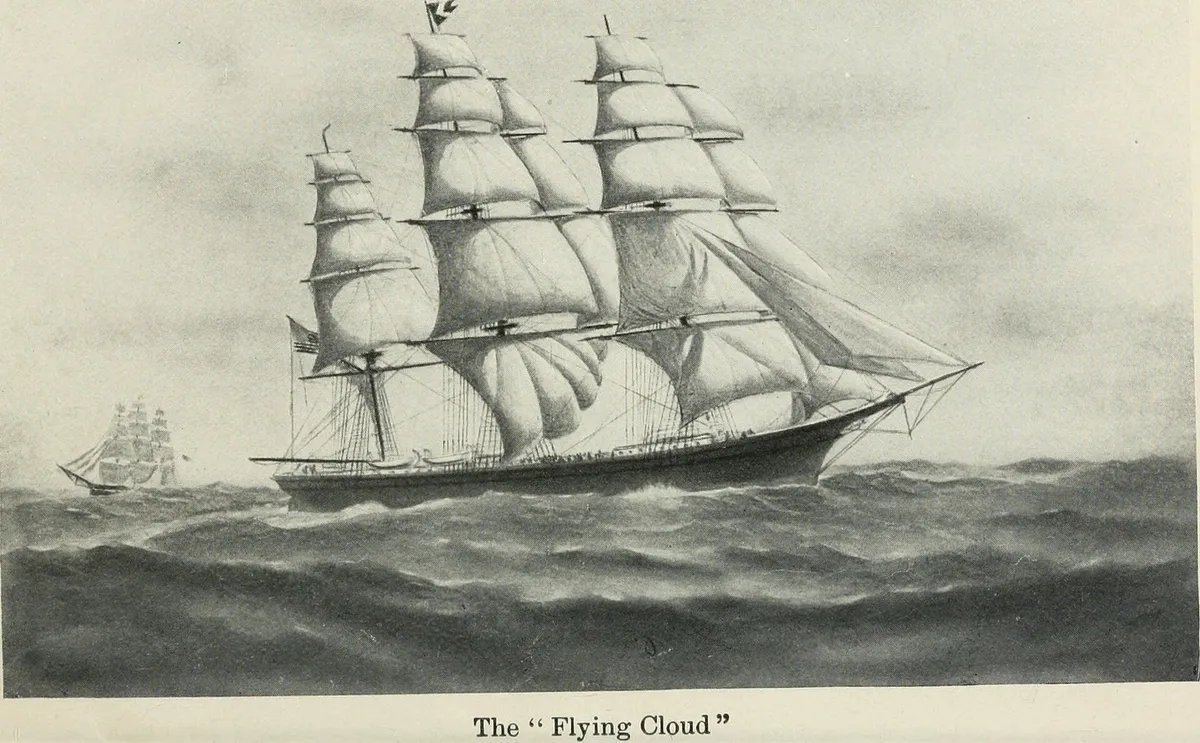
Flying Cloud was the fastest sailing vessel of her era, and her speed record from New York to San Francisco stood for over 100 years. She made the passage around Cape Horn in 89 days and 8 hours in 1854, a mark no commercial sailing vessel would beat until 1989. To put that in perspective: a record set before the Civil War survived the invention of the telephone, the automobile, both World Wars, and the moon landing. She was built by Donald McKay in East Boston, the best clipper ship designer who ever lived, at the peak of the California Gold Rush. Speed was money. Every day shaved off the passage to San Francisco meant earlier access to cargo rates that could pay for the ship in a single voyage. Owners drove these ships hard, and captains who delivered fast passages became celebrities. Josiah Perkins Creesy commanded Flying Cloud, but the secret weapon was his wife. Eleanor Creesy was the ship's navigator. She plotted the courses, read the currents, and made the decisions about when to press south into the roaring forties and when to hold off. Her work with Matthew Fontaine Maury's wind and current charts was masterful. She found favorable currents and winds that other navigators missed. On the record-setting 1854 voyage, she navigated through a cracked mainmast and a near-mutiny. She never held an official rank, was never paid, and appears in most histories as a footnote to her husband. She was one of the best navigators in the world. The clipper ship era lasted barely 15 years. Steam was already winning when Flying Cloud launched. These ships were profitable only because the Gold Rush created insane demand for fast passage to California, and the tea trade paid premiums for early-season delivery. Once the transcontinental railroad was completed in 1869 and the Suez Canal opened the same year, clippers were obsolete overnight. Beautiful, fast, and suddenly pointless. Flying Cloud herself was worked to death. After her glory years on the California run, she was sold to British owners who used her in the timber trade. She was condemned and burned for her copper fastenings at St. John, New Brunswick in 1874. She was 23 years old. Clipper ships were built for speed, not longevity, and hard driving wore them out fast. The hull that could do 18 knots was also a hull that was being slowly torn apart by the forces that made it fast.
Flying Dutchman
The Flying Dutchman is the oldest ghost ship legend that still has teeth. It predates every haunted house, every campfire story, every horror franchise. Sailors were telling this story in the 1700s, and it spooked people who had genuinely hard lives on genuinely dangerous oceans. The core legend is simple. A Dutch captain, usually named Hendrick van der Decken, tried to round the Cape of Good Hope in a storm. He swore an oath that he would round the Cape if it took him until Judgment Day. God, or the Devil, or the sea itself took him at his word. The ship sails forever, never making port, its crew aging without dying. The legend persists because it speaks to something real about the ocean. The sea doesn't care about your schedule, your cargo, or your oath. It will take your ship and your life with equal indifference. The Flying Dutchman is what happens when human stubbornness meets a force that has no concept of surrender. Wagner wrote an opera about it in 1843. Coleridge riffed on it in The Rime of the Ancient Mariner. Disney put it in Pirates of the Caribbean. Spongebob Squarepants lives near one. The legend adapts to every era because the fear it represents never goes away. The ocean is still out there, and it's still bigger than you are.