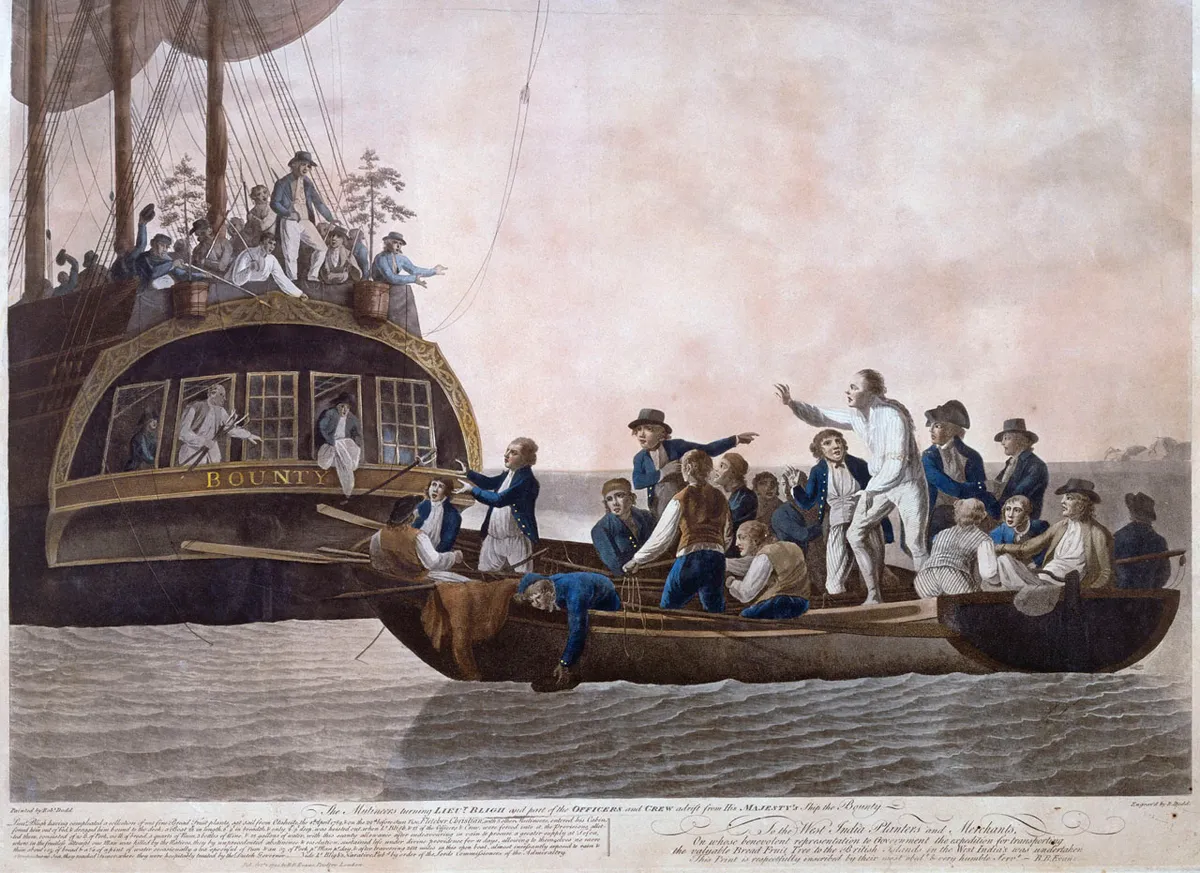
HMS Bounty
Why it matters
The Bounty's story isn't really about a ship. It's about what happens when you put 46 men on a 91-foot vessel, send them to paradise, and then ask them to leave. The mission was simple enough: sail to Tahiti, collect breadfruit plants, deliver them to the Caribbean as cheap food for enslaved workers. The plants mattered more than the crew. Captain Bligh had the great cabin converted into a greenhouse, and the men slept where they could.
The mutiny on April 28, 1789 was fast and ugly. Fletcher Christian and roughly half the crew seized the ship at dawn. Bligh and 18 loyal men were put into a 23-foot open launch with minimal provisions. What happened next is one of the most extraordinary feats of seamanship in recorded history. Bligh navigated that overloaded boat 3,618 nautical miles across open ocean to Timor, using a pocket watch and memory for charts. He lost only one man, killed by hostile islanders at Tofua. The voyage took 47 days.
The mutineers didn't fare as well. Christian took the Bounty to Pitcairn Island with eight other mutineers, six Polynesian men, and twelve Polynesian women. They burned the ship in Bounty Bay to avoid detection. Within four years, most of the men were dead. Murder, alcohol distilled from a local root, jealousy over the women. By 1800, only one mutineer was still alive: John Adams, surrounded by the women and children of dead men.
The Bounty has been romanticized into a story about tyranny versus freedom. The reality is messier. Bligh was demanding but not unusually cruel by Royal Navy standards. Christian may have been suffering a breakdown. The Tahitian stopover lasted five months, and many crew members formed relationships with local women. Leaving paradise for a return voyage under strict naval discipline was more than some of them could bear.
The ship itself was unremarkable. A small, converted merchant vessel that served the Navy for barely three years before being torched in a South Pacific bay. But the story it generated has been retold in novels, films, and naval histories for over two centuries. Every version says more about the era that produced it than about what actually happened on that ship.
What it was like
Life aboard the Bounty was cramped even by 18th-century standards. The ship was originally a coal hauler, not designed for long voyages with a full crew. When Bligh converted the great cabin into a breadfruit nursery, he displaced himself and his officers into even tighter quarters. The men slept in hammocks slung so close together that turning over meant touching the man next to you. The smell was what you'd expect: bilge water, unwashed bodies, tar, salt pork going off in the tropics.
The five months in Tahiti broke something in the crew. Warm water, fresh food, women, no watches to stand. Then Bligh ordered them back to sea, back to salt beef and hard tack and the endless routine of a working vessel. The contrast was brutal. Christian reportedly told Bligh on the morning of the mutiny that he'd been in hell for weeks.
For the 18 men set adrift with Bligh, the launch was a floating coffin that somehow didn't kill them. Twenty-three feet long, loaded past the gunwales, bailing constantly. They survived on occasional bird catches, rainwater, and a quarter-pint of water per man per day. Sunburn, saltwater boils, starvation. Several men couldn't walk when they finally reached Timor.
The crew
Ship's Master (Bligh)
William Bligh held the rank of Lieutenant but served as commanding officer. A protégé of Captain Cook and a gifted navigator, he ran the ship with obsessive attention to provisioning and hygiene. His crew suffered fewer losses to scurvy than most vessels of the era. His weakness was his mouth. He publicly humiliated officers and crew alike, and in the confined space of a 91-foot ship, there was nowhere to escape the abuse.
Master's Mate (Christian)
Fletcher Christian was responsible for navigation and watch supervision. He'd sailed with Bligh before and requested the posting. By the time of the mutiny, he was sleep-deprived and possibly suicidal. He told several people he'd originally planned to desert on a makeshift raft before deciding to take the ship instead. He was 24 years old.
Botanist (Nelson)
David Nelson was the civilian botanist responsible for the breadfruit collection. He'd sailed on Cook's third voyage and knew his plants. He tended the 1,015 breadfruit specimens in the converted great cabin, watering them with fresh water while the crew went thirsty. He was set adrift with Bligh and survived the open-boat voyage, only to die of fever in Timor three weeks after landing.
Patina notes
The Bounty burned at Pitcairn Island in January 1790. The mutineers stripped what they could and set her alight in what is now called Bounty Bay. The wreck settled in shallow water and has been deteriorating for over two centuries.
Copper sheathing, iron fittings, and ballast stones are scattered across the bay floor. The warm Pacific water and coral growth have consumed most of the wood.
What remains is essentially an archaeological scatter pattern. A rudder and anchor were recovered in the 20th century. The site is one of the most remote shipwrecks on earth, accessible only by longboat from Pitcairn, which itself is one of the most isolated inhabited islands in the world.
Preservation reality
There is no intact Bounty to visit. The original burned in 1790 and what's left is underwater at Pitcairn Island. Artifacts including the anchor, rudder, and copper fittings are held at the Fiji Museum in Suva.
A full-size replica was built in Nova Scotia in 1960 for the Marlon Brando film and sailed for decades as a museum and sail-training vessel. That replica sank in Hurricane Sandy in October 2012 off Cape Hatteras, killing two crew members.
The captain's decision to sail into the storm rather than seek port was questioned in the Coast Guard investigation. So the Bounty managed to generate tragedy twice, 222 years apart.
Where to see one
- • Fiji Museum, Suva (original artifacts)
- • Pitcairn Island (underwater wreck site)
Preservation organizations
- • Pitcairn Islands Study Center
- • Fiji Museum
Sources
Related vessels
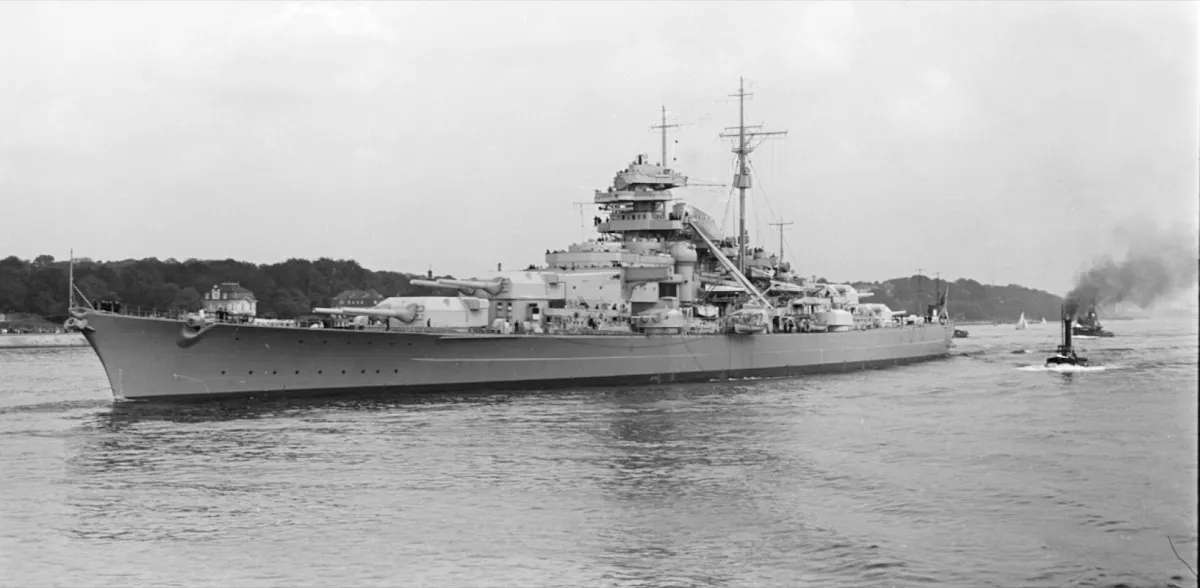
Bismarck
Bismarck's operational career lasted eight days. In that time, she became the most famous warship of the twentieth century. On May 24, 1941, she engaged HMS Hood and HMS Prince of Wales in the Denmark Strait. A shell from Bismarck penetrated Hood's magazine. The explosion broke Hood in half. She sank in three minutes. Of 1,418 crew, three survived. Hood was the pride of the Royal Navy. Churchill's order was immediate and absolute: sink the Bismarck. The Royal Navy sent everything. Battleships, carriers, cruisers, destroyers. Swordfish torpedo bombers — fabric-covered biplanes that looked like they belonged in the previous war — scored the hit that jammed Bismarck's rudder. She could only steam in circles. The next morning, King George V and Rodney pounded her for ninety minutes. Bismarck's crew scuttled her. Of 2,065 men, 114 survived.
Black Pearl
Before 2003, the pirate movie was a dead genre. After Pirates of the Caribbean, every kid in America wanted a ship with black sails. The Black Pearl did for pirate vessels what the Millennium Falcon did for spaceships. It made the vehicle a character. The ship represents freedom in its purest cinematic form. Jack Sparrow doesn't want gold or power. He wants his ship back. That's it. The entire first film is a man trying to reclaim the one thing that makes him who he is. The Black Pearl isn't transportation. It's identity. Johnny Depp's performance gets the credit, and it should. But the ship sells the fantasy. The black sails against a Caribbean sunset. The ragged rigging. The impossible speed. You believe this ship is alive because the movie treats it like one. The prop was built on a steel barge called the Sunset, dressed with a full wooden superstructure. Additional ships were constructed for later films, and digital effects expanded the Pearl's capabilities well beyond anything that floats.
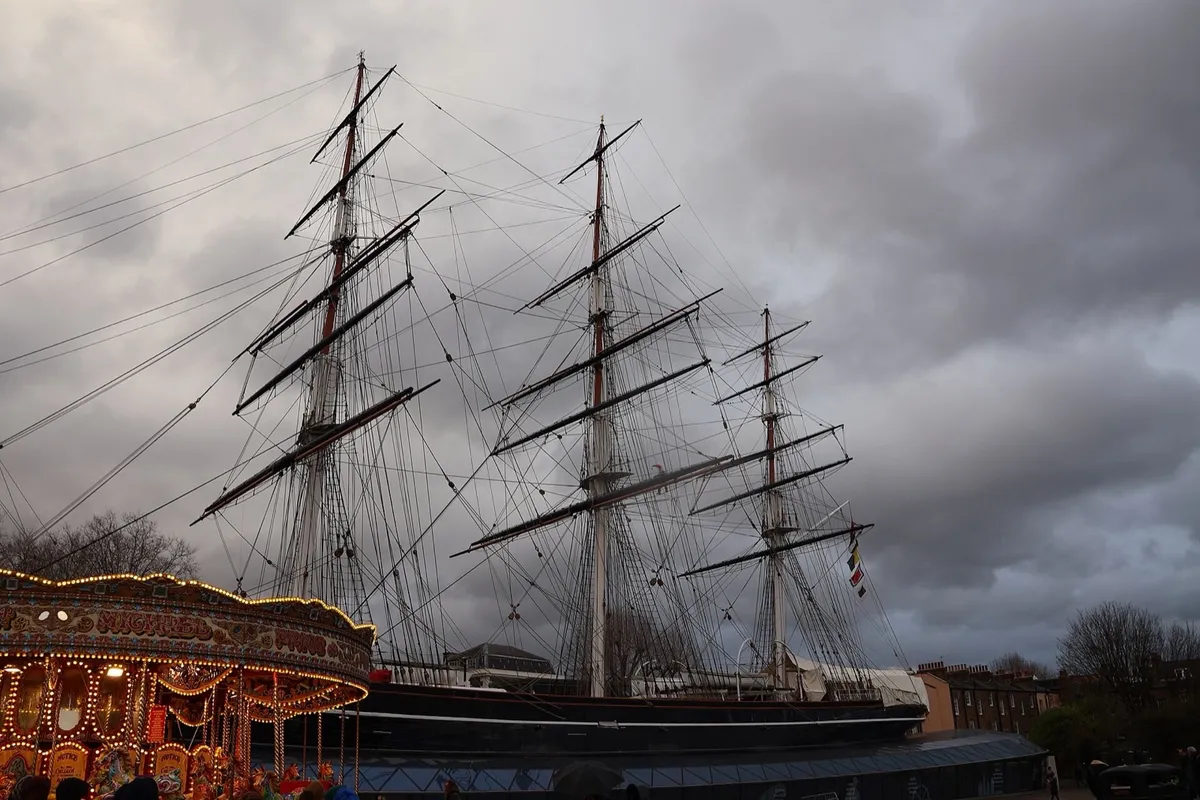
Cutty Sark
The Cutty Sark was born obsolete. She launched in 1869, the same year the Suez Canal opened and killed the tea clipper trade in a single stroke. Steam ships could use the canal. Sailing ships couldn't. The entire economic logic that justified building a vessel optimized for speed from China to London evaporated before she'd completed her first season. That's either terrible timing or a fitting monument to an era that was already dead. She raced in the tea trade anyway for a few seasons, most famously against the clipper Thermopylae in 1872. Cutty Sark was winning when she lost her rudder in a gale and had to jury-rig a replacement from spare spars. She still finished the voyage, arriving in London only a week behind Thermopylae. That tells you everything about the ship and the men who sailed her. Her second life was in the Australian wool trade, and this is where she finally proved herself. Under Captain Richard Woodget (1885-1895), she became the fastest wool clipper afloat, consistently making the passage from Sydney to London in under 80 days. She'd load over 5,000 bales of wool, drive south into the roaring forties, and run her easting down at speeds that left every other sailing vessel behind. Woodget was the captain she deserved. The name comes from Robert Burns's 1791 poem "Tam o' Shanter." Tam, drunk and riding home, watches witches dance and shouts in admiration at a young witch wearing a cutty sark, a short nightgown. She chases him. He barely escapes. The ship's figurehead is the witch Nannie, reaching forward with arm outstretched. It's a perfect name for a ship that was always chasing something just out of reach. After the wool trade declined, she was sold to a Portuguese company, renamed Ferreira, and spent decades hauling cargo in the South Atlantic. A retired sea captain named Wilfred Dowman found her in a Portuguese port in 1922, recognized what she was, bought her, and brought her home to England. Without Dowman, she would have been broken up. She is the only clipper ship that survives.