Various English Yards
The anonymous merchant shipyards of England's south and east coasts built Mayflower and thousands of other merchant vessels during the 16th and 17th centuries. No record survives of where Mayflower was built, but she was likely constructed in the Harwich area, where her master Christopher Jones had connections. English merchant shipyards of this era produced vessels for the wine trade, the coastal cargo trade, and eventually the transatlantic colonization runs. These yards were small operations employing a handful of shipwrights working with hand tools and local timber. Most vessels were built by eye, from tradition, and from the accumulated knowledge of men who had been shaping oak since childhood. No plans survive for most of these ships. HMS Bounty, built in Hull in 1784 as a merchant collier named Bethia before being purchased by the Royal Navy, came from the same tradition of sturdy, unremarkable construction. The English merchant yards built ships that were not fast, not beautiful, and not meant to last. They were cargo haulers: sturdy, slow, and expendable. That some of them carried passengers who founded nations or sparked mutinies that captured the public imagination for centuries was entirely incidental to the builders' intentions.
Heritage
The anonymous English merchant yards of the 16th and 17th centuries built the ships that created the British Empire. Not warships, just cargo haulers repurposed for colonization, exploration, and naval service. The gap between these ships' humble origins and their historical significance is enormous. Mayflower was a used wine trader. Bounty was a converted coal hauler. Neither was designed for the voyage that made it famous. The yards that built them were producing commodity vessels for a maritime economy that consumed ships the way a modern economy consumes trucks. That these particular vessels survived in memory while thousands of their sisters vanished without trace is a reminder that history selects for narrative, not for craft.
Vessels (4)
HMS Bounty
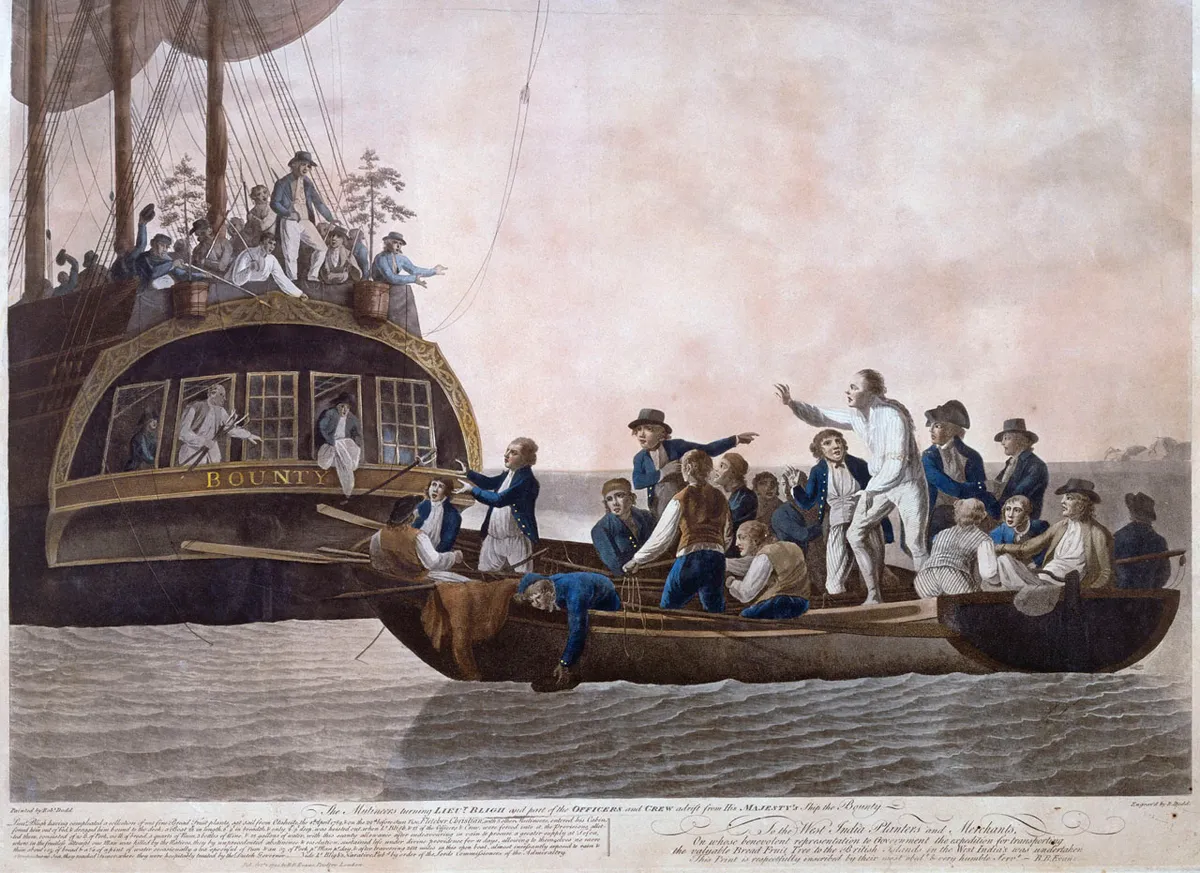
The Bounty's story isn't really about a ship. It's about what happens when you put 46 men on a 91-foot vessel, send them to paradise, and then ask them to leave. The mission was simple enough: sail to Tahiti, collect breadfruit plants, deliver them to the Caribbean as cheap food for enslaved workers. The plants mattered more than the crew. Captain Bligh had the great cabin converted into a greenhouse, and the men slept where they could. The mutiny on April 28, 1789 was fast and ugly. Fletcher Christian and roughly half the crew seized the ship at dawn. Bligh and 18 loyal men were put into a 23-foot open launch with minimal provisions. What happened next is one of the most extraordinary feats of seamanship in recorded history. Bligh navigated that overloaded boat 3,618 nautical miles across open ocean to Timor, using a pocket watch and memory for charts. He lost only one man, killed by hostile islanders at Tofua. The voyage took 47 days. The mutineers didn't fare as well. Christian took the Bounty to Pitcairn Island with eight other mutineers, six Polynesian men, and twelve Polynesian women. They burned the ship in Bounty Bay to avoid detection. Within four years, most of the men were dead. Murder, alcohol distilled from a local root, jealousy over the women. By 1800, only one mutineer was still alive: John Adams, surrounded by the women and children of dead men. The Bounty has been romanticized into a story about tyranny versus freedom. The reality is messier. Bligh was demanding but not unusually cruel by Royal Navy standards. Christian may have been suffering a breakdown. The Tahitian stopover lasted five months, and many crew members formed relationships with local women. Leaving paradise for a return voyage under strict naval discipline was more than some of them could bear. The ship itself was unremarkable. A small, converted merchant vessel that served the Navy for barely three years before being torched in a South Pacific bay. But the story it generated has been retold in novels, films, and naval histories for over two centuries. Every version says more about the era that produced it than about what actually happened on that ship.
Mayflower
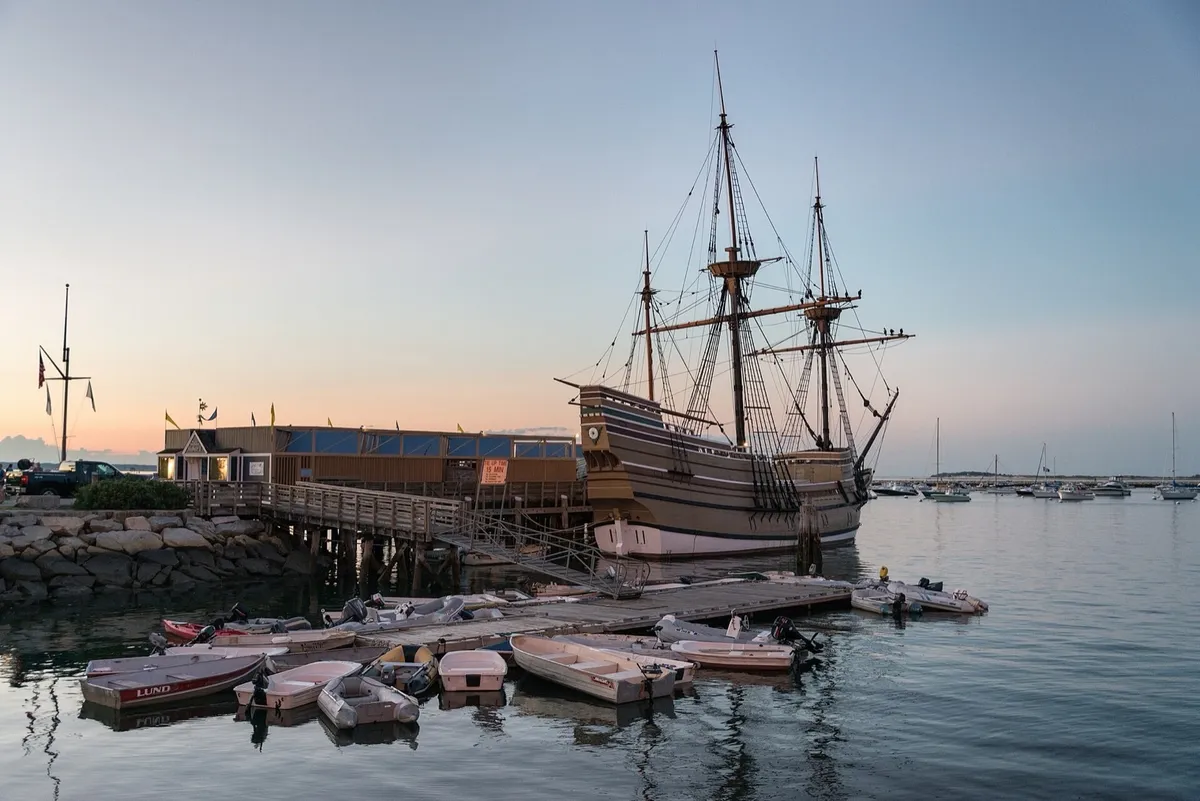
Mayflower carried 102 passengers and about 30 crew from Plymouth, England to Cape Cod in the autumn of 1620. The crossing took 66 days. They were aiming for Virginia. They hit Massachusetts instead. That navigational miss changed the political trajectory of North America. The ship was a cargo hauler, not a passenger vessel. She'd spent years carrying wine between England and France. For the Atlantic crossing, the 'tween decks cargo hold was converted into living space by building crude wooden partitions. The ceiling height was about five feet. Into this space they packed 102 people, their belongings, livestock, tools, food stores, and their ambitions for a new world. Two people died during the crossing. One baby was born. The passengers arrived exhausted, malnourished, and sick. They anchored off Provincetown, explored for a month, then settled at Plymouth. That first winter killed half of them. The ship sat in Plymouth harbor through the winter because the crew was too sick to sail home. Mayflower matters not because the voyage was heroic. It wasn't. It was a desperate, poorly planned, badly timed expedition by people who had burned every bridge behind them. They left too late in the season, on a ship that leaked, with inadequate supplies, and landed in the wrong place. What makes it significant is that the survivors stayed. The Mayflower Compact, signed aboard before anyone went ashore, was a self-governing agreement that became a foundational document for American democracy. It was born of practical necessity, not idealism. They needed rules because they'd landed outside the jurisdiction of their charter.
Royal Fortune
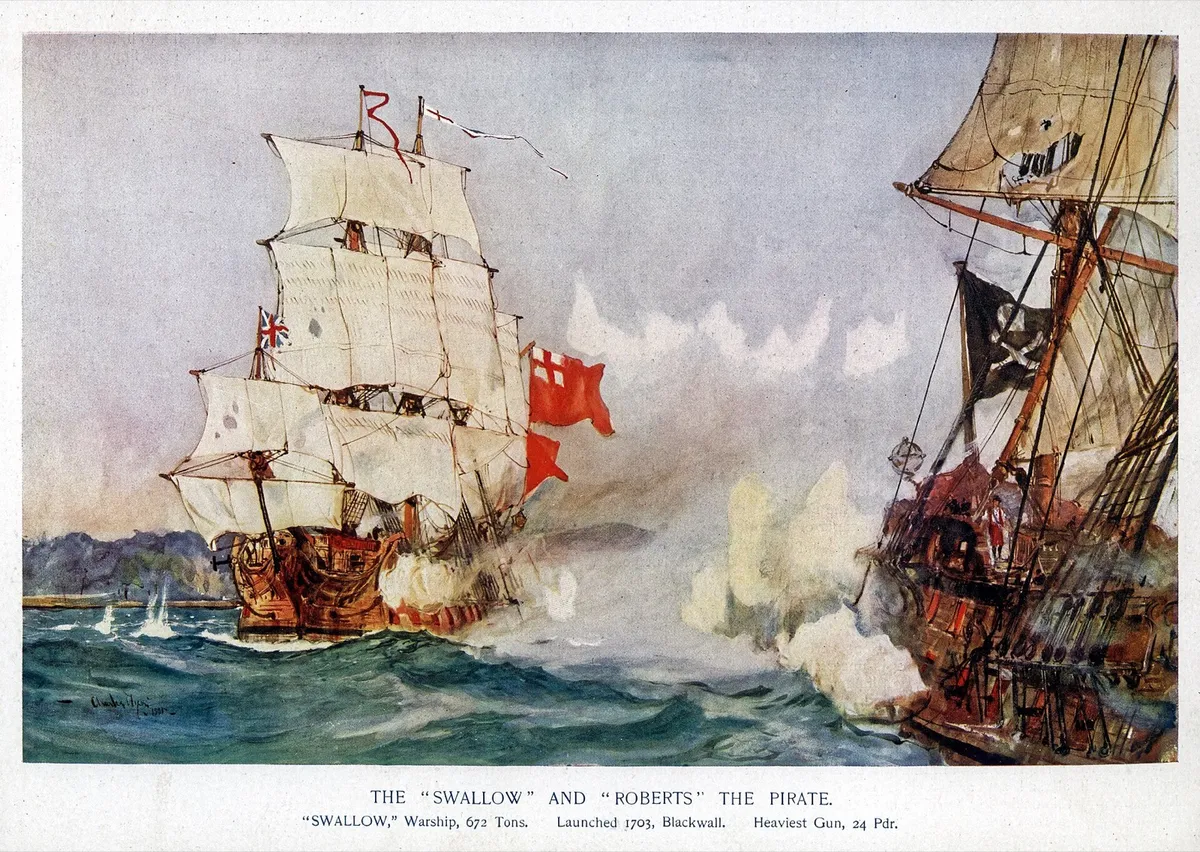
Bartholomew Roberts, "Black Bart," captured over 400 ships in three years. That number is not a typo. Four hundred. No pirate before or since came close. He operated from Newfoundland to Brazil to West Africa, and every navy in the Atlantic wanted him dead. The final Royal Fortune was his last and largest flagship, a 52-gun warship that could go toe-to-toe with anything the Royal Navy sent after him. Roberts is the pirate who actually wrote the code. Not the Hollywood version. Real articles of agreement that his crew signed. Lights out at eight. No gambling for money aboard. Every man gets a vote. Every man gets a share. If you lose your right arm in battle, you get 600 pieces of eight in compensation. If you desert during a fight, the punishment is death or marooning. It was a constitution for thieves, and it worked better than most legitimate governments of the era. The man himself was a contradiction. He dressed extravagantly, wearing crimson damask waistcoats and diamond crosses. He never drank anything stronger than tea. He was Welsh, deeply religious by pirate standards, and reportedly furious about being forced into piracy when his merchant ship was captured. He turned out to be spectacularly good at it. Roberts went through multiple ships named Royal Fortune, trading up as he captured better vessels. The final one was a French warship he took off the African coast. He refitted her, loaded her with guns, and sailed her for roughly two years. She was the most heavily armed pirate ship of the Golden Age. It ended on February 10, 1722, off Cape Lopez in present-day Gabon. HMS Swallow, a Royal Navy warship under Captain Chaloner Ogle, caught Roberts at anchor. Roberts dressed in his finest clothes and sailed out to fight. A blast of grapeshot hit him in the throat. He was dead before he hit the deck. His crew, following his standing orders, threw his body overboard in full dress before the Navy could take it as a trophy. The sea got him. Nobody else did.
Whydah Gally
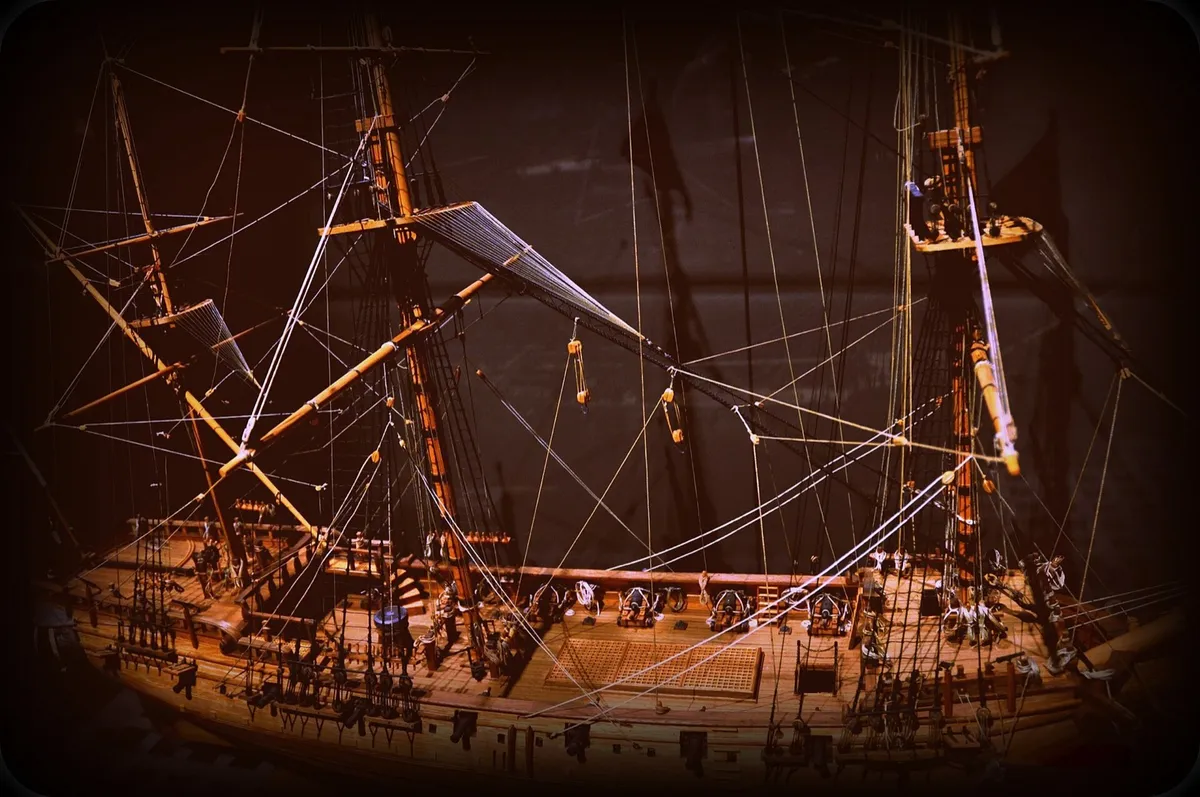
The Whydah (pronounced "WID-uh") is the only verified pirate shipwreck in the world. Every other supposed pirate wreck is a guess, a legend, or a tourism pitch. The Whydah has a ship's bell with the name on it. That's authentication you can't argue with. She was built in London around 1715 as a slave ship, purpose-built for speed. The triangle trade demanded fast hulls. You loaded trade goods in England, exchanged them for enslaved people in West Africa, crossed the Atlantic as quickly as possible because your cargo was dying every day, sold the survivors in the Caribbean, then loaded sugar and headed home. The Whydah made at least one full circuit before Captain Sam Bellamy took her. Bellamy captured the Whydah in February 1717 near the Bahamas. He was 28 years old, handsome, and reportedly refused to wear wigs, earning him the name "Black Sam." He'd been a pirate for about a year. When he took the Whydah, she was carrying the profits of her slave voyage: indigo, sugar, gold, silver, and ivory. Bellamy kept the cargo, transferred his crew aboard, and made her his flagship. For two months, Bellamy terrorized the Atlantic coast. He captured over 50 ships. By the time the Whydah went down, she was carrying an estimated 4.5 tons of gold and silver, the plunder of dozens of vessels. Bellamy was, by some calculations, the wealthiest pirate in recorded history. He just didn't get to spend any of it. On April 26, 1717, a nor'easter caught the Whydah off the coast of Cape Cod near Wellfleet, Massachusetts. The storm drove her onto a sandbar. The masts snapped. The hull broke apart. Bellamy and 143 of his 146 crew drowned. Two survivors washed ashore. The whole career, start to finish, lasted about fourteen months.