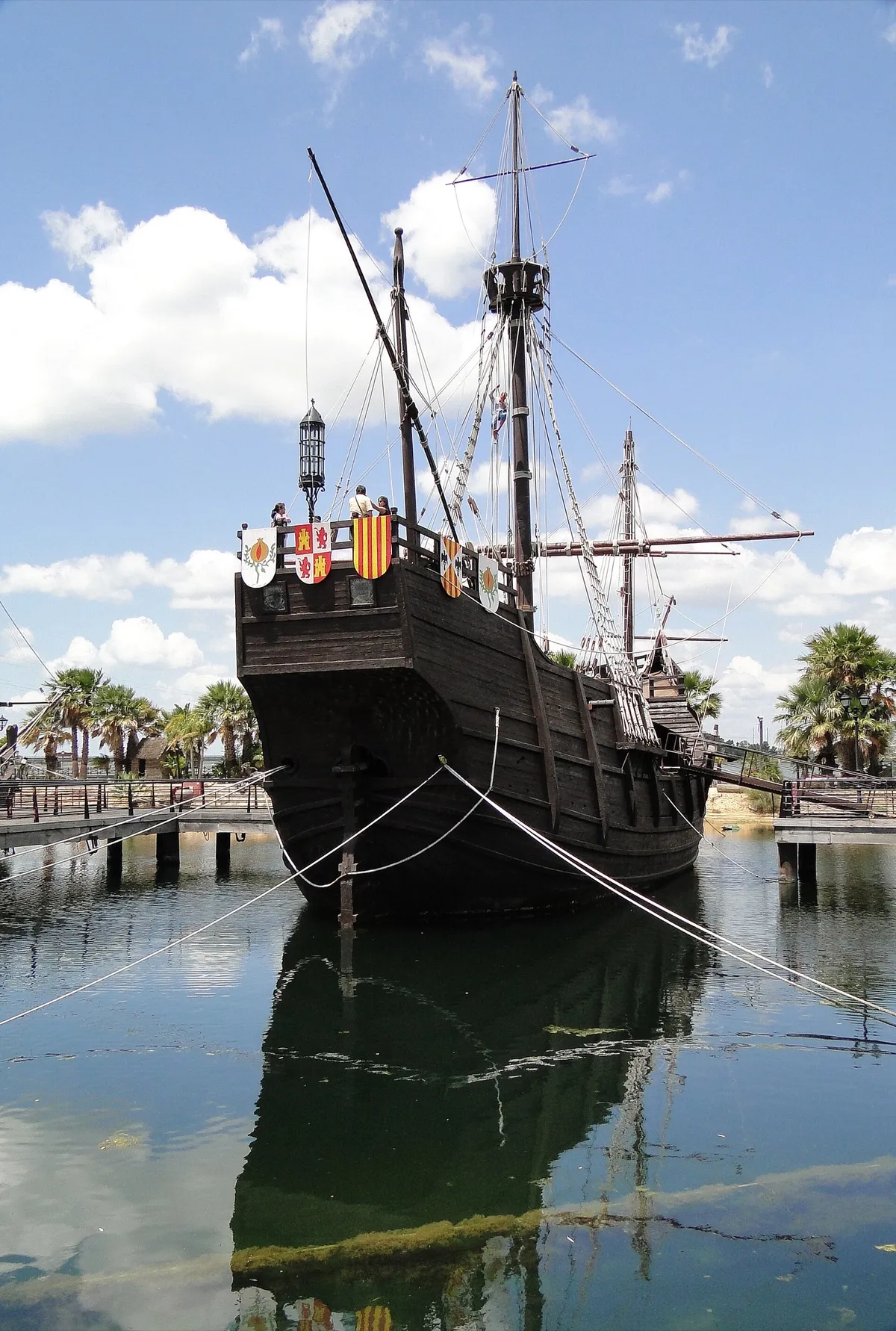
Santa María
Nao (carrack)
Why it matters
Santa María was the flagship of the most consequential naval expedition in history. Columbus sailed her across the Atlantic in 1492 and she never came back. She ran aground on a coral reef off the north coast of Hispaniola on Christmas Day while a cabin boy was at the tiller. Columbus was asleep. The captain was asleep. The watch officer had handed the helm to a kid, which Columbus had expressly forbidden.
The ship couldn't be freed. Columbus ordered her stripped. The crew salvaged timber, nails, fittings, and stores, and built a fortified settlement on shore called La Navidad. Thirty-nine men volunteered to stay. When Columbus returned on his second voyage in November 1493, the settlement was burned to the ground and every man was dead. The Taíno had killed them, reportedly in retaliation for the Spaniards' violence and abduction of women.
Columbus despised the Santa María. He considered her too slow, too heavy, and too deep-drafted for coastal exploration. She was a nao, a cargo vessel built to haul goods in bulk, not to thread through uncharted shoals. Columbus called her "la capitana" when being formal and complained about her in his log constantly. His real love was the Niña. The loss of Santa María on a reef validated every objection he'd ever raised about her.
The ship's historical importance is enormous and brutal. She carried the first sustained European contact with the Americas. Everything that followed, the colonization, the slave trade, the decimation of indigenous populations, the creation of the modern Atlantic world, traces a line back to this sluggish, unloved cargo ship and the 40 men who sailed her into the unknown.
What it was like
Forty men lived on a vessel roughly 62 feet long. The crew slept on deck or in whatever sheltered spot they could find. Only Columbus had a private cabin, a small space in the sterncastle. The crew ate one hot meal a day, cooked on a firebox on deck: usually a stew of salt pork, dried beans, and hardtack. Water went foul within weeks. Wine was the reliable hydration. The daily routine was four-hour watches, with time kept by a sand glass that a ship's boy turned every half hour and marked with a prayer.
The Atlantic crossing took five weeks, which was fast. But the crew had no idea where they were going or how far it was. By early October they were terrified. The wind blew steadily west, which was great for the outbound voyage and deeply frightening for the return. How would they sail back against the trade winds? Columbus lied to them about the distance traveled, keeping two logs: one accurate, one showing shorter distances to calm the crew. The famous near-mutiny wasn't dramatic. It was the slow erosion of trust between men who'd been at sea for a month with no land in sight.
The crew
Helmsman
The tiller on Santa María was below decks. The helmsman couldn't see where the ship was going. He steered by feel and by shouted orders from the officer on deck above. On Christmas Eve 1492, the helmsman position was handed to a grumete (ship's boy), which directly caused the grounding. The boy couldn't feel the change in current as the ship drifted onto the reef. By the time the keel struck coral, it was too late.
Ship's Boy (Grumete)
The grumetes were boys aged 12 to 17. They turned the sand glass, sang the time-keeping prayers, served food, cleaned the deck, and handled light rigging. They were the lowest rank aboard and took the worst abuse. They also did the jobs nobody else wanted, like crawling into the bilge to pump water. On Santa María, a grumete at the helm caused the loss of the ship.
Lombard Gunner
Santa María carried four small lombard cannons, more for intimidation than warfare. The gunners also served as general crew. Their weapons were primarily useful for impressing indigenous people with noise and smoke. The actual military value of four lombards against any organized resistance was negligible, which the garrison at La Navidad discovered the hard way.
Patina notes
Santa María is somewhere under the seabed off the north coast of Haiti. The coral reef that wrecked her has grown over the remains for 500 years. Multiple expeditions have claimed to find the wreck.
In 2014, Barry Clifford announced he'd located it. Subsequent analysis by UNESCO showed the site contained copper fasteners that didn't exist until the 17th or 18th century.
The real wreck, if anything survives, is buried under centuries of coral growth and sediment. The timber Columbus salvaged for La Navidad was likely burned when the settlement was destroyed.
Preservation reality
No original material has been confirmed. Multiple full-size replicas exist. The most visited is at the Muelle de las Carabelas (Wharf of the Caravels) in Palos de la Frontera, Spain, where the original expedition departed.
Columbus, Ohio has a replica that was built in Spain and sailed across the Atlantic in 1991 for the quincentenary. The replicas are useful for understanding scale but are educated guesses.
No construction plans for Santa María survive. Everything we know about her dimensions comes from working backward from Columbus's log entries and contemporary accounts of similar naos.
Where to see one
- • Muelle de las Carabelas, Palos de la Frontera, Spain (replicas of all three ships)
- • Santa María replica, Battelle Riverfront Park, Columbus, OH
Preservation organizations
- • Muelle de las Carabelas Museum
Sources
- Columbus's Log (translated by Robert Fuson) (2026-03-05)
- UNESCO Investigation of Clifford Wreck Claim (2026-03-05)
Related vessels
Black Pearl
Before 2003, the pirate movie was a dead genre. After Pirates of the Caribbean, every kid in America wanted a ship with black sails. The Black Pearl did for pirate vessels what the Millennium Falcon did for spaceships. It made the vehicle a character. The ship represents freedom in its purest cinematic form. Jack Sparrow doesn't want gold or power. He wants his ship back. That's it. The entire first film is a man trying to reclaim the one thing that makes him who he is. The Black Pearl isn't transportation. It's identity. Johnny Depp's performance gets the credit, and it should. But the ship sells the fantasy. The black sails against a Caribbean sunset. The ragged rigging. The impossible speed. You believe this ship is alive because the movie treats it like one. The prop was built on a steel barge called the Sunset, dressed with a full wooden superstructure. Additional ships were constructed for later films, and digital effects expanded the Pearl's capabilities well beyond anything that floats.
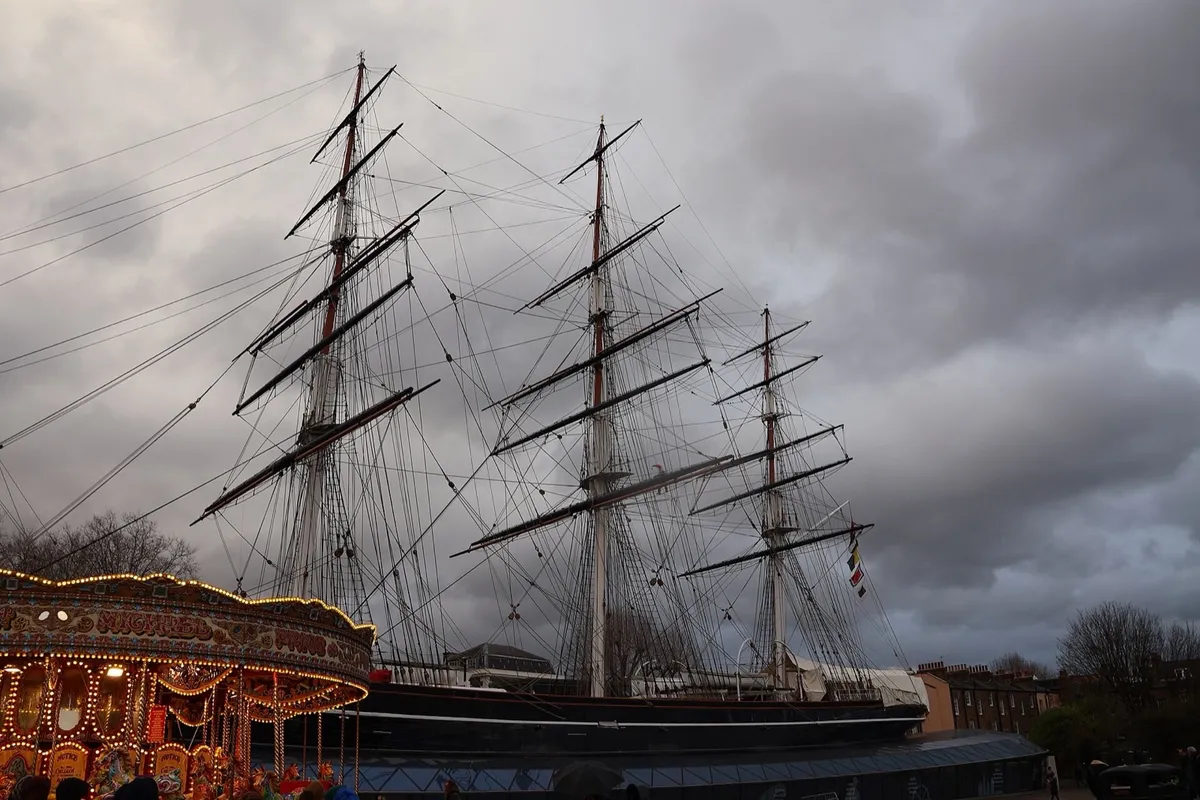
Cutty Sark
The Cutty Sark was born obsolete. She launched in 1869, the same year the Suez Canal opened and killed the tea clipper trade in a single stroke. Steam ships could use the canal. Sailing ships couldn't. The entire economic logic that justified building a vessel optimized for speed from China to London evaporated before she'd completed her first season. That's either terrible timing or a fitting monument to an era that was already dead. She raced in the tea trade anyway for a few seasons, most famously against the clipper Thermopylae in 1872. Cutty Sark was winning when she lost her rudder in a gale and had to jury-rig a replacement from spare spars. She still finished the voyage, arriving in London only a week behind Thermopylae. That tells you everything about the ship and the men who sailed her. Her second life was in the Australian wool trade, and this is where she finally proved herself. Under Captain Richard Woodget (1885-1895), she became the fastest wool clipper afloat, consistently making the passage from Sydney to London in under 80 days. She'd load over 5,000 bales of wool, drive south into the roaring forties, and run her easting down at speeds that left every other sailing vessel behind. Woodget was the captain she deserved. The name comes from Robert Burns's 1791 poem "Tam o' Shanter." Tam, drunk and riding home, watches witches dance and shouts in admiration at a young witch wearing a cutty sark, a short nightgown. She chases him. He barely escapes. The ship's figurehead is the witch Nannie, reaching forward with arm outstretched. It's a perfect name for a ship that was always chasing something just out of reach. After the wool trade declined, she was sold to a Portuguese company, renamed Ferreira, and spent decades hauling cargo in the South Atlantic. A retired sea captain named Wilfred Dowman found her in a Portuguese port in 1922, recognized what she was, bought her, and brought her home to England. Without Dowman, she would have been broken up. She is the only clipper ship that survives.
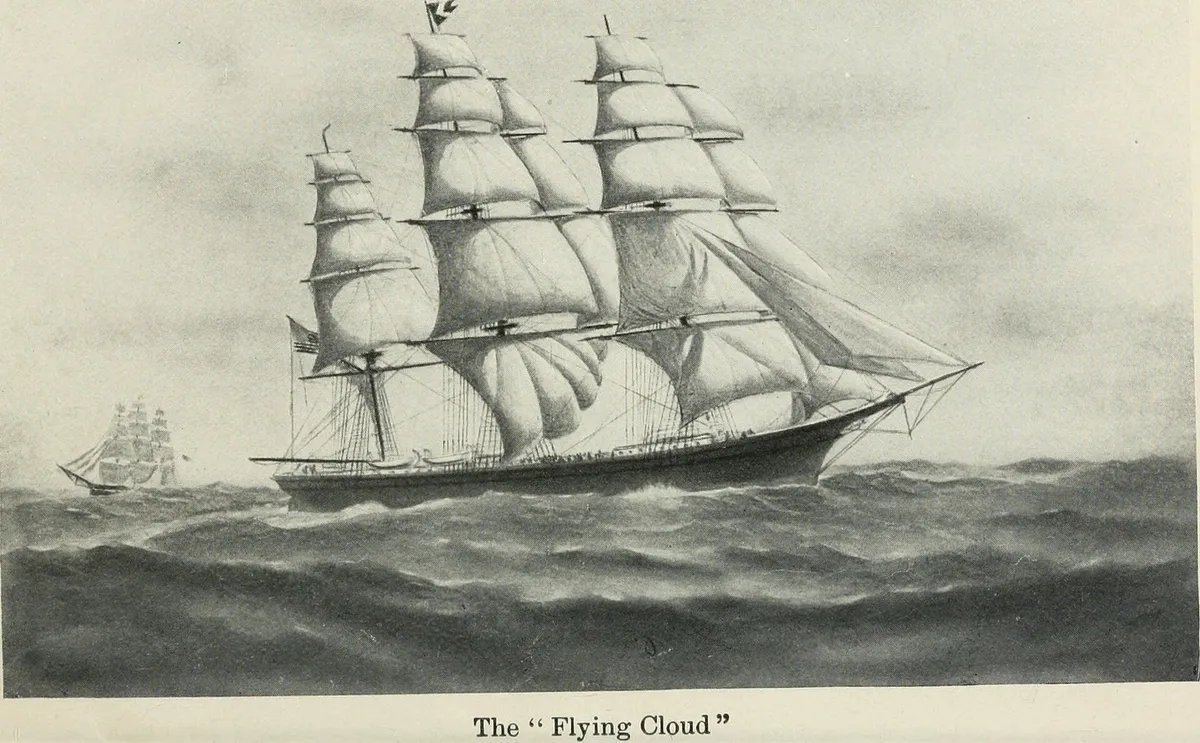
Flying Cloud
Flying Cloud was the fastest sailing vessel of her era, and her speed record from New York to San Francisco stood for over 100 years. She made the passage around Cape Horn in 89 days and 8 hours in 1854, a mark no commercial sailing vessel would beat until 1989. To put that in perspective: a record set before the Civil War survived the invention of the telephone, the automobile, both World Wars, and the moon landing. She was built by Donald McKay in East Boston, the best clipper ship designer who ever lived, at the peak of the California Gold Rush. Speed was money. Every day shaved off the passage to San Francisco meant earlier access to cargo rates that could pay for the ship in a single voyage. Owners drove these ships hard, and captains who delivered fast passages became celebrities. Josiah Perkins Creesy commanded Flying Cloud, but the secret weapon was his wife. Eleanor Creesy was the ship's navigator. She plotted the courses, read the currents, and made the decisions about when to press south into the roaring forties and when to hold off. Her work with Matthew Fontaine Maury's wind and current charts was masterful. She found favorable currents and winds that other navigators missed. On the record-setting 1854 voyage, she navigated through a cracked mainmast and a near-mutiny. She never held an official rank, was never paid, and appears in most histories as a footnote to her husband. She was one of the best navigators in the world. The clipper ship era lasted barely 15 years. Steam was already winning when Flying Cloud launched. These ships were profitable only because the Gold Rush created insane demand for fast passage to California, and the tea trade paid premiums for early-season delivery. Once the transcontinental railroad was completed in 1869 and the Suez Canal opened the same year, clippers were obsolete overnight. Beautiful, fast, and suddenly pointless. Flying Cloud herself was worked to death. After her glory years on the California run, she was sold to British owners who used her in the timber trade. She was condemned and burned for her copper fastenings at St. John, New Brunswick in 1874. She was 23 years old. Clipper ships were built for speed, not longevity, and hard driving wore them out fast. The hull that could do 18 knots was also a hull that was being slowly torn apart by the forces that made it fast.