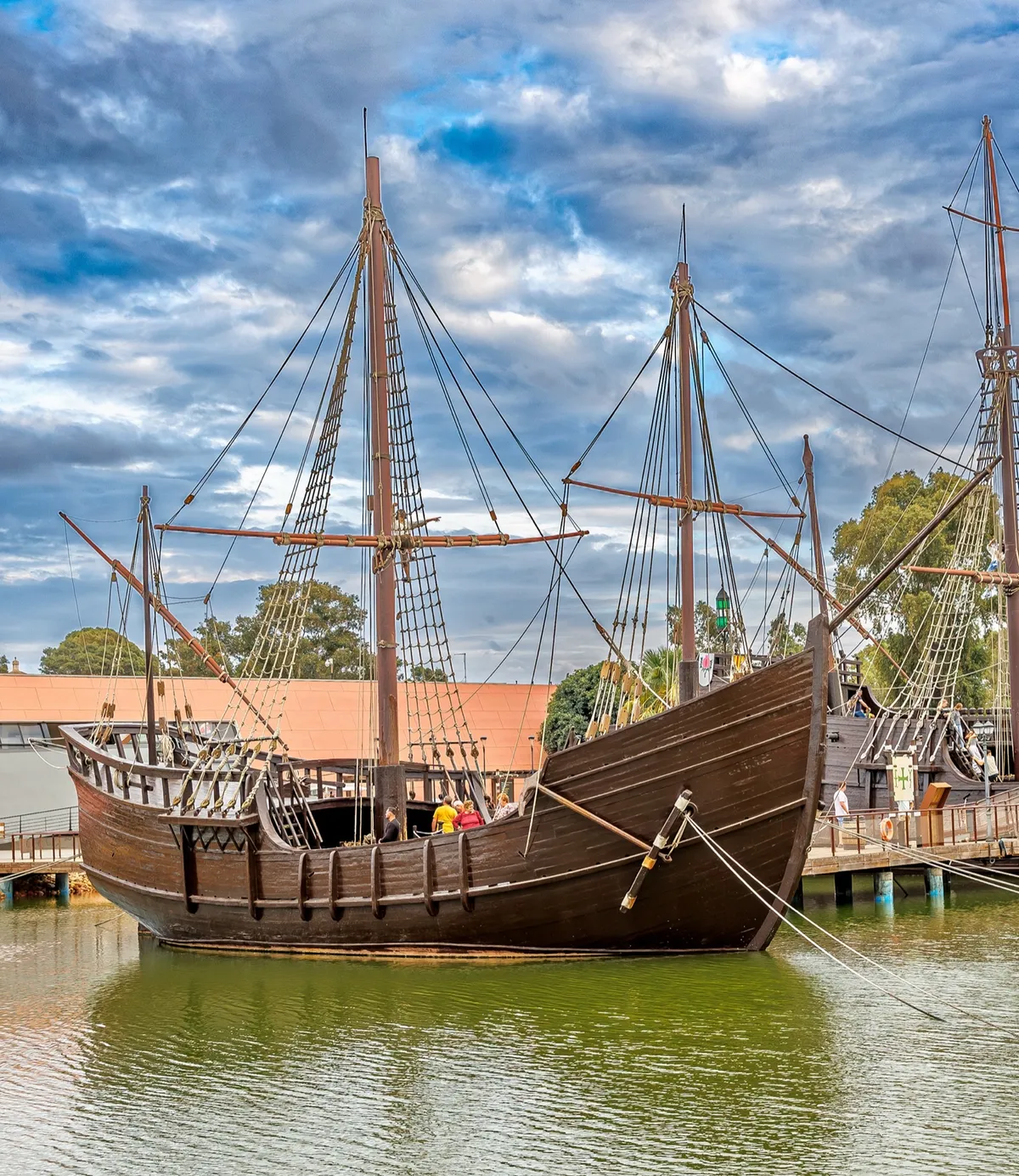
Pinta
Caravel (redonda rig)
Why it matters
Pinta was the first European ship to sight the Americas. At 2 a.m. on October 12, 1492, her lookout Rodrigo de Triana spotted a white cliff in the moonlight and fired a lombard to signal the fleet. Thirty-three days of open ocean sailing were over. Land.
Columbus later claimed he'd seen a light the evening before, which conveniently entitled him to the lifetime pension the Spanish crown had promised to the first man to sight land. Rodrigo de Triana never received a cent. He reportedly converted to Islam and moved to North Africa. The first man to see the New World died in obscurity, cheated by his own admiral.
Pinta's captain was Martín Alonso Pinzón, the most experienced sailor on the expedition and a man who did not enjoy taking orders from Columbus. Pinzón went rogue at least twice. In late November 1492, he sailed Pinta away from the fleet without permission, heading for a large island (probably Great Inagua) where he'd heard there was gold. He was gone for six weeks. Columbus was furious. Pinzón rejoined the fleet in January, offered a weak excuse, and the two men barely spoke for the remainder of the voyage.
On the return crossing, another storm separated the ships. Pinta reached Bayona, Spain before Niña reached Lisbon. Pinzón sent a message to Ferdinand and Isabella requesting an audience to report the discoveries himself. The monarchs refused and told him to wait for Columbus. Pinzón was already sick. He died within weeks of reaching Spain, probably from syphilis contracted in the Caribbean. The Pinzón family spent the next 20 years in court, suing the Columbus estate for credit and compensation.
What it was like
Pinta's crew of 26 had the same brutal conditions as Niña's men: open deck sleeping, minimal shelter, salt provisions, and the constant motion of a small caravel in ocean swells. But Pinta's crew had a different dynamic. Their captain was Martín Alonso Pinzón, a local hero in Palos who'd recruited most of them personally. Their loyalty was to Pinzón, not Columbus. This created a ship within a fleet that operated semi-independently.
When Pinzón broke away to search for gold, his crew went willingly. They were sailors from Palos who trusted their captain over a Genoese outsider. The six weeks they spent alone in uncharted Caribbean waters, without the other ships, without any support, must have been both terrifying and exhilarating. They were 26 men on a 56-foot boat exploring an unknown world with no backup plan.
The return voyage was worse. The February storms that hit the fleet in the mid-Atlantic were severe enough that both ships were nearly lost. Pinta's rudder had been repaired early in the voyage (it broke suspiciously soon after departure, and Columbus suspected sabotage by the ship's owner, who didn't want his vessel on the expedition). Whether the repair held through the return storms is one of the small miracles of the voyage.
The crew
Captain (Martín Alonso Pinzón)
Pinzón was arguably the reason the expedition happened at all. When Columbus couldn't recruit crews in Palos, Pinzón used his personal reputation and money to convince men to sign on. He was a wealthy shipowner, an experienced Atlantic sailor, and a proud man who resented serving under Columbus. His decision to break away and search for gold independently was either bold initiative or rank insubordination, depending on whose account you believe. He never got to tell his side. He was dead within a month of reaching Spain.
Lookout (Rodrigo de Triana)
Rodrigo de Triana was stationed in Pinta's crow's nest on the night of October 11-12, 1492. His job was to stare at the dark horizon and watch for anything. At 2 a.m., he saw a white sand cliff reflecting moonlight, about 6 miles ahead. He shouted and fired the signal gun. It was San Salvador (Guanahani in Taíno). Columbus later backdated his own sighting to the previous evening to claim the 10,000-maravedí annual pension. Rodrigo got nothing. His name barely survives in the historical record.
Ship's Carpenter
The carpenter on Pinta earned his keep before the expedition even left coastal waters. The rudder broke shortly after departure from Palos. The ship put into the Canary Islands for repair. The carpenter had to fabricate a new rudder pintle or reattach the old one with limited tools and materials. This repair had to hold for an Atlantic crossing and back. On a caravel, the rudder was the single most critical moving part. If it failed in mid-ocean, the ship was helpless.
Patina notes
Pinta's fate after the first voyage is completely unknown. She may have continued in service in the coastal trade. She may have been broken up. No wreck has ever been identified, and no records of her disposal survive.
Like most working ships of the era, she was valuable when she floated and worthless when she didn't. A caravel hull in the Caribbean climate, attacked by teredo worms and baked by tropical sun, deteriorated fast. The nails and iron fittings were the last useful things on a dying ship.
Preservation reality
No original material survives or has been identified. The replica at Muelle de las Carabelas in Palos de la Frontera is the best representation available.
Built for the 1992 quincentenary, she sits alongside replicas of Niña and Santa María. The Columbus Foundation also operates a Pinta replica that tours U.S.
ports. Like all replicas of these ships, the design is partly speculative. No construction plans survive for any of Columbus's vessels. Naval architects have worked backward from contemporary illustrations, cargo capacity records, and knowledge of 15th-century Iberian shipbuilding traditions.
Where to see one
- • Muelle de las Carabelas, Palos de la Frontera, Spain
- • Columbus Foundation Pinta replica (touring, check schedule)
Preservation organizations
- • Muelle de las Carabelas Museum
- • Columbus Foundation
Sources
- Samuel Eliot Morison, Admiral of the Ocean Sea (2026-03-05)
- The Pinzón Brothers and the Voyage of Discovery (2026-03-05)
Related vessels
Black Pearl
Before 2003, the pirate movie was a dead genre. After Pirates of the Caribbean, every kid in America wanted a ship with black sails. The Black Pearl did for pirate vessels what the Millennium Falcon did for spaceships. It made the vehicle a character. The ship represents freedom in its purest cinematic form. Jack Sparrow doesn't want gold or power. He wants his ship back. That's it. The entire first film is a man trying to reclaim the one thing that makes him who he is. The Black Pearl isn't transportation. It's identity. Johnny Depp's performance gets the credit, and it should. But the ship sells the fantasy. The black sails against a Caribbean sunset. The ragged rigging. The impossible speed. You believe this ship is alive because the movie treats it like one. The prop was built on a steel barge called the Sunset, dressed with a full wooden superstructure. Additional ships were constructed for later films, and digital effects expanded the Pearl's capabilities well beyond anything that floats.
Cutty Sark
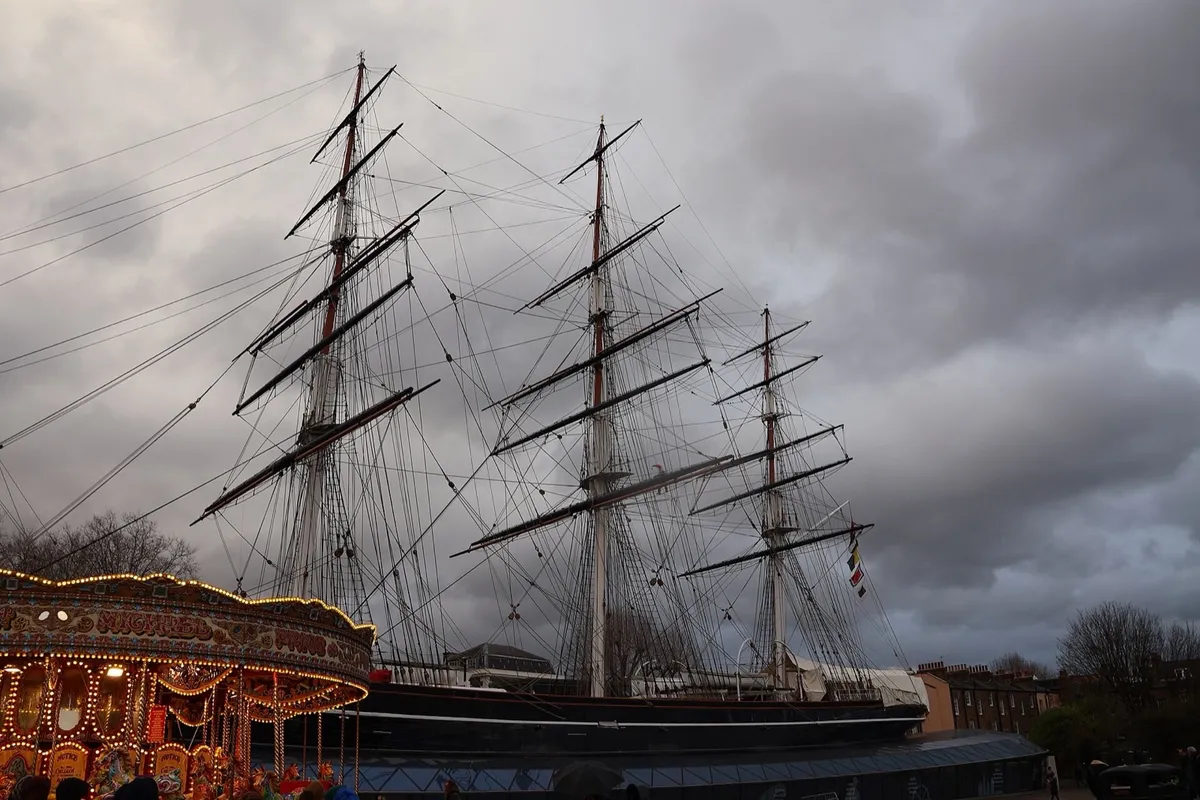
The Cutty Sark was born obsolete. She launched in 1869, the same year the Suez Canal opened and killed the tea clipper trade in a single stroke. Steam ships could use the canal. Sailing ships couldn't. The entire economic logic that justified building a vessel optimized for speed from China to London evaporated before she'd completed her first season. That's either terrible timing or a fitting monument to an era that was already dead. She raced in the tea trade anyway for a few seasons, most famously against the clipper Thermopylae in 1872. Cutty Sark was winning when she lost her rudder in a gale and had to jury-rig a replacement from spare spars. She still finished the voyage, arriving in London only a week behind Thermopylae. That tells you everything about the ship and the men who sailed her. Her second life was in the Australian wool trade, and this is where she finally proved herself. Under Captain Richard Woodget (1885-1895), she became the fastest wool clipper afloat, consistently making the passage from Sydney to London in under 80 days. She'd load over 5,000 bales of wool, drive south into the roaring forties, and run her easting down at speeds that left every other sailing vessel behind. Woodget was the captain she deserved. The name comes from Robert Burns's 1791 poem "Tam o' Shanter." Tam, drunk and riding home, watches witches dance and shouts in admiration at a young witch wearing a cutty sark, a short nightgown. She chases him. He barely escapes. The ship's figurehead is the witch Nannie, reaching forward with arm outstretched. It's a perfect name for a ship that was always chasing something just out of reach. After the wool trade declined, she was sold to a Portuguese company, renamed Ferreira, and spent decades hauling cargo in the South Atlantic. A retired sea captain named Wilfred Dowman found her in a Portuguese port in 1922, recognized what she was, bought her, and brought her home to England. Without Dowman, she would have been broken up. She is the only clipper ship that survives.
Flying Cloud
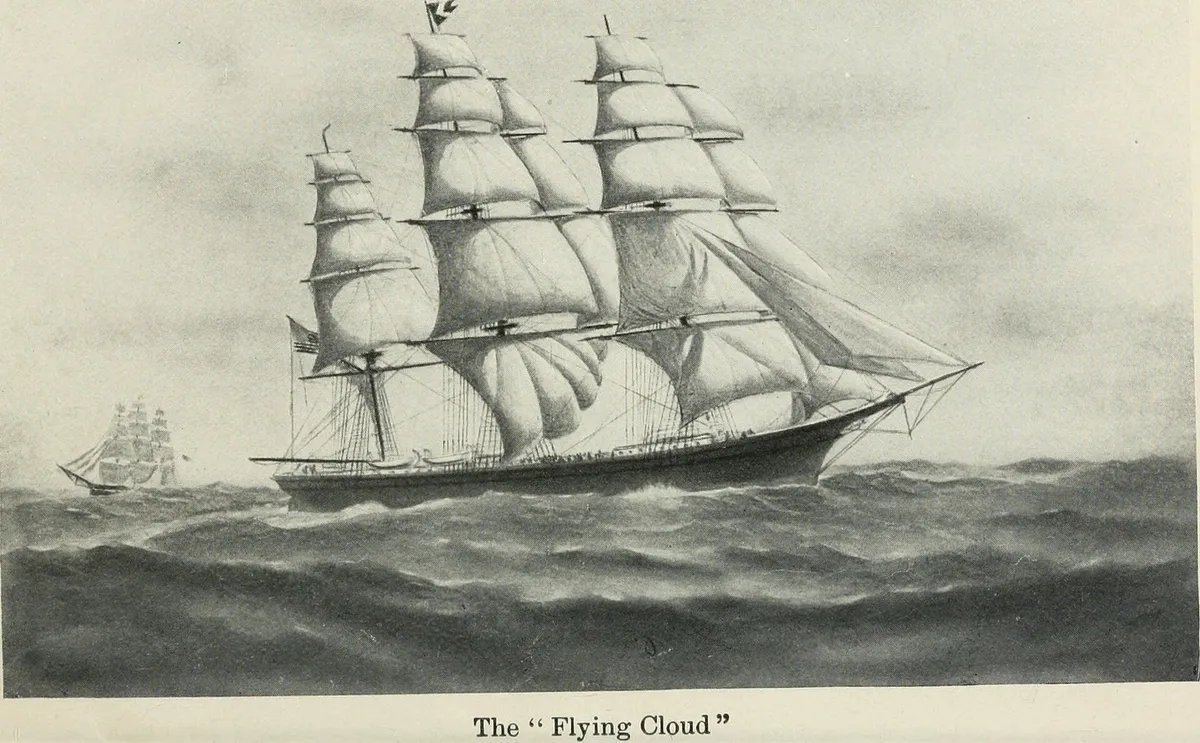
Flying Cloud was the fastest sailing vessel of her era, and her speed record from New York to San Francisco stood for over 100 years. She made the passage around Cape Horn in 89 days and 8 hours in 1854, a mark no commercial sailing vessel would beat until 1989. To put that in perspective: a record set before the Civil War survived the invention of the telephone, the automobile, both World Wars, and the moon landing. She was built by Donald McKay in East Boston, the best clipper ship designer who ever lived, at the peak of the California Gold Rush. Speed was money. Every day shaved off the passage to San Francisco meant earlier access to cargo rates that could pay for the ship in a single voyage. Owners drove these ships hard, and captains who delivered fast passages became celebrities. Josiah Perkins Creesy commanded Flying Cloud, but the secret weapon was his wife. Eleanor Creesy was the ship's navigator. She plotted the courses, read the currents, and made the decisions about when to press south into the roaring forties and when to hold off. Her work with Matthew Fontaine Maury's wind and current charts was masterful. She found favorable currents and winds that other navigators missed. On the record-setting 1854 voyage, she navigated through a cracked mainmast and a near-mutiny. She never held an official rank, was never paid, and appears in most histories as a footnote to her husband. She was one of the best navigators in the world. The clipper ship era lasted barely 15 years. Steam was already winning when Flying Cloud launched. These ships were profitable only because the Gold Rush created insane demand for fast passage to California, and the tea trade paid premiums for early-season delivery. Once the transcontinental railroad was completed in 1869 and the Suez Canal opened the same year, clippers were obsolete overnight. Beautiful, fast, and suddenly pointless. Flying Cloud herself was worked to death. After her glory years on the California run, she was sold to British owners who used her in the timber trade. She was condemned and burned for her copper fastenings at St. John, New Brunswick in 1874. She was 23 years old. Clipper ships were built for speed, not longevity, and hard driving wore them out fast. The hull that could do 18 knots was also a hull that was being slowly torn apart by the forces that made it fast.