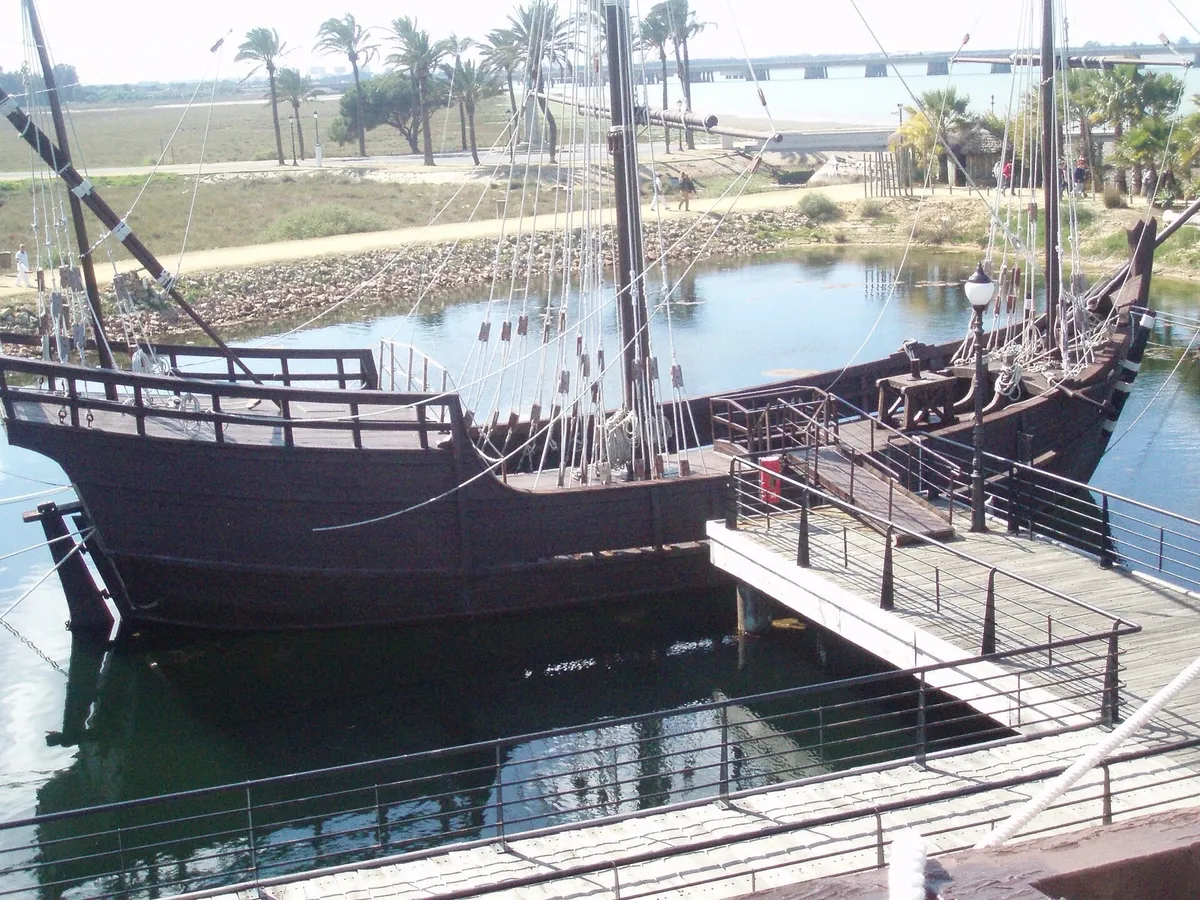
Niña
Caravel (redonda rig after refit)
Why it matters
Niña was the workhorse of Columbus's expeditions and the ship he actually trusted with his life. Her real name was Santa Clara. 'Niña' was a nickname, probably after her owner Juan Niño. Columbus sailed her on the first and second voyages and she made at least five Atlantic crossings total, more than any other vessel of the 15th century.
When Santa María ran aground on Christmas Day 1492, Columbus transferred to Niña for the return voyage. She carried him home. During the crossing back, they hit a storm so severe that Columbus wrote out an account of his discoveries on parchment, sealed it in a wax-coated barrel, and threw it overboard in case the ship went down. The ship didn't go down. Niña was that kind of vessel.
She was a caravel, a Portuguese-developed design that was the technological marvel of the age. Small, shallow-drafted, and maneuverable, caravels could sail closer to the wind than any square-rigged ship. Columbus had her re-rigged from lateen to square sails in the Canary Islands before the Atlantic crossing, giving her the best of both worlds: square sails for running before the trade winds, with the option to go back to lateen for coastal work.
Niña survived at least two Caribbean hurricanes after the first voyage. She was still sailing in 1501, possibly later. For a 50-foot wooden vessel built in the 1480s to still be operational after 15 years of hard Atlantic service is extraordinary. Most ships of her size and era lasted 10 years.
What it was like
Twenty-four men on a 50-foot boat in the open Atlantic. There was no below-decks accommodation. The crew slept on the open deck, under the stars or under whatever canvas they could rig for shade and rain protection. Only the captain had anything resembling shelter, a small raised area at the stern. Everyone else was exposed to the weather around the clock.
The caravel's advantage was also her curse: she was small and fast, which meant she rode every wave. In any kind of sea state, the motion was constant and violent. Seasickness was not a temporary condition; it was the baseline. Food preparation was primitive, a sand-filled firebox on deck where one hot meal could be cooked if conditions allowed. Many days, conditions didn't allow. Cold salt meat and hardtack.
But the crew of Niña were experienced coastal sailors from Palos and Moguer, towns with deep seafaring traditions. Vicente Yáñez Pinzón, her captain, was one of the best navigators in Spain. The crew knew their ship, trusted her, and sailed her harder than anyone thought possible. They had to. When you're on the smallest ship in a fleet crossing an unknown ocean, competence isn't optional.
The crew
Captain (Vicente Yáñez Pinzón)
Pinzón was from a family of sailors in Palos. He captained Niña on the first voyage, then led his own expedition to South America in 1499, making him the first European to reach Brazil. He was a quiet professional compared to his brother Martín Alonso on Pinta. He kept Niña in formation, followed orders, and brought his crew home alive. Columbus trusted him, which was not something Columbus did easily.
Rigger/Sailmaker
The refit from lateen to square rig in the Canary Islands was a major operation on a small ship. After the conversion, maintaining the hybrid rig was constant work. Niña's sails were her engine, and in the salt air of the Atlantic they degraded fast. Canvas tore, lines chafed, blocks seized. The rigger's job never stopped. On a crew of 24, everyone maintained rigging, but one or two men had primary responsibility for sail repair and line replacement.
Lookout
On a ship this small, the lookout perched on a small platform at the top of the mainmast. The entire mast was maybe 40 feet tall. The horizon from that height was about 7 miles. The lookout's job during the Atlantic crossing was to spot land, birds, floating vegetation, anything that suggested the unknown continent Columbus promised was out there. It was hours of staring at empty ocean, clinging to a swaying mast, knowing that if you fell there was nothing between you and the deck but air.
Patina notes
Niña's final fate is unknown. She was still in service in 1501 and may have continued sailing for several more years. No wreck has been identified. A 50-foot wooden caravel that spent 15 years in Caribbean and Atlantic service would have been riddled with teredo worms, her planking softened, her frames weakened.
She likely ended her days beached and stripped for usable hardware. The nails, fittings, and anchors were more valuable than the hull. The wood would have rotted within a few years in the tropical climate.
Preservation reality
No original material survives. The best replica is at the Muelle de las Carabelas in Palos de la Frontera, alongside replicas of Santa María and Pinta.
The replica was built for the 500th anniversary in 1992 using traditional construction methods. Another replica, built by the Columbus Foundation, has sailed extensively in the U.S.
and is periodically available for tours. The replicas consistently surprise visitors with how small the ship is. Fifty feet is a large recreational sailboat today. It's an absurdly small vessel for crossing the Atlantic with 24 men and no charts.
Where to see one
- • Muelle de las Carabelas, Palos de la Frontera, Spain
- • Columbus Foundation replica (touring, check schedule)
Preservation organizations
- • Muelle de las Carabelas Museum
- • Columbus Foundation
Sources
- Samuel Eliot Morison, Admiral of the Ocean Sea (2026-03-05)
- Columbus Foundation (2026-03-05)
Related vessels
Black Pearl
Before 2003, the pirate movie was a dead genre. After Pirates of the Caribbean, every kid in America wanted a ship with black sails. The Black Pearl did for pirate vessels what the Millennium Falcon did for spaceships. It made the vehicle a character. The ship represents freedom in its purest cinematic form. Jack Sparrow doesn't want gold or power. He wants his ship back. That's it. The entire first film is a man trying to reclaim the one thing that makes him who he is. The Black Pearl isn't transportation. It's identity. Johnny Depp's performance gets the credit, and it should. But the ship sells the fantasy. The black sails against a Caribbean sunset. The ragged rigging. The impossible speed. You believe this ship is alive because the movie treats it like one. The prop was built on a steel barge called the Sunset, dressed with a full wooden superstructure. Additional ships were constructed for later films, and digital effects expanded the Pearl's capabilities well beyond anything that floats.
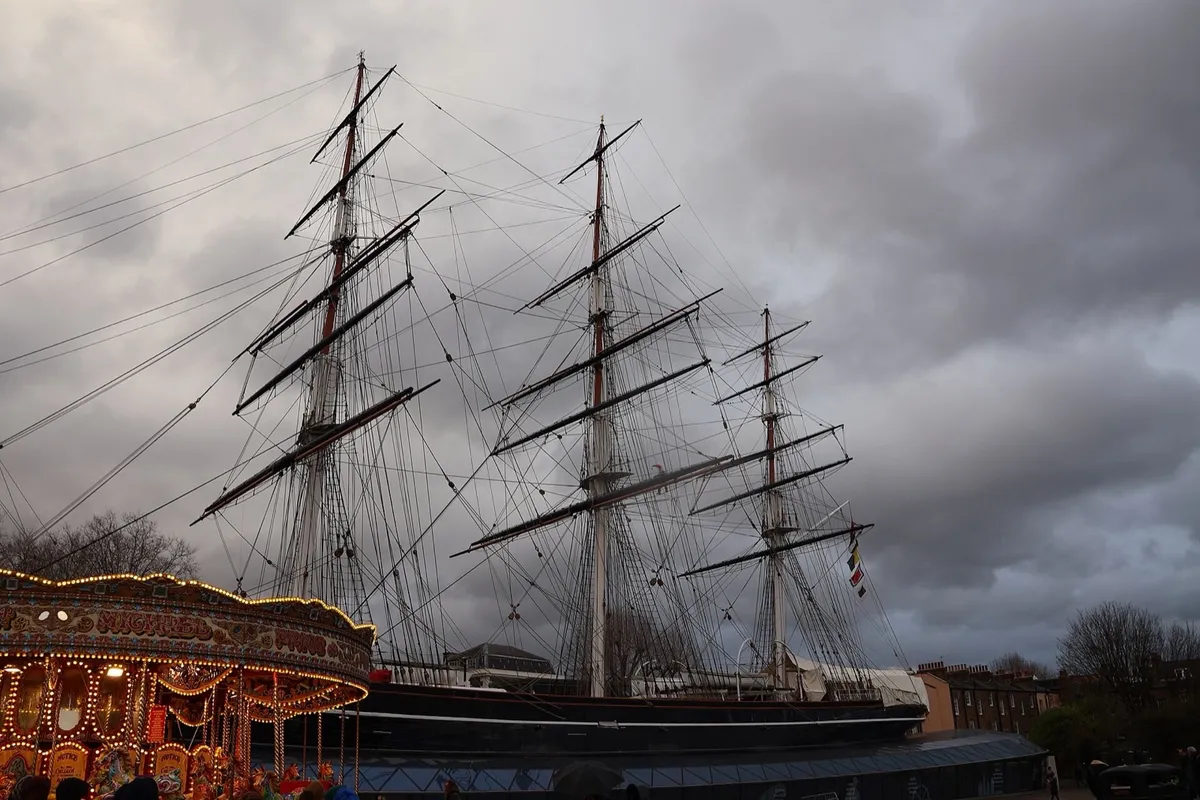
Cutty Sark
The Cutty Sark was born obsolete. She launched in 1869, the same year the Suez Canal opened and killed the tea clipper trade in a single stroke. Steam ships could use the canal. Sailing ships couldn't. The entire economic logic that justified building a vessel optimized for speed from China to London evaporated before she'd completed her first season. That's either terrible timing or a fitting monument to an era that was already dead. She raced in the tea trade anyway for a few seasons, most famously against the clipper Thermopylae in 1872. Cutty Sark was winning when she lost her rudder in a gale and had to jury-rig a replacement from spare spars. She still finished the voyage, arriving in London only a week behind Thermopylae. That tells you everything about the ship and the men who sailed her. Her second life was in the Australian wool trade, and this is where she finally proved herself. Under Captain Richard Woodget (1885-1895), she became the fastest wool clipper afloat, consistently making the passage from Sydney to London in under 80 days. She'd load over 5,000 bales of wool, drive south into the roaring forties, and run her easting down at speeds that left every other sailing vessel behind. Woodget was the captain she deserved. The name comes from Robert Burns's 1791 poem "Tam o' Shanter." Tam, drunk and riding home, watches witches dance and shouts in admiration at a young witch wearing a cutty sark, a short nightgown. She chases him. He barely escapes. The ship's figurehead is the witch Nannie, reaching forward with arm outstretched. It's a perfect name for a ship that was always chasing something just out of reach. After the wool trade declined, she was sold to a Portuguese company, renamed Ferreira, and spent decades hauling cargo in the South Atlantic. A retired sea captain named Wilfred Dowman found her in a Portuguese port in 1922, recognized what she was, bought her, and brought her home to England. Without Dowman, she would have been broken up. She is the only clipper ship that survives.
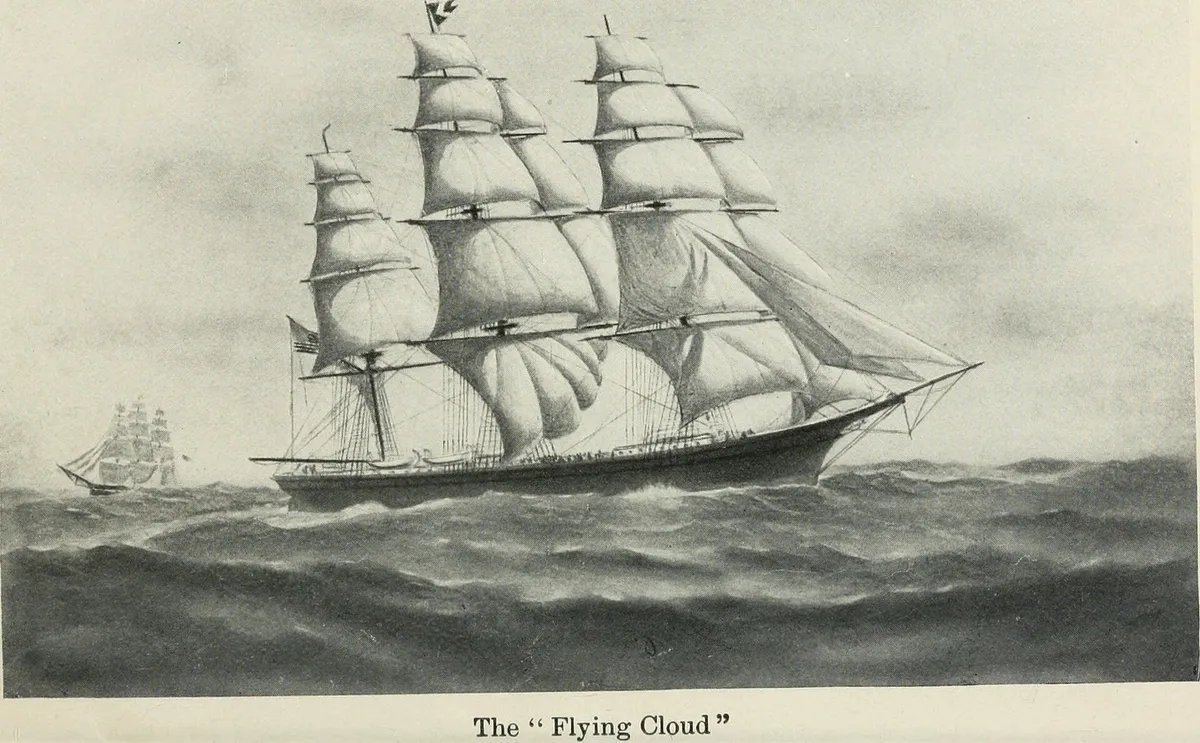
Flying Cloud
Flying Cloud was the fastest sailing vessel of her era, and her speed record from New York to San Francisco stood for over 100 years. She made the passage around Cape Horn in 89 days and 8 hours in 1854, a mark no commercial sailing vessel would beat until 1989. To put that in perspective: a record set before the Civil War survived the invention of the telephone, the automobile, both World Wars, and the moon landing. She was built by Donald McKay in East Boston, the best clipper ship designer who ever lived, at the peak of the California Gold Rush. Speed was money. Every day shaved off the passage to San Francisco meant earlier access to cargo rates that could pay for the ship in a single voyage. Owners drove these ships hard, and captains who delivered fast passages became celebrities. Josiah Perkins Creesy commanded Flying Cloud, but the secret weapon was his wife. Eleanor Creesy was the ship's navigator. She plotted the courses, read the currents, and made the decisions about when to press south into the roaring forties and when to hold off. Her work with Matthew Fontaine Maury's wind and current charts was masterful. She found favorable currents and winds that other navigators missed. On the record-setting 1854 voyage, she navigated through a cracked mainmast and a near-mutiny. She never held an official rank, was never paid, and appears in most histories as a footnote to her husband. She was one of the best navigators in the world. The clipper ship era lasted barely 15 years. Steam was already winning when Flying Cloud launched. These ships were profitable only because the Gold Rush created insane demand for fast passage to California, and the tea trade paid premiums for early-season delivery. Once the transcontinental railroad was completed in 1869 and the Suez Canal opened the same year, clippers were obsolete overnight. Beautiful, fast, and suddenly pointless. Flying Cloud herself was worked to death. After her glory years on the California run, she was sold to British owners who used her in the timber trade. She was condemned and burned for her copper fastenings at St. John, New Brunswick in 1874. She was 23 years old. Clipper ships were built for speed, not longevity, and hard driving wore them out fast. The hull that could do 18 knots was also a hull that was being slowly torn apart by the forces that made it fast.