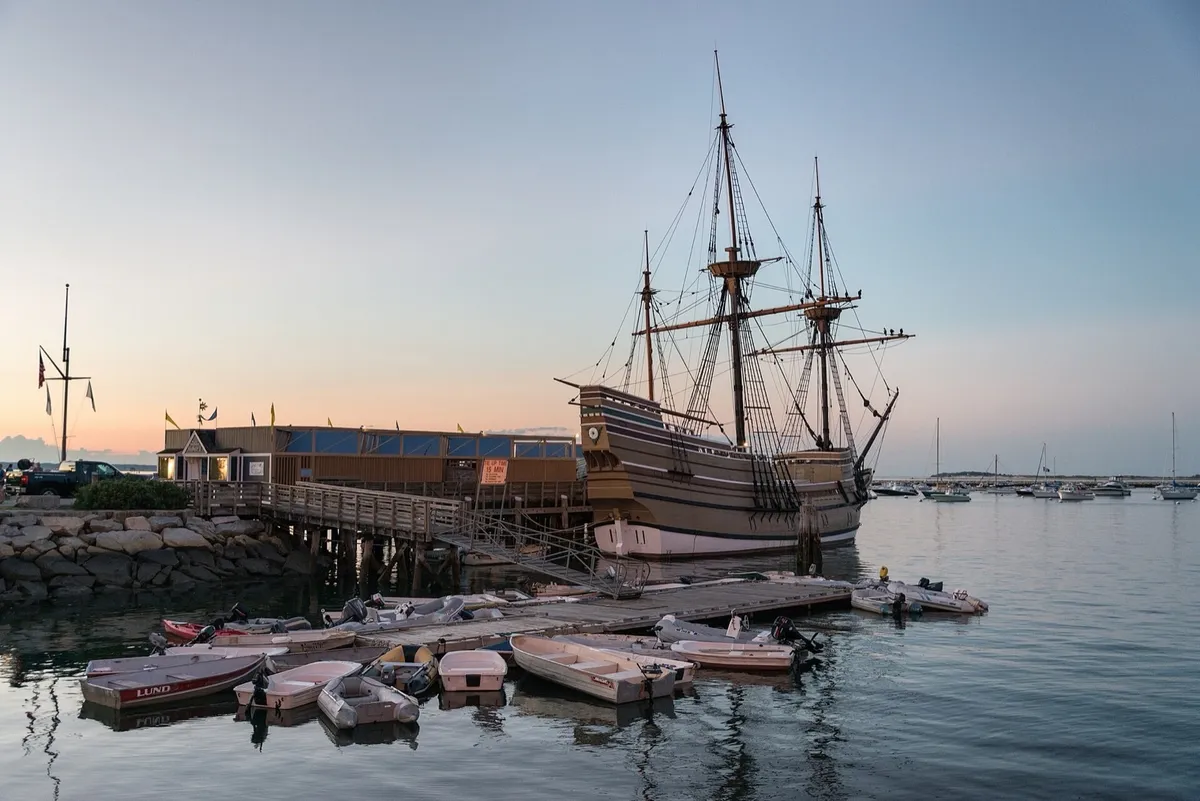
Mayflower
Merchant vessel (converted for passenger transport)
Why it matters
Mayflower carried 102 passengers and about 30 crew from Plymouth, England to Cape Cod in the autumn of 1620. The crossing took 66 days. They were aiming for Virginia. They hit Massachusetts instead. That navigational miss changed the political trajectory of North America.
The ship was a cargo hauler, not a passenger vessel. She'd spent years carrying wine between England and France. For the Atlantic crossing, the 'tween decks cargo hold was converted into living space by building crude wooden partitions. The ceiling height was about five feet. Into this space they packed 102 people, their belongings, livestock, tools, food stores, and their ambitions for a new world.
Two people died during the crossing. One baby was born. The passengers arrived exhausted, malnourished, and sick. They anchored off Provincetown, explored for a month, then settled at Plymouth. That first winter killed half of them. The ship sat in Plymouth harbor through the winter because the crew was too sick to sail home.
Mayflower matters not because the voyage was heroic. It wasn't. It was a desperate, poorly planned, badly timed expedition by people who had burned every bridge behind them. They left too late in the season, on a ship that leaked, with inadequate supplies, and landed in the wrong place. What makes it significant is that the survivors stayed. The Mayflower Compact, signed aboard before anyone went ashore, was a self-governing agreement that became a foundational document for American democracy. It was born of practical necessity, not idealism. They needed rules because they'd landed outside the jurisdiction of their charter.
What it was like
The 'tween decks where passengers lived was roughly 75 feet long, 25 feet wide, and 5 feet tall. Adults couldn't stand upright. There were no portholes. The only light came from candles and whatever leaked through the deck planking above. The space was shared with chickens, goats, and dogs. The smell was staggering. People were seasick for weeks. The ship's bilge water sloshed below them. Chamber pots were the only sanitation.
The North Atlantic in November is violent. Storms cracked a main beam amidships, which had to be repaired with a great iron screw the passengers had brought for their houses. Waves swept the decks constantly. One passenger, John Howland, was washed overboard and grabbed a trailing halyard. He survived. The crew resented the passengers. William Bradford recorded that the boatswain openly mocked the sick and told them he looked forward to throwing their bodies overboard.
The crew's own experience wasn't much better. They worked the ship through gales with frozen rigging and soaked sails that weighed hundreds of pounds when wet. Navigation was dead reckoning and prayer. Master Christopher Jones made landfall at Cape Cod after 66 days of sailing essentially blind.
The crew
Ship's Master (Christopher Jones)
Jones was responsible for the ship, the route, and getting everyone across alive. He navigated by compass, lead line, and accumulated experience. No charts of the American coast were reliable. When storms pushed them north of their Virginia destination, Jones made the call to anchor at Cape Cod rather than risk the dangerous shoals off Nantucket. He stayed through the winter, losing half his own crew to the same diseases killing the colonists.
Cooper
John Alden was hired as the ship's cooper, responsible for maintaining the barrels that held everything: beer, water, salt meat, hardtack, gunpowder. In a wooden ship, barrels were the shipping containers of the age. They leaked, swelled, dried out, and needed constant attention. Alden was supposed to return to England. He stayed. His descendants include John Adams and John Quincy Adams.
Ordinary Seaman
The crew of about 30 handled sails, rigging, pumps, and the endless maintenance a wooden ship demands at sea. They worked four-hour watches around the clock. Their quarters in the forecastle were cramped and wet. They ate salt beef, dried peas, and hardtack crawling with weevils. They were professional sailors who signed on for a cargo run and got an expedition instead.
Patina notes
The original Mayflower's fate is uncertain. She returned to England in April 1621, and Christopher Jones died the following year. The ship was assessed for probate in 1624 at a value of 128 pounds, suggesting she was in poor condition.
One tradition says her timbers were used to build a barn in Jordans, Buckinghamshire. The barn exists. The claim is unprovable. What's certain is that a 17-year-old merchant vessel that had endured a brutal North Atlantic winter was probably firewood within a few years. Wooden ships of this era lasted 15-20 years if they were lucky.
Preservation reality
No original material survives. Mayflower II, a full-size replica, was built in Devon, England in 1956 and sailed to Plymouth, Massachusetts in 1957. She's operated by Plimoth Patuxet Museums and underwent a massive multi-year restoration completed in 2020 for the 400th anniversary of the original voyage.
The restoration replaced most of her hull planking, deck beams, and rigging. She's berthed at State Pier in Plymouth and open for tours. The replica gives a visceral sense of scale: standing in the 'tween decks, you understand immediately that 102 people could not have survived this space for 66 days without extraordinary suffering.
Where to see one
- • Mayflower II, State Pier, Plymouth, MA (operated by Plimoth Patuxet Museums)
- • Plimoth Patuxet Museums, Plymouth, MA
Preservation organizations
- • Plimoth Patuxet Museums
- • General Society of Mayflower Descendants
Sources
- Plimoth Patuxet Museums (2026-03-05)
- William Bradford, Of Plymouth Plantation (2026-03-05)
Related vessels
Black Pearl
Before 2003, the pirate movie was a dead genre. After Pirates of the Caribbean, every kid in America wanted a ship with black sails. The Black Pearl did for pirate vessels what the Millennium Falcon did for spaceships. It made the vehicle a character. The ship represents freedom in its purest cinematic form. Jack Sparrow doesn't want gold or power. He wants his ship back. That's it. The entire first film is a man trying to reclaim the one thing that makes him who he is. The Black Pearl isn't transportation. It's identity. Johnny Depp's performance gets the credit, and it should. But the ship sells the fantasy. The black sails against a Caribbean sunset. The ragged rigging. The impossible speed. You believe this ship is alive because the movie treats it like one. The prop was built on a steel barge called the Sunset, dressed with a full wooden superstructure. Additional ships were constructed for later films, and digital effects expanded the Pearl's capabilities well beyond anything that floats.
Cutty Sark
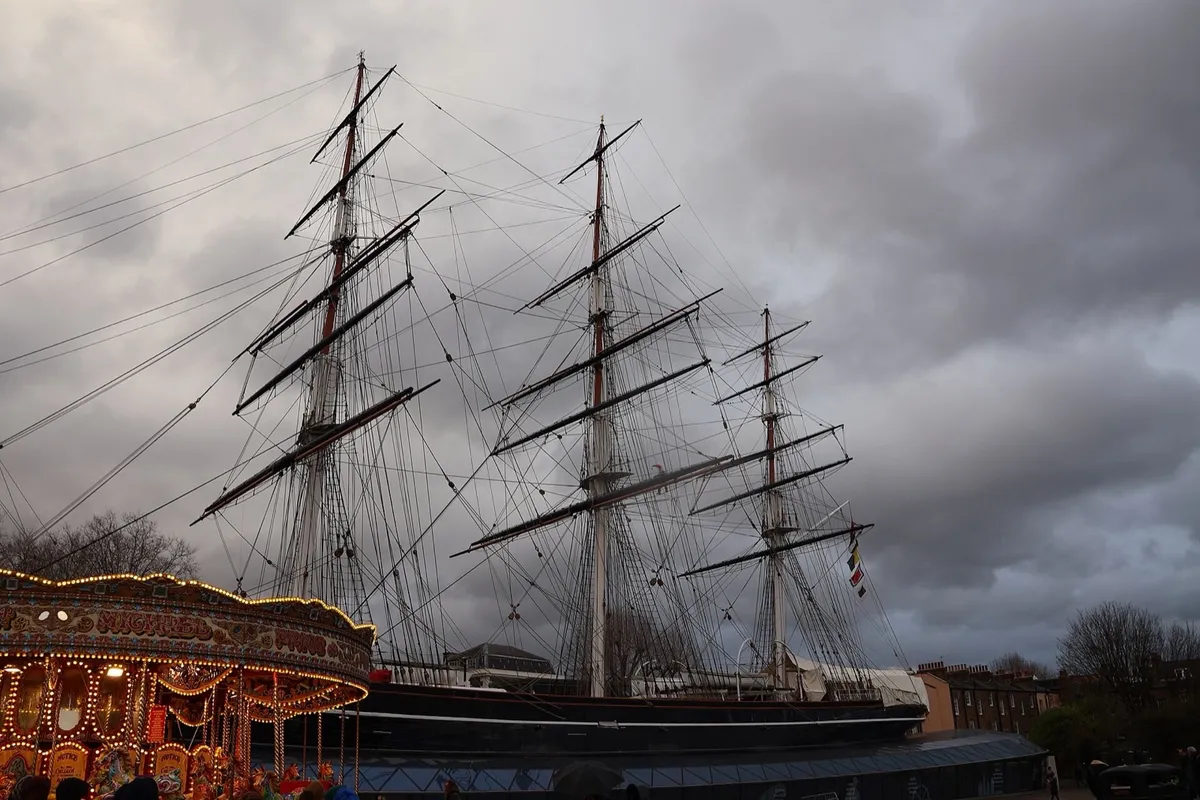
The Cutty Sark was born obsolete. She launched in 1869, the same year the Suez Canal opened and killed the tea clipper trade in a single stroke. Steam ships could use the canal. Sailing ships couldn't. The entire economic logic that justified building a vessel optimized for speed from China to London evaporated before she'd completed her first season. That's either terrible timing or a fitting monument to an era that was already dead. She raced in the tea trade anyway for a few seasons, most famously against the clipper Thermopylae in 1872. Cutty Sark was winning when she lost her rudder in a gale and had to jury-rig a replacement from spare spars. She still finished the voyage, arriving in London only a week behind Thermopylae. That tells you everything about the ship and the men who sailed her. Her second life was in the Australian wool trade, and this is where she finally proved herself. Under Captain Richard Woodget (1885-1895), she became the fastest wool clipper afloat, consistently making the passage from Sydney to London in under 80 days. She'd load over 5,000 bales of wool, drive south into the roaring forties, and run her easting down at speeds that left every other sailing vessel behind. Woodget was the captain she deserved. The name comes from Robert Burns's 1791 poem "Tam o' Shanter." Tam, drunk and riding home, watches witches dance and shouts in admiration at a young witch wearing a cutty sark, a short nightgown. She chases him. He barely escapes. The ship's figurehead is the witch Nannie, reaching forward with arm outstretched. It's a perfect name for a ship that was always chasing something just out of reach. After the wool trade declined, she was sold to a Portuguese company, renamed Ferreira, and spent decades hauling cargo in the South Atlantic. A retired sea captain named Wilfred Dowman found her in a Portuguese port in 1922, recognized what she was, bought her, and brought her home to England. Without Dowman, she would have been broken up. She is the only clipper ship that survives.
Flying Cloud
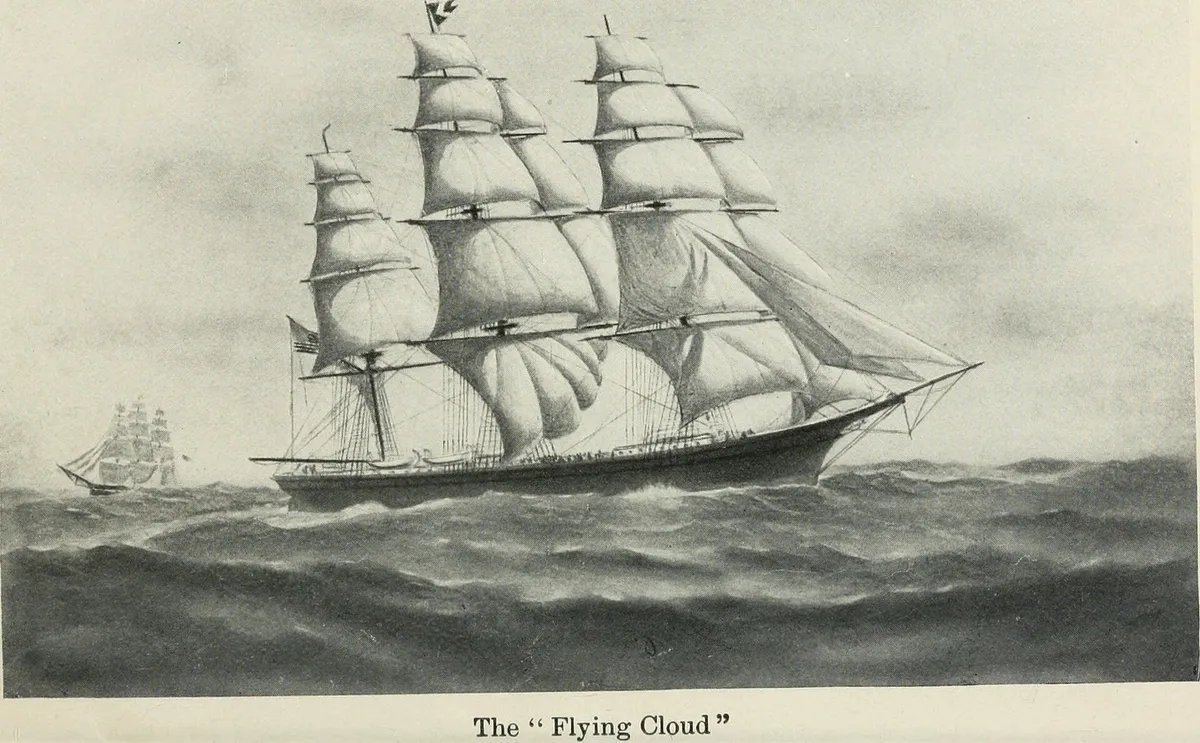
Flying Cloud was the fastest sailing vessel of her era, and her speed record from New York to San Francisco stood for over 100 years. She made the passage around Cape Horn in 89 days and 8 hours in 1854, a mark no commercial sailing vessel would beat until 1989. To put that in perspective: a record set before the Civil War survived the invention of the telephone, the automobile, both World Wars, and the moon landing. She was built by Donald McKay in East Boston, the best clipper ship designer who ever lived, at the peak of the California Gold Rush. Speed was money. Every day shaved off the passage to San Francisco meant earlier access to cargo rates that could pay for the ship in a single voyage. Owners drove these ships hard, and captains who delivered fast passages became celebrities. Josiah Perkins Creesy commanded Flying Cloud, but the secret weapon was his wife. Eleanor Creesy was the ship's navigator. She plotted the courses, read the currents, and made the decisions about when to press south into the roaring forties and when to hold off. Her work with Matthew Fontaine Maury's wind and current charts was masterful. She found favorable currents and winds that other navigators missed. On the record-setting 1854 voyage, she navigated through a cracked mainmast and a near-mutiny. She never held an official rank, was never paid, and appears in most histories as a footnote to her husband. She was one of the best navigators in the world. The clipper ship era lasted barely 15 years. Steam was already winning when Flying Cloud launched. These ships were profitable only because the Gold Rush created insane demand for fast passage to California, and the tea trade paid premiums for early-season delivery. Once the transcontinental railroad was completed in 1869 and the Suez Canal opened the same year, clippers were obsolete overnight. Beautiful, fast, and suddenly pointless. Flying Cloud herself was worked to death. After her glory years on the California run, she was sold to British owners who used her in the timber trade. She was condemned and burned for her copper fastenings at St. John, New Brunswick in 1874. She was 23 years old. Clipper ships were built for speed, not longevity, and hard driving wore them out fast. The hull that could do 18 knots was also a hull that was being slowly torn apart by the forces that made it fast.