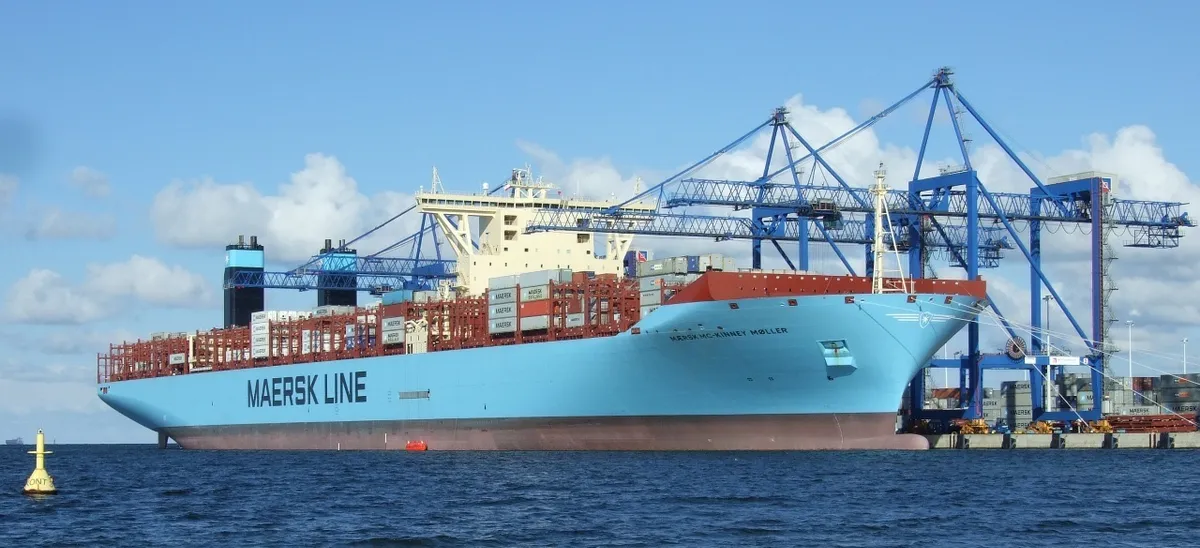
Maersk Triple E-class
Why it matters
The Triple E-class is the industrial revolution's final form. A quarter-mile of steel carrying $1 billion in cargo, run by 22 people. When the first one, Maersk Mc-Kinney Moller, launched in 2013, she was the largest container ship ever built. The name stands for Economy of scale, Energy efficiency, Environmentally improved. Maersk wasn't being poetic. They were being accurate.
These ships rewired global infrastructure just by existing. The channels into the Port of Baltimore had to be dredged deeper. The Bayonne Bridge in New Jersey had to be raised so they could pass underneath. The Francis Scott Key Bridge replacement (after the Dali brought down the original in 2024) had to account for these monsters in its design. When a single ship class forces a country to rebuild its bridges and harbors, that's not a vessel. That's a geological event.
If you live near the Chesapeake Bay, you've seen them. They're the ships on the horizon that look wrong because your brain can't reconcile the scale. A quarter-mile long, stacked fourteen containers high on deck, gliding at 23 knots with the grace of something that has no business being graceful. The wake alone is a hazard to small craft.
The economics are staggering. One Triple E can carry 18,340 containers. Each container holds roughly $50,000 in goods. Do the math and you get close to a billion dollars of cargo per voyage. The shipping cost per container? About $500 across the Pacific. That's why your TV costs $300 instead of $3,000. That's why global manufacturing works.
Twenty ships were built in the class, all at Daewoo's Okpo yard in South Korea. They represent the point where container shipping stopped being about boats and became pure logistics infrastructure that happens to float.
What it was like
Twenty-two people on a ship the size of a small town, at sea for weeks at a time. The bridge sits at the stern, fourteen stories above the waterline, and from there the bow is literally a quarter mile away. You can't see the front of your own ship clearly without binoculars. The automation is extraordinary. The engine room largely runs itself, monitored from a climate-controlled control room that looks like a power plant's operations center. Most of the crew can go days without seeing each other.
The isolation hits different on a ship this big. On a small vessel, tight quarters force human contact. On a Triple E, you have to make an effort to find another person. The accommodations are comfortable by maritime standards: private cabins, a gym, a small pool. But comfortable solitude is still solitude. Ninety-day rotations with sporadic satellite internet and port calls measured in hours, not days. The ship spends maybe 24 hours in port before the cranes finish and she's back at sea.
The sound is constant. Not the dramatic crashing of waves, but a deep mechanical hum that vibrates through every surface. The two-stroke diesels below produce a low-frequency pulse you feel in your chest more than hear with your ears. After a few weeks, the silence of land feels wrong.
The crew
Master (Captain)
Responsible for a $185 million vessel carrying close to a billion dollars in cargo, navigating channels that were literally dredged for this ship class. The Suez Canal transit alone takes 12 hours and requires Egyptian pilots aboard. The Captain's real stress isn't open ocean. It's port approaches, narrow channels, and the knowledge that this ship takes over a mile to stop from cruising speed. Every command carries weight measured in billions of dollars and thousands of tons of momentum.
Chief Engineer
Manages twin Wartsila diesels that together produce 107,000 horsepower. The engine room spans multiple decks and the waste heat recovery system alone could power a small town. The chief runs this operation with a team of maybe four engineers. When something fails mid-Pacific, there's no calling for help. You diagnose, you fabricate parts if needed, you fix it. The fuel consumption is around 200 tons per day. That's not a typo.
Able Seaman
The deck crew handles mooring, maintenance, and watchkeeping on a deck so long it has its own weather. Container lashings need checking, rust never sleeps on 1,312 feet of steel, and in heavy weather the deck is a no-go zone. Containers stacked fourteen high act like sails in a crosswind. When one breaks free, it's 30 tons of steel and consumer electronics crashing into the Pacific. Hundreds of containers go overboard every year across the global fleet.
Patina notes
A Triple E accumulates wear at industrial scale. The hull paint degrades between five-year drydock cycles, showing rust streaks where containers have scraped and seawater has worked its way in.
The deck fittings corrode relentlessly. The container guides and cell guides in the holds get beaten and scarred by thousands of loading cycles. These ships aren't meant to age gracefully. They're meant to work for 25 years and then go to the breakers.
Preservation reality
No Triple E-class ship has been preserved, and none likely will be. At 1,312 feet, they're simply too large for any museum or memorial. When they reach end of life, they'll be beached at a ship-breaking yard in South Asia and dismantled over months.
The first ones won't hit retirement until the late 2030s. For now, the best way to see one is to watch the shipping lanes near any major container port.
Where to see one
- • Port of Baltimore approach (Chesapeake Bay)
- • Port of Rotterdam, Netherlands
- • Port of Los Angeles/Long Beach observation points
- • Bayonne Bridge, New Jersey (they barely fit under it)
Preservation organizations
- • Maersk Line
- • International Maritime Organization
Sources
- Maersk Triple E-class specifications (2026-03-05)
- World Shipping Council (2026-03-05)
Related vessels
Bering Sea Crab Boat
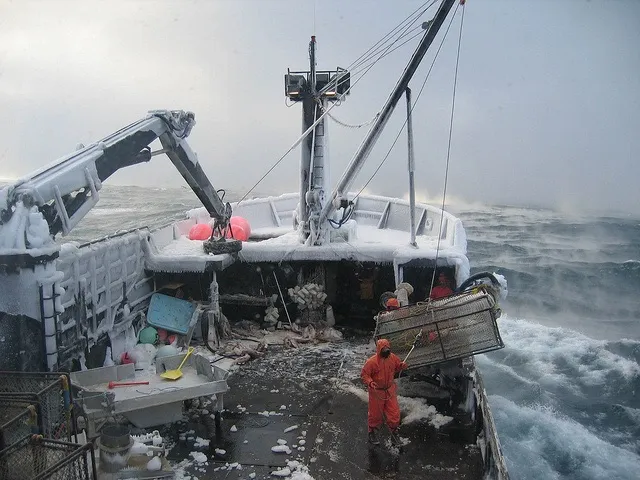
Before Deadliest Catch premiered on Discovery Channel in 2005, almost nobody outside Alaska knew what Bering Sea crab fishing looked like. Afterward, boats like the Northwestern, Cornelia Marie, and Time Bandit became household names. The show turned a brutal, obscure commercial fishery into reality television. What it got right is that the job is genuinely insane. The Bering Sea king crab and opilio (snow crab) fisheries operate in some of the worst conditions on earth. Winter storms generate 40-foot seas. Wind chill drops to minus 40. Spray freezes on contact with the superstructure, adding tons of topside weight that can capsize a boat if not knocked off. The crews use baseball bats and sledgehammers to break ice off the rails, rigging, and wheelhouse. This is a real thing that happens on a regular basis. The fatality rate for Bering Sea crab fishing has historically been 80 times the national average for workplace deaths. Coast Guard reforms, rationalization of the fishery (switching from a short derby season to individual fishing quotas), and better safety equipment have brought the rate down, but it's still the most dangerous fishery in North America. Between 1990 and 2010, dozens of boats and over a hundred lives were lost. The economics are as extreme as the conditions. Under the old derby system, the entire king crab season was compressed into a few days. Boats raced to catch as much as possible before the season closed. Crews could earn $30,000-$80,000 for a few weeks of work. They could also earn nothing if the catch was poor, or die if the weather turned. The quota system, implemented in 2005, spread the season out and reduced the death rate. It also reduced the gold-rush paydays. Now the money is steadier but lower. The boats still go out in terrible weather because that's where the crab are.
Bombardier Sea-Doo
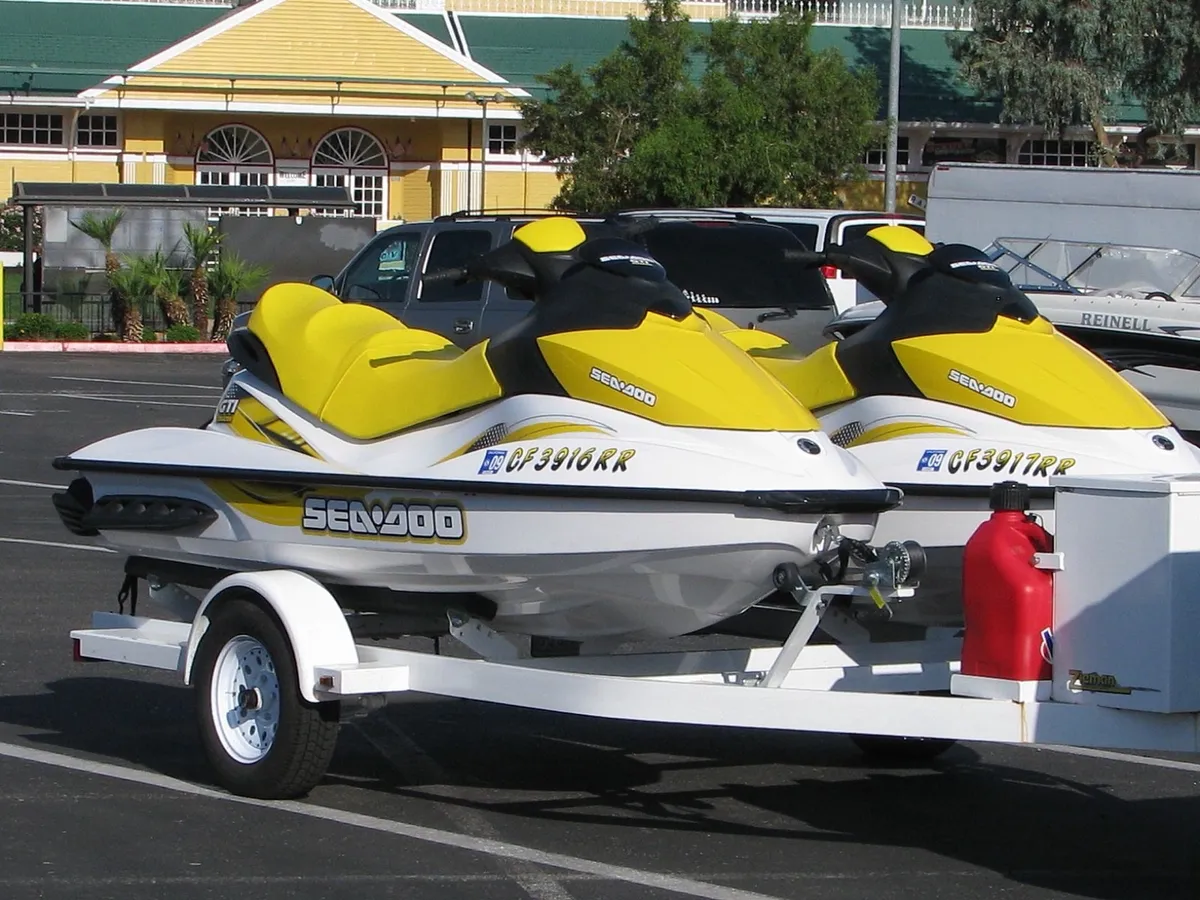
Sea-Doo has the weirdest origin story in powersports. Bombardier, a Canadian aerospace and train company, decided in 1968 that personal watercraft were the future. They built the Sea-Doo, it flopped, and they shelved it for twenty years. In 1988 they relaunched with modern engineering and a Rotax engine, and within five years they were outselling Kawasaki. A company that builds subway cars and business jets makes one of the most popular toys on the water. That's a sentence nobody predicted. If the WaveRunner is the Accord, the Sea-Doo is the WRX. Bombardier's approach has always been engineering-first. They were first with on-water braking (the iBR system, which uses a reverse gate to slow down). First with a viable fishing PWC. First with closed-loop cooling to keep saltwater out of the engine. They treat PWC like a technology platform rather than a toy, and it shows. The FISH PRO is the most absurd and brilliant product in the PWC market. It's a $20,000 personal watercraft with a Garmin fish finder, a 13.5-gallon cooler, rod holders, and a trolling mode. The idea that someone would go offshore fishing on something the size of a motorcycle seemed insane. Then people started actually catching fish on them, and now there's a whole subculture of PWC anglers. Sea-Doo's Achilles heel has historically been reliability. The Rotax engines are powerful but the electrical systems and supercharger seals on the high-performance models have earned a reputation for expensive repairs. Yamaha owners love pointing this out. Sea-Doo owners don't hear them because they're too far ahead.
Carolina Skiff
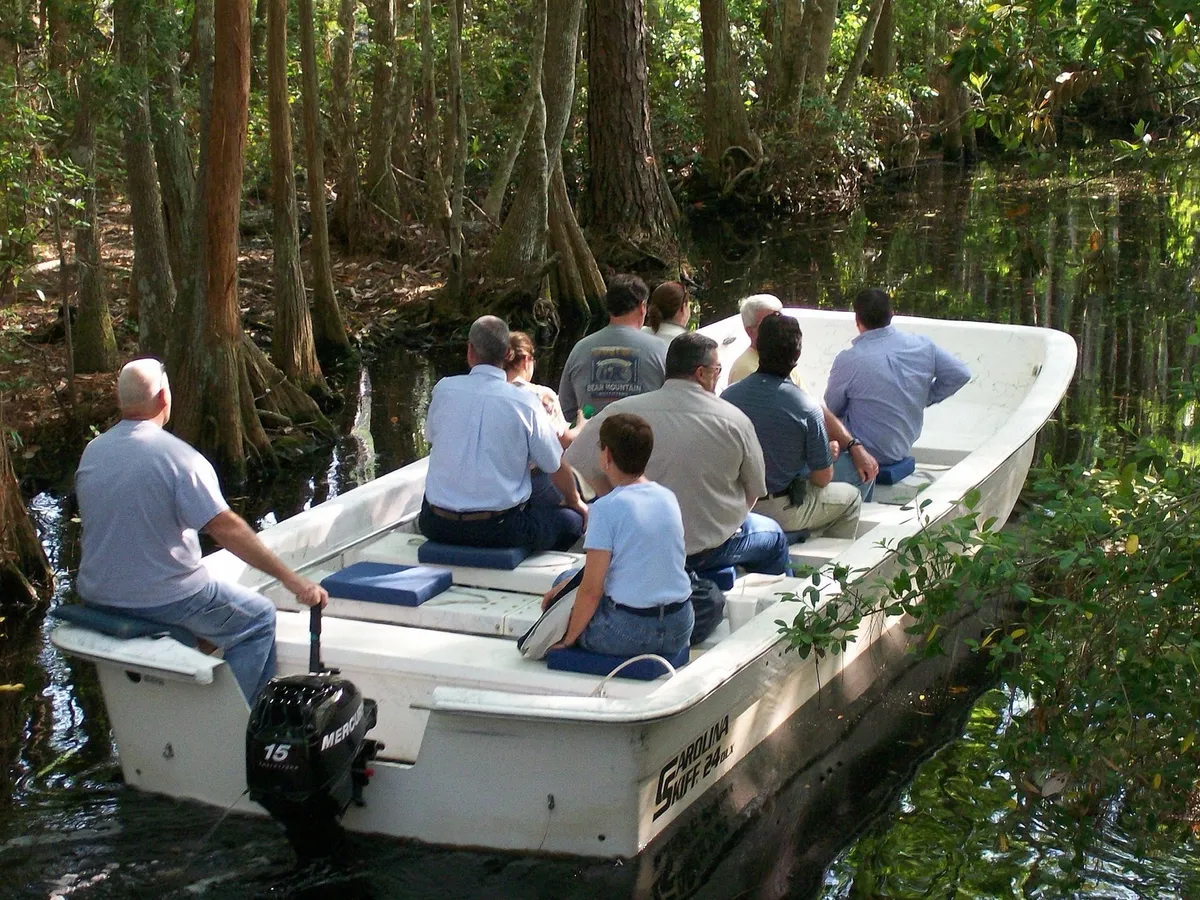
The Carolina Skiff is the most popular boat in America that nobody brags about owning. Founded in 1983 in Wadesboro, North Carolina, the company had one idea: build the cheapest, simplest fiberglass boat possible and sell a ton of them. It worked. Carolina Skiff moves more units than brands costing three times as much. The design philosophy is aggressive simplicity. Flat bottom. No wood anywhere in the hull (wood rots, which is why cheap boats fall apart). One-piece fiberglass layup. Self-bailing cockpit. The boats are sold without engines because the company figured out that letting buyers rig their own outboard kept the sticker price low and the customization high. A bare 17-footer can be had for under $10,000. Rig a used Yamaha on the back and you're fishing for less than a decent used car. People who own Boston Whalers and Grady-Whites look down on Carolina Skiffs. This is documented, quantifiable snobbery. The Carolina Skiff owner's response is universal: they're out fishing right now while the Grady-White is in the shop getting its third trim tab adjusted. The Skiff doesn't ride as well in rough water (flat bottom, remember). It doesn't look as pretty at the dock. It will never be featured in a glossy boat magazine. But it floats in six inches of water, it's nearly impossible to sink, and it costs less than the electronics package on a center console. The Corolla of boats. The Timex of boats. The "it just works" of boats. Carolina Skiff understood something that premium brands never will: most fishing happens in calm water within five miles of the ramp.