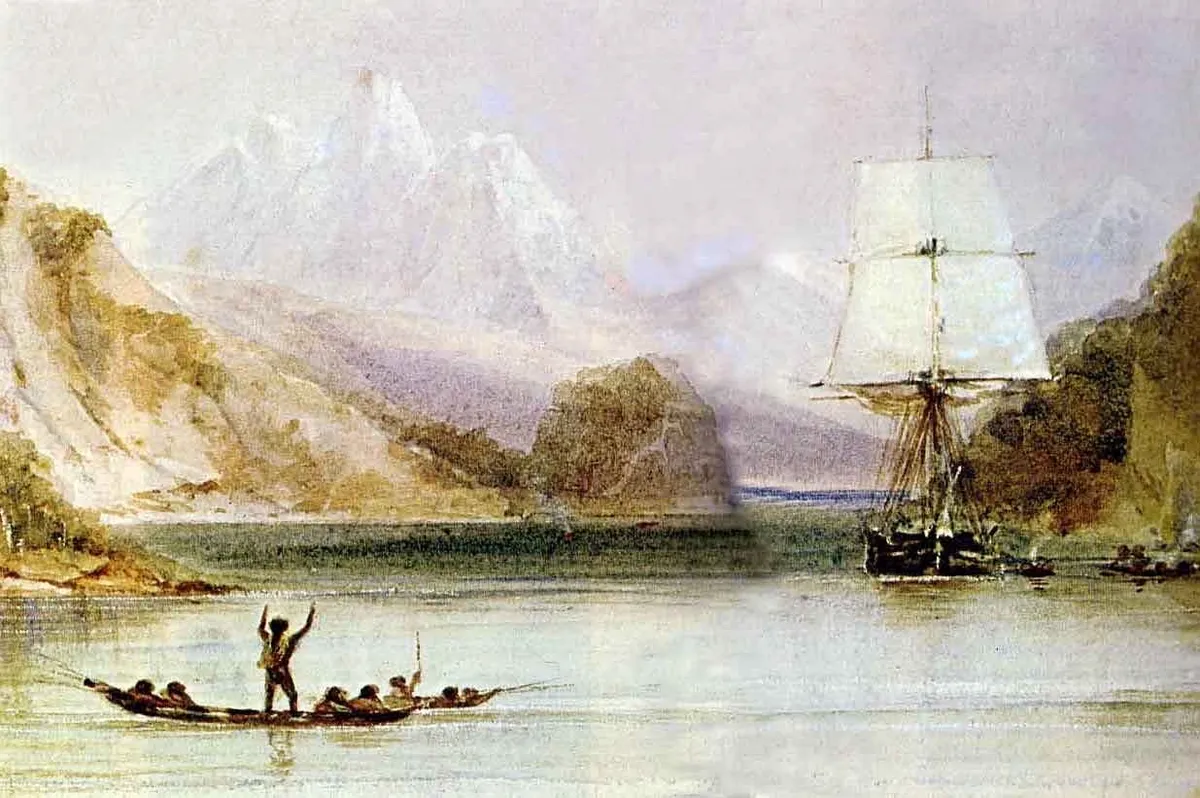
HMS Beagle
Why it matters
HMS Beagle was a perfectly ordinary warship that happened to carry the right person to the right places at the right time. She was one of over 100 Cherokee-class brig-sloops built by the Royal Navy. Nothing special about the hull, the rig, or the design. What made her extraordinary was that in 1831, a 22-year-old theology graduate named Charles Darwin talked his way aboard as the captain's gentleman companion and unpaid naturalist, and what he saw during the next five years rewrote the story of life on earth.
The Beagle made three voyages. The first (1826-1830) was a survey mission to South America under Captain Pringle Stokes, who shot himself in the head in a fit of despair at the conditions in Tierra del Fuego. Robert FitzRoy took command and brought the ship home. The second voyage (1831-1836) is the famous one. FitzRoy wanted a gentleman companion to keep him company and keep him sane. He'd seen what isolation did to Stokes and knew he carried the same risk. Darwin got the job partly because FitzRoy liked the shape of his nose. Phrenology was taken seriously in 1831.
Darwin spent five years collecting specimens, making observations, and being violently seasick. He was miserable at sea and ecstatic on land. The Galápagos Islands got most of the credit, but it was the full range of observations across South America, the Pacific, and beyond that built the case for evolution by natural selection. On the Origin of Species wouldn't be published until 1859, twenty-three years after the voyage ended. The ideas needed that long to mature, and Darwin needed that long to gather his nerve.
FitzRoy's story is the darker thread. He was a brilliant navigator and a deeply religious man who came to believe that Darwin's work contradicted Scripture. He spent years trying to reconcile what the voyage had revealed with his faith. He couldn't. He became Chief of the new Meteorological Department, invented weather forecasting, was mocked by the press for inaccurate predictions, and cut his throat with a razor in 1865. The man who made Darwin's voyage possible was destroyed in part by what that voyage produced.
The Beagle herself was retired from naval service in 1845 and transferred to the Coastguard. She was moored in the Essex marshes as Watch Vessel 7, had her masts removed, and was used as a floating customs station to catch smugglers. By 1870, she was sold for scrap. The ship that changed biology was buried in river mud.
What it was like
Seventy-four men on a 90-foot vessel for five years. The Beagle was cramped even by Royal Navy standards. Darwin's workspace was the poop cabin at the stern, roughly 10 by 11 feet, which he shared with the chart table, the ship's library, and two other officers. His hammock hung over the chart table. He stored specimens in every available space, and the ship gradually filled with rocks, bones, bird skins, and jars of preserved creatures in alcohol.
Darwin was seasick constantly. Not occasionally. Constantly. In his diary, he describes the misery in clinical detail. He couldn't work at sea, couldn't eat, couldn't think clearly. The minute the ship anchored, he went ashore and stayed as long as possible. FitzRoy accommodated this, and Darwin's overland expeditions while the ship continued its survey work produced some of the most important observations of the voyage.
For the working crew, the Beagle's survey mission meant endless, tedious precision work. Taking depth soundings, recording coastal features, checking chronometers. FitzRoy carried 22 chronometers aboard and compared them obsessively to establish accurate longitude. The survey work was vital for maritime charts that would be used for decades, but for the men doing it, it was repetitive labor in remote, often hostile waters. Tierra del Fuego was freezing. The tropics were malarial. The food was standard Navy issue: salt meat, dried peas, and occasional fresh provisions when they could get them.
The crew
Captain (FitzRoy)
Robert FitzRoy was 26 when he took command of the Beagle for the second voyage. An aristocrat, a gifted surveyor, and a man haunted by mental illness that ran in his family. His uncle, Viscount Castlereagh, had cut his own throat. FitzRoy feared the same fate and invited Darwin partly to have someone to talk to during the long southern nights. He ran a tight ship and produced charts of exceptional quality. He also carried three Fuegians back to their homeland, part of a colonial experiment in 'civilizing' indigenous people that failed completely.
Naturalist (Darwin)
Darwin had no official naval rank and received no pay. He was technically FitzRoy's guest. He ate with the captain, had access to the ship's boats for shore excursions, and was given space to store and prepare specimens. He paid his own expenses. His daily work aboard was reading, writing up notes, preserving specimens, and trying not to vomit. On shore, he became a different person: tireless, curious, walking miles through terrain that would stop most men. He shot, collected, and catalogued with obsessive thoroughness.
Ship's Artist (Martens)
Conrad Martens served as the ship's artist from Montevideo to Valparaíso, replacing Augustus Earle who left due to illness. Martens produced watercolors and sketches of every port, coastline, and notable feature the Beagle encountered. Before photography, the expedition artist was the documentary record. Martens worked on deck in all conditions, capturing the landscapes that Darwin was simultaneously trying to understand. His paintings of Tierra del Fuego and the Andes are the visual record of the voyage.
Patina notes
The Beagle is almost certainly still in the mud. After her service as a coastguard watch station in the Essex marshes near Paglesham, she was stripped of useful materials and abandoned.
The river silted over her. A 2004 archaeological survey using magnetometry identified a buried anomaly matching the Beagle's dimensions and location in the marshes near the River Roach.
The team believes they've found her, but excavation hasn't happened. If the hull survives, it's been preserved by the anaerobic mud, the same conditions that preserve ancient ships across Northern Europe.
The oak frame may be largely intact beneath the silt. The copper sheathing would have corroded but left chemical traces. She's been underground for roughly 150 years, within sight of a farmhouse.
Preservation reality
You cannot visit HMS Beagle. She's buried in the Essex marshes and has never been excavated. The most tangible connection is at Down House in Kent, Darwin's home for 40 years, now an English Heritage site.
His study, where he wrote On the Origin of Species, is preserved with his specimens and instruments. The Natural History Museum in London holds Darwin's Beagle collections, including the famous Galápagos finches.
There's a full-size Beagle cross-section at the museum in Narbonne, France, of all places. The Sedgwick Museum in Cambridge has geological specimens from the voyage.
For the ship herself, the most you can do is stand in the Essex marshes near Paglesham and look at the ground where she probably lies. A small plaque marks the approximate location.
It's a quiet, flat, windswept place. A strange final port for a ship that sailed around the world.
Where to see one
- • Down House, Downe, Kent, England (Darwin's home)
- • Natural History Museum, London (Beagle collections)
- • Paglesham, Essex, England (probable burial site)
Preservation organizations
- • English Heritage (Down House)
- • Natural History Museum London
- • HMS Beagle Project
Sources
- Charles Darwin, The Voyage of the Beagle (1839) (2026-03-05)
- Robert FitzRoy, Narrative of the Surveying Voyages (1839) (2026-03-05)
- BBC News - Team Believes It Has Found HMS Beagle (2026-03-05)
Related vessels
Black Pearl
Before 2003, the pirate movie was a dead genre. After Pirates of the Caribbean, every kid in America wanted a ship with black sails. The Black Pearl did for pirate vessels what the Millennium Falcon did for spaceships. It made the vehicle a character. The ship represents freedom in its purest cinematic form. Jack Sparrow doesn't want gold or power. He wants his ship back. That's it. The entire first film is a man trying to reclaim the one thing that makes him who he is. The Black Pearl isn't transportation. It's identity. Johnny Depp's performance gets the credit, and it should. But the ship sells the fantasy. The black sails against a Caribbean sunset. The ragged rigging. The impossible speed. You believe this ship is alive because the movie treats it like one. The prop was built on a steel barge called the Sunset, dressed with a full wooden superstructure. Additional ships were constructed for later films, and digital effects expanded the Pearl's capabilities well beyond anything that floats.
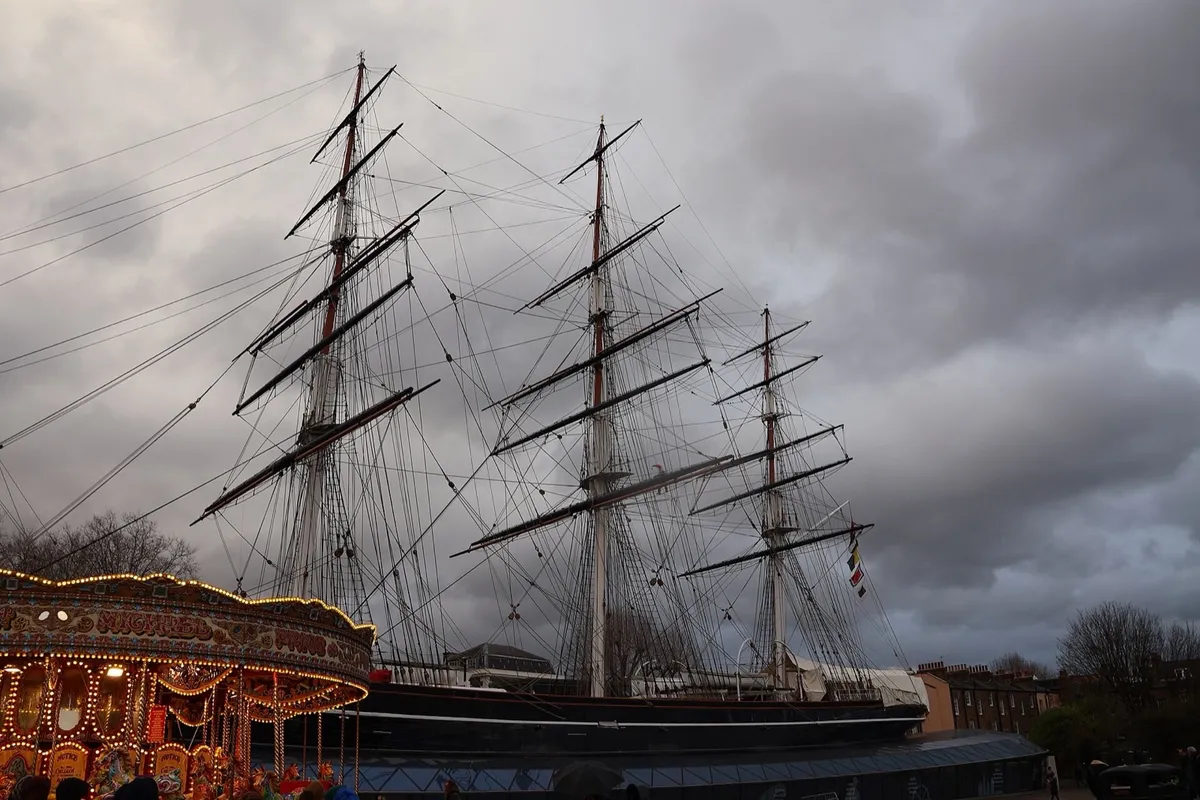
Cutty Sark
The Cutty Sark was born obsolete. She launched in 1869, the same year the Suez Canal opened and killed the tea clipper trade in a single stroke. Steam ships could use the canal. Sailing ships couldn't. The entire economic logic that justified building a vessel optimized for speed from China to London evaporated before she'd completed her first season. That's either terrible timing or a fitting monument to an era that was already dead. She raced in the tea trade anyway for a few seasons, most famously against the clipper Thermopylae in 1872. Cutty Sark was winning when she lost her rudder in a gale and had to jury-rig a replacement from spare spars. She still finished the voyage, arriving in London only a week behind Thermopylae. That tells you everything about the ship and the men who sailed her. Her second life was in the Australian wool trade, and this is where she finally proved herself. Under Captain Richard Woodget (1885-1895), she became the fastest wool clipper afloat, consistently making the passage from Sydney to London in under 80 days. She'd load over 5,000 bales of wool, drive south into the roaring forties, and run her easting down at speeds that left every other sailing vessel behind. Woodget was the captain she deserved. The name comes from Robert Burns's 1791 poem "Tam o' Shanter." Tam, drunk and riding home, watches witches dance and shouts in admiration at a young witch wearing a cutty sark, a short nightgown. She chases him. He barely escapes. The ship's figurehead is the witch Nannie, reaching forward with arm outstretched. It's a perfect name for a ship that was always chasing something just out of reach. After the wool trade declined, she was sold to a Portuguese company, renamed Ferreira, and spent decades hauling cargo in the South Atlantic. A retired sea captain named Wilfred Dowman found her in a Portuguese port in 1922, recognized what she was, bought her, and brought her home to England. Without Dowman, she would have been broken up. She is the only clipper ship that survives.
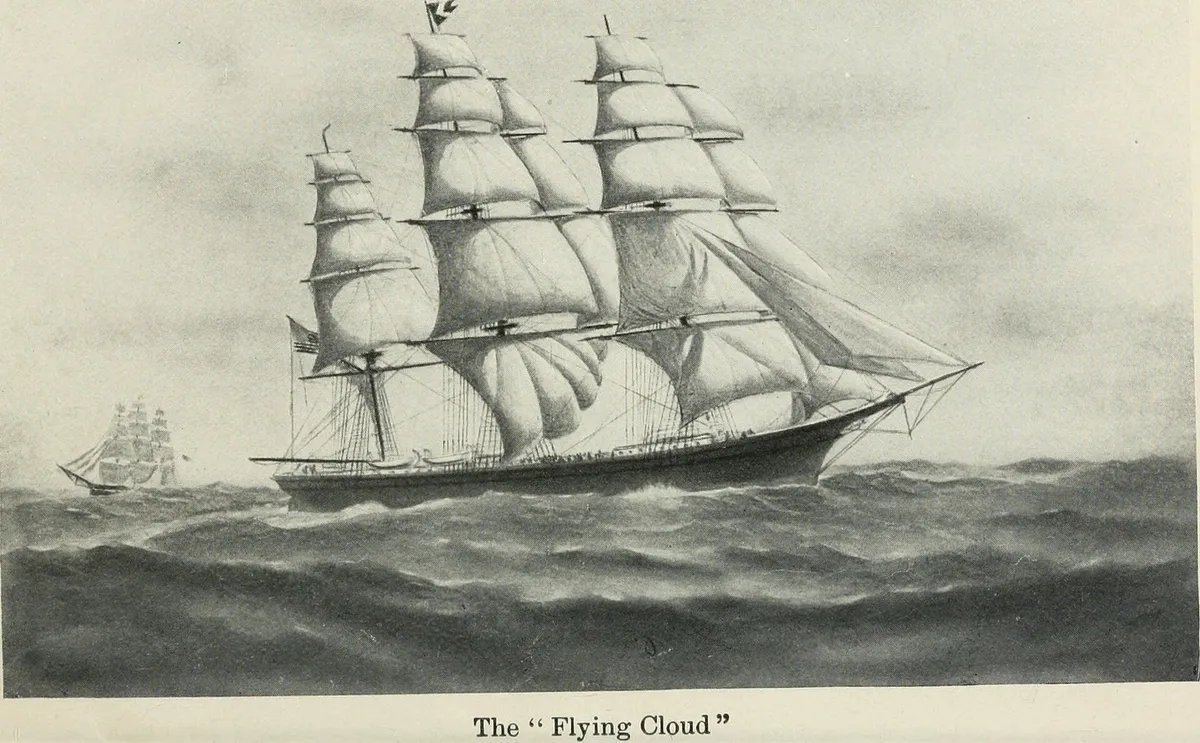
Flying Cloud
Flying Cloud was the fastest sailing vessel of her era, and her speed record from New York to San Francisco stood for over 100 years. She made the passage around Cape Horn in 89 days and 8 hours in 1854, a mark no commercial sailing vessel would beat until 1989. To put that in perspective: a record set before the Civil War survived the invention of the telephone, the automobile, both World Wars, and the moon landing. She was built by Donald McKay in East Boston, the best clipper ship designer who ever lived, at the peak of the California Gold Rush. Speed was money. Every day shaved off the passage to San Francisco meant earlier access to cargo rates that could pay for the ship in a single voyage. Owners drove these ships hard, and captains who delivered fast passages became celebrities. Josiah Perkins Creesy commanded Flying Cloud, but the secret weapon was his wife. Eleanor Creesy was the ship's navigator. She plotted the courses, read the currents, and made the decisions about when to press south into the roaring forties and when to hold off. Her work with Matthew Fontaine Maury's wind and current charts was masterful. She found favorable currents and winds that other navigators missed. On the record-setting 1854 voyage, she navigated through a cracked mainmast and a near-mutiny. She never held an official rank, was never paid, and appears in most histories as a footnote to her husband. She was one of the best navigators in the world. The clipper ship era lasted barely 15 years. Steam was already winning when Flying Cloud launched. These ships were profitable only because the Gold Rush created insane demand for fast passage to California, and the tea trade paid premiums for early-season delivery. Once the transcontinental railroad was completed in 1869 and the Suez Canal opened the same year, clippers were obsolete overnight. Beautiful, fast, and suddenly pointless. Flying Cloud herself was worked to death. After her glory years on the California run, she was sold to British owners who used her in the timber trade. She was condemned and burned for her copper fastenings at St. John, New Brunswick in 1874. She was 23 years old. Clipper ships were built for speed, not longevity, and hard driving wore them out fast. The hull that could do 18 knots was also a hull that was being slowly torn apart by the forces that made it fast.