La Amistad
Why it matters
The Amistad was a small, unremarkable Spanish schooner that moved cargo between Cuban ports. In June 1839, she was carrying 53 Africans who had been kidnapped from Sierra Leone, shipped across the Atlantic on the slave ship Tecora, and sold at auction in Havana. They were being transported to a sugar plantation in Puerto Principe when Sengbe Pieh, known to the courts as Joseph Cinque, led a revolt.
The captives broke free of their chains using a nail and a file. They killed the captain and the cook. They spared two crew members, Jose Ruiz and Pedro Montes, and ordered them to sail back to Africa. Ruiz and Montes complied during the day but reversed course at night, sailing northwest instead of east. For two months the Amistad zigzagged up the American coast while the Africans slowly starved.
The US Navy brig Washington intercepted the Amistad off Long Island in August 1839. What followed was a legal battle that went all the way to the Supreme Court. The Spanish government demanded the return of their "property." President Van Buren wanted to comply. Abolitionists funded the defense. Former president John Quincy Adams, 73 years old and half-retired, argued the case before the Supreme Court in a performance that lasted eight hours over two days.
The Court ruled that the Africans had been illegally kidnapped and had the right to use force to secure their freedom. They were not property. They were free people. Thirty-five survivors eventually returned to Sierra Leone in 1842, funded by abolitionist donations. The case didn't end slavery. It didn't even slow it down much. But it established in American law that enslaved people were human beings with legal rights, and it gave the abolitionist movement a victory they could point to for the next twenty years.
The ship's name means "friendship" in Spanish. The irony writes itself.
What it was like
For the Spanish crew, the Amistad was a routine coastal job. Move cargo, collect pay, don't ask questions about what the cargo used to be called. The captain, Ramon Ferrer, had made these runs before. The cook made meals. The crew worked the sails. Below deck, 53 people were chained in a hold designed for dry goods.
For the captives, the experience was the end of a nightmare that started in Africa. They'd already survived the Middle Passage on the Tecora, weeks in the Havana barracoons, and auction. The Amistad was supposed to be the final leg to a sugar plantation. The hold was dark, hot, and airless. They were given minimal food and water. When Cinque found a way to free himself, the decision to fight wasn't complicated. They had nothing left to lose.
After the revolt, the Africans tried to sail a ship none of them knew how to operate, navigating by the sun during the day while their Spanish prisoners quietly reversed course every night. They were at sea for two months. Some died of thirst and hunger. By the time the Washington found them off Montauk, they were emaciated and desperate.
The crew
Sengbe Pieh (Joseph Cinque), Revolt Leader
A rice farmer from the Mende people of Sierra Leone. He was about 25 years old when he was captured. On the Amistad, he found a nail and worked it until he could open his shackles, then freed the others. He led the attack on the crew at night, armed with sugar cane knives found in the cargo hold. After the revolt he tried to navigate by the stars, but he wasn't a sailor. He spent two months trying to get home and ended up in Connecticut.
Jose Ruiz, Surviving Spanish Crew
The man who had purchased most of the Africans at the Havana slave market. After the revolt, Cinque spared him because he needed someone who could sail. Ruiz agreed to navigate toward Africa during the day and secretly reversed course every night, heading northwest toward the American coast. He played both sides perfectly until the Navy showed up. He then had the audacity to file charges against the Africans for piracy and murder.
Grabeau, Second-in-Command
Another Mende captive who helped Cinque organize the revolt and maintain order afterward. During the two months at sea, Grabeau helped ration the dwindling food and water supply among the surviving Africans. He kept people alive through force of will. In the American courts, he served as one of the key witnesses, communicating through a Mende interpreter that Yale linguists had located on the New Haven docks.
Patina notes
The original Amistad was seized by the US government after the Navy intercepted her and was likely sold at auction or broken up. Small wooden schooners of this era had lifespans measured in decades at best, and a ship that had been neglected for two months at sea with an inexperienced crew would have been in rough shape.
No part of the original vessel is known to survive. Wood, rope, canvas, and iron fittings. The Atlantic took all of it back.
Preservation reality
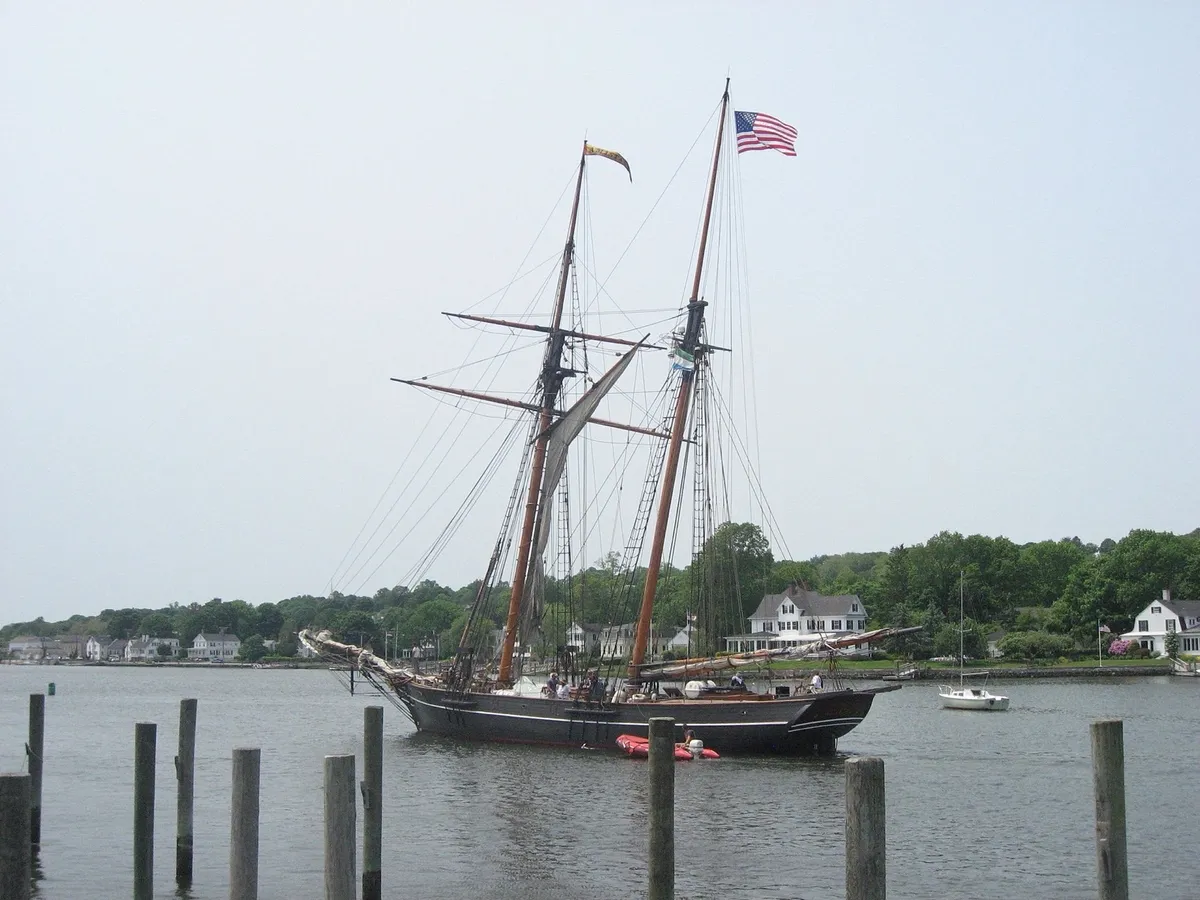
A full-scale replica, Amistad, was launched in 2000 from Mystic Seaport in Connecticut. She's a 78-foot topsail schooner that sails as a floating classroom and memorial, visiting ports along the East Coast and teaching the history of the slave trade.
The replica is operated by Discovering Amistad, Inc. and is homeported in New Haven. The original trial took place in New Haven, and a memorial stands at City Hall.
The Amistad Research Center at Tulane University in New Orleans holds the largest collection of African American historical documents in the country, named for the case. The Supreme Court decision itself is the most enduring artifact.
Where to see one
- • Amistad replica, New Haven, CT (homeport, sailing schedule varies)
- • Mystic Seaport Museum, Mystic, CT (where the replica was built)
- • Amistad Memorial, New Haven City Hall, CT
Preservation organizations
- • Discovering Amistad, Inc.
- • Amistad Research Center, Tulane University
- • Mystic Seaport Museum
Sources
- Amistad Case - National Archives (2026-03-05)
- United States v. The Amistad - Supreme Court Opinion (2026-03-05)
Related vessels
Black Pearl
Before 2003, the pirate movie was a dead genre. After Pirates of the Caribbean, every kid in America wanted a ship with black sails. The Black Pearl did for pirate vessels what the Millennium Falcon did for spaceships. It made the vehicle a character. The ship represents freedom in its purest cinematic form. Jack Sparrow doesn't want gold or power. He wants his ship back. That's it. The entire first film is a man trying to reclaim the one thing that makes him who he is. The Black Pearl isn't transportation. It's identity. Johnny Depp's performance gets the credit, and it should. But the ship sells the fantasy. The black sails against a Caribbean sunset. The ragged rigging. The impossible speed. You believe this ship is alive because the movie treats it like one. The prop was built on a steel barge called the Sunset, dressed with a full wooden superstructure. Additional ships were constructed for later films, and digital effects expanded the Pearl's capabilities well beyond anything that floats.
Cutty Sark
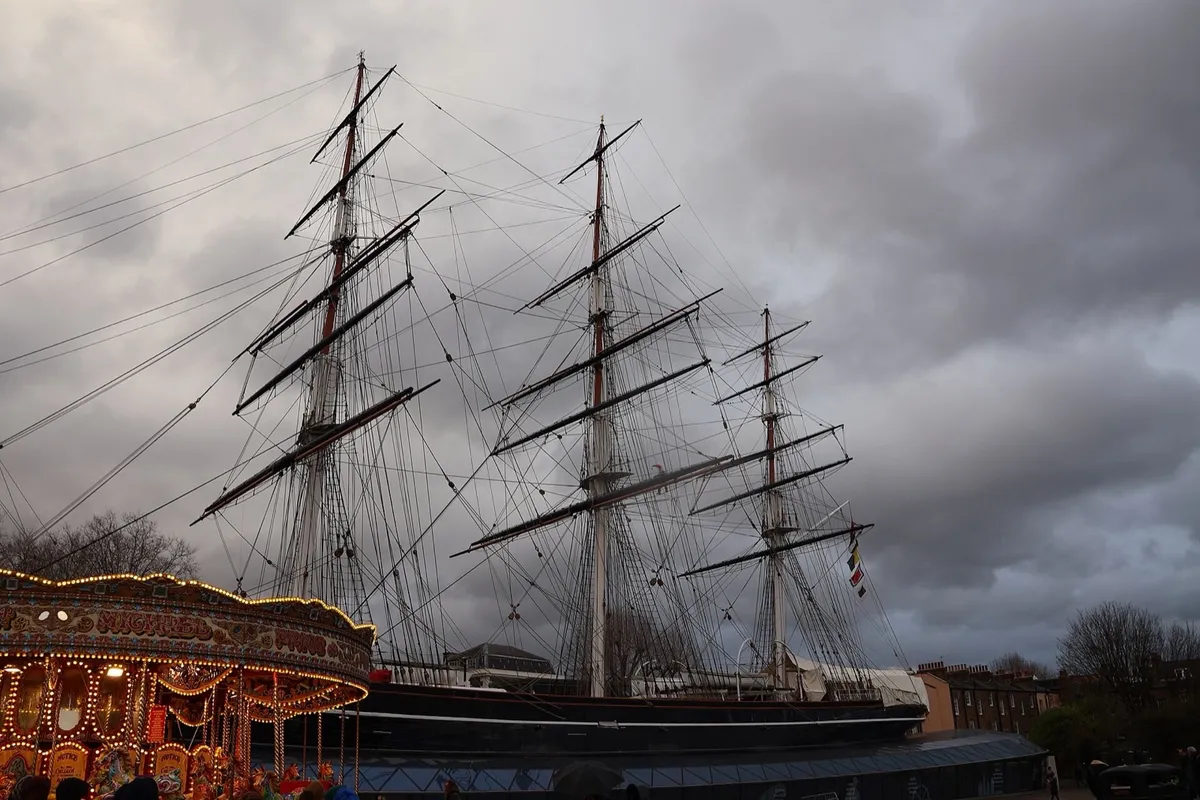
The Cutty Sark was born obsolete. She launched in 1869, the same year the Suez Canal opened and killed the tea clipper trade in a single stroke. Steam ships could use the canal. Sailing ships couldn't. The entire economic logic that justified building a vessel optimized for speed from China to London evaporated before she'd completed her first season. That's either terrible timing or a fitting monument to an era that was already dead. She raced in the tea trade anyway for a few seasons, most famously against the clipper Thermopylae in 1872. Cutty Sark was winning when she lost her rudder in a gale and had to jury-rig a replacement from spare spars. She still finished the voyage, arriving in London only a week behind Thermopylae. That tells you everything about the ship and the men who sailed her. Her second life was in the Australian wool trade, and this is where she finally proved herself. Under Captain Richard Woodget (1885-1895), she became the fastest wool clipper afloat, consistently making the passage from Sydney to London in under 80 days. She'd load over 5,000 bales of wool, drive south into the roaring forties, and run her easting down at speeds that left every other sailing vessel behind. Woodget was the captain she deserved. The name comes from Robert Burns's 1791 poem "Tam o' Shanter." Tam, drunk and riding home, watches witches dance and shouts in admiration at a young witch wearing a cutty sark, a short nightgown. She chases him. He barely escapes. The ship's figurehead is the witch Nannie, reaching forward with arm outstretched. It's a perfect name for a ship that was always chasing something just out of reach. After the wool trade declined, she was sold to a Portuguese company, renamed Ferreira, and spent decades hauling cargo in the South Atlantic. A retired sea captain named Wilfred Dowman found her in a Portuguese port in 1922, recognized what she was, bought her, and brought her home to England. Without Dowman, she would have been broken up. She is the only clipper ship that survives.
Flying Cloud
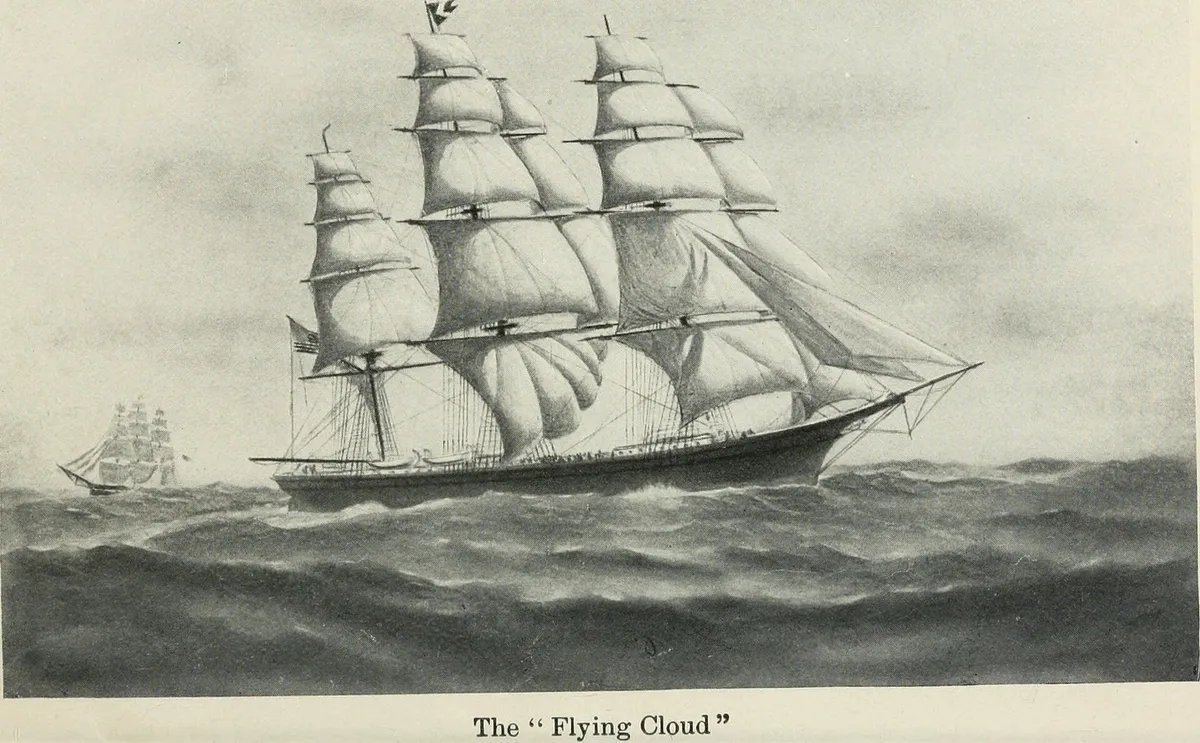
Flying Cloud was the fastest sailing vessel of her era, and her speed record from New York to San Francisco stood for over 100 years. She made the passage around Cape Horn in 89 days and 8 hours in 1854, a mark no commercial sailing vessel would beat until 1989. To put that in perspective: a record set before the Civil War survived the invention of the telephone, the automobile, both World Wars, and the moon landing. She was built by Donald McKay in East Boston, the best clipper ship designer who ever lived, at the peak of the California Gold Rush. Speed was money. Every day shaved off the passage to San Francisco meant earlier access to cargo rates that could pay for the ship in a single voyage. Owners drove these ships hard, and captains who delivered fast passages became celebrities. Josiah Perkins Creesy commanded Flying Cloud, but the secret weapon was his wife. Eleanor Creesy was the ship's navigator. She plotted the courses, read the currents, and made the decisions about when to press south into the roaring forties and when to hold off. Her work with Matthew Fontaine Maury's wind and current charts was masterful. She found favorable currents and winds that other navigators missed. On the record-setting 1854 voyage, she navigated through a cracked mainmast and a near-mutiny. She never held an official rank, was never paid, and appears in most histories as a footnote to her husband. She was one of the best navigators in the world. The clipper ship era lasted barely 15 years. Steam was already winning when Flying Cloud launched. These ships were profitable only because the Gold Rush created insane demand for fast passage to California, and the tea trade paid premiums for early-season delivery. Once the transcontinental railroad was completed in 1869 and the Suez Canal opened the same year, clippers were obsolete overnight. Beautiful, fast, and suddenly pointless. Flying Cloud herself was worked to death. After her glory years on the California run, she was sold to British owners who used her in the timber trade. She was condemned and burned for her copper fastenings at St. John, New Brunswick in 1874. She was 23 years old. Clipper ships were built for speed, not longevity, and hard driving wore them out fast. The hull that could do 18 knots was also a hull that was being slowly torn apart by the forces that made it fast.