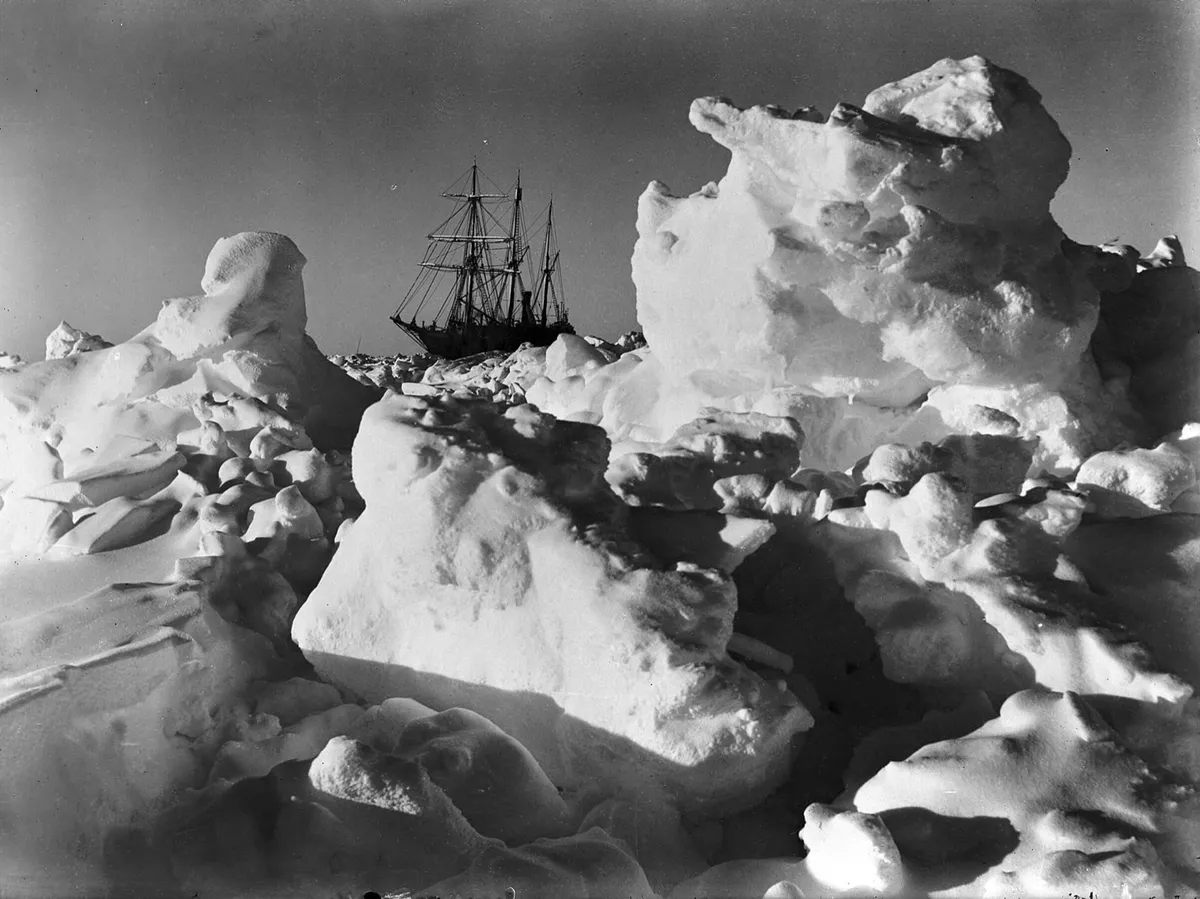
Endurance
Why it matters
Endurance never reached Antarctica. That's the first thing to understand. Shackleton's Imperial Trans-Antarctic Expedition was supposed to cross the continent from the Weddell Sea to the Ross Sea, roughly 1,800 miles over the pole. They didn't make it to shore.
Endurance entered the Weddell Sea pack ice in December 1914 and became trapped on January 19, 1915. For ten months the crew lived aboard while the ice slowly crushed the ship around them. Frank Hurley's photographs show the hull buckling, the deck timbers splintering, the masts leaning at impossible angles. On October 27, 1915, Shackleton ordered the crew onto the ice. Endurance sank on November 21.
What followed is the greatest survival story in the history of exploration. Twenty-eight men camped on drifting ice floes for five months, eating seals and penguins, watching the floe they lived on crack and shrink. When the ice broke up in April 1916, they launched three salvaged lifeboats and sailed through open Antarctic seas to Elephant Island, a desolate rock at the tip of the Antarctic Peninsula. It was the first time they'd stood on solid ground in 497 days.
Shackleton then took five men in the 22-foot James Caird and sailed 800 miles across the Southern Ocean to South Georgia Island. The Drake Passage is the most violent stretch of open water on earth. The boat was open. They navigated by dead reckoning and occasional sun sights through storm clouds. They made landfall on the wrong side of the island and Shackleton, Worsley, and Crean then crossed South Georgia's unmapped mountain range on foot to reach the whaling station at Stromness.
Not a single man died. All 28 survived. The Trans-Antarctic Expedition was a complete failure by its stated objective and an absolute triumph of leadership. Shackleton brought everybody home.
The wreck was found in March 2022 by the Endurance22 expedition at a depth of 10,000 feet in the Weddell Sea. The ship is upright, intact, with the name "ENDURANCE" still clearly visible on the stern. The cold, low-oxygen water preserved her like no one expected.
What it was like
Before the ice took her, Endurance was a functional but cramped expedition ship. The crew of 28 shared a space smaller than most modern apartments. The Ritz, as the crew sarcastically named the main living quarters, held bunks, a stove, and a table. Temperatures inside rarely climbed above freezing. The dogs lived in kennels on deck and howled through the night.
Once the ship was beset in ice, daily life became a careful exercise in keeping men sane. Shackleton understood that boredom and despair would kill faster than cold. He organized dog sled races, football matches on the ice, theatrical performances, and regular meals. He assigned tents strategically, putting the most difficult personalities in his own tent where he could manage them. The crew ate seal, penguin, and whatever stores they could salvage. When the dogs could no longer be fed, they were shot. The men who'd raised them from puppies had to do it.
The boat journey in the James Caird was something else entirely. Six men in a 22-foot whaleboat modified with a canvas deck, sailing through 60-foot seas in sub-zero temperatures. They couldn't stand up. Their sleeping bags were soaked and frozen. Their drinking water was contaminated with salt. Navigation depended on Worsley getting a clear sun sight through a gap in the clouds while bracing himself in a heaving boat. They were at sea for 16 days.
The crew
Ship's Carpenter (Harry McNish)
McNish rebuilt the James Caird for the open ocean crossing, raising the sides and fitting a makeshift canvas deck using salvaged wood, nails, and lamp wick caulking. He did this work on an Antarctic beach with frozen hands and improvised tools. The boat's survival, and therefore the entire crew's survival, depended on his craftsmanship. Shackleton later denied him the Polar Medal over an earlier dispute about orders.
Expedition Photographer (Frank Hurley)
Hurley's photographs and film footage are the reason this story survived as more than a footnote. When Endurance sank, he dove into the flooded ship to recover his glass plate negatives, then selected the best 150 and smashed the rest so he wouldn't be tempted to carry more across the ice. Every iconic image of the crushed ship, the men on the ice, the dog teams, came from plates he carried through the entire ordeal.
Navigator (Frank Worsley)
Worsley navigated the James Caird 800 miles across the Southern Ocean using a sextant, a chronometer, and dead reckoning. He got exactly four sun sights during the 16-day voyage. A navigation error of even two degrees would have sent them past South Georgia into the empty South Atlantic with no land for thousands of miles. He hit the island.
Patina notes
Endurance sat on the bottom of the Weddell Sea for 107 years before the Endurance22 expedition found her in March 2022 at a depth of 9,869 feet. The wreck is remarkably intact.
The stern nameplate is legible. The wheel is in place. The masts are broken but still attached. The cold (-1.8°C water), high pressure, and absence of wood-eating organisms like shipworms at that depth have preserved her far better than anyone expected.
The hull planking is still visible. The deck structures are recognizable. She's upright with a slight list. Above the waterline on the ice, Endurance was crushed over months, her timbers splintering and groaning loud enough to keep men awake at night. Below the water, she landed softly in fine sediment and the Weddell Sea kept her like a time capsule.
Preservation reality
Endurance will never be raised. She's protected under the Antarctic Treaty as a Historic Site and Monument, which prohibits any physical interference with the wreck. The Falklands Maritime Heritage Trust, which organized the 2022 discovery expedition, used advanced underwater vehicles to document the wreck in extraordinary detail but touched nothing. The resulting imagery is the most detailed survey of any deep-ocean shipwreck ever conducted.
The ship exists now as a 3D digital model and thousands of hours of high-resolution video. The physical artifacts from the expedition are scattered across several institutions. The Royal Geographical Society in London holds Hurley's photographs and expedition records. The Scott Polar Research Institute in Cambridge has documents and personal effects. The South Georgia Museum at Grytviken, on the island where Shackleton is buried, tells the story in the place where it ended. Dulwich College in London, Shackleton's school, has a small collection. The James Caird itself is at Dulwich, on permanent display.
Where to see one
- • The James Caird at Dulwich College, London, England
- • Royal Geographical Society, London, England
- • South Georgia Museum, Grytviken, South Georgia
- • Scott Polar Research Institute, Cambridge, England
Preservation organizations
- • Falklands Maritime Heritage Trust
- • Royal Geographical Society
- • Scott Polar Research Institute
- • Antarctic Heritage Trust
Sources
- Endurance22 Expedition (2026-03-05)
- South by Ernest Shackleton (Project Gutenberg) (2026-03-05)
- Royal Geographical Society - Shackleton Collection (2026-03-05)
Related vessels
Carroll A. Deering
On January 31, 1921, the Carroll A. Deering ran aground on Diamond Shoals off Cape Hatteras, North Carolina, with all sails set. The Coast Guard reached her four days later. The lifeboats were gone. The crew's personal belongings were gone. But dinner was being prepared in the galley, the tables were set, and the ship's cats were still aboard. Eleven men had vanished from a brand-new, well-found schooner in one of the most heavily trafficked shipping lanes on the East Coast. No bodies were ever recovered. No lifeboat was ever found. The investigation pulled in five government agencies, and the deeper they dug, the stranger it got. The ship's logs were missing. The steering gear had been deliberately smashed. Navigation equipment was gone. Two anchors had been dropped, with their chains hanging over the bow in a way that suggested the ship had been anchored and then cut loose. Someone had wrecked the ship's ability to navigate and steer, then left. On January 29, two days before the grounding, a lightship keeper at Cape Lookout reported that a crewman on the Deering had hailed him through a megaphone, saying the ship had lost her anchors. The man on the megaphone was not an officer. That detail haunted investigators. Theories ranged from mutiny to rum-running pirates to Soviet agents. The Deering's first mate, Charles McLellan, had openly clashed with the original captain (who fell ill and was replaced before the final voyage). The replacement captain, W.B. Wormell, was 66 years old and may not have had full control of his crew. At least nine other vessels disappeared in the same area around the same time, leading some to call it an early "Bermuda Triangle" cluster. The FBI, the State Department, and the Department of Commerce all investigated. None of them solved it. The case files were sealed, then lost, then partially recovered decades later. Herbert Hoover, then Secretary of Commerce, personally oversaw the investigation and came away frustrated. Whatever happened aboard the Carroll A. Deering, eleven men took the answer with them.
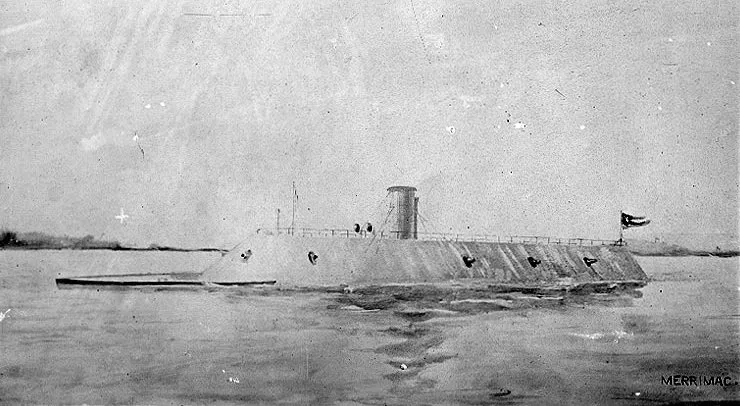
CSS Virginia
The CSS Virginia was born from desperation and scrap metal. When Union forces abandoned the Norfolk Navy Yard in April 1861, they burned the steam frigate USS Merrimack to the waterline and sank her. The Confederacy raised the hull, found the engines salvageable (barely), and built an armored casemate on top. Four inches of iron plate bolted over 24 inches of oak and pine, sloped at 36 degrees to deflect shot. She looked like a barn roof floating on a raft. She was the most dangerous warship in the Western Hemisphere. On March 8, 1862, Virginia steamed into Hampton Roads and attacked the Union blockading squadron. She rammed and sank the USS Cumberland, a 24-gun sloop that went down with 121 of her crew still fighting. Her guns couldn't hurt Virginia. The frigate USS Congress surrendered after Virginia's shells set her ablaze. Another 120 men died. The wooden warships USS Minnesota, USS Roanoke, and USS St. Lawrence all ran aground trying to escape. If Virginia had returned the next morning unopposed, she could have broken the Union blockade. But Monitor was waiting. The four-hour engagement the next day proved that the age of wooden warships was finished. Virginia landed dozens of hits on Monitor without breaking through. Monitor's Dahlgrens cracked Virginia's armor in places but couldn't penetrate. Virginia tried to ram but Monitor was too nimble. It was the first battle between ironclad warships, and it ended with both sides claiming victory and neither ship sunk. Virginia fought in the area for two more months but never left the Roads. Her 21-foot draft meant she could only navigate deep channels, and her engines, already condemned before the war started, could barely push her at walking speed. When Union forces advanced on Norfolk in May 1862, the crew tried to lighten her enough to escape upriver. They couldn't. On May 11, her crew set her afire and she exploded when the flames reached the magazine. Nothing of the ship survived.
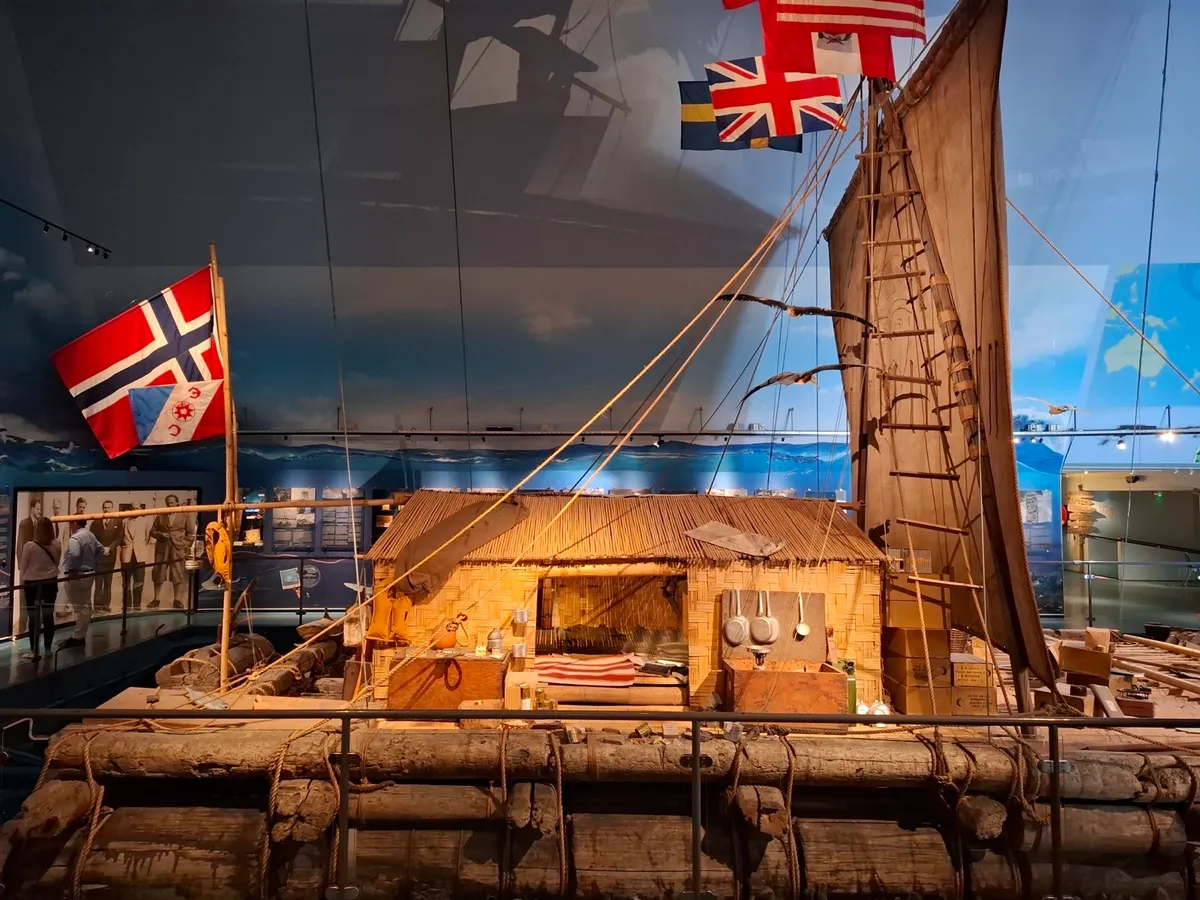
Kon-Tiki
In 1947, Thor Heyerdahl built a raft from balsa logs using techniques available to pre-Columbian South Americans and sailed it 4,300 miles across the Pacific to prove that ancient peoples could have colonized Polynesia from South America. The scientific establishment thought he was insane. Balsa wood, they said, would become waterlogged and sink. The raft would break apart in heavy seas. Six men would die in the Pacific to prove a crackpot theory. Heyerdahl sailed anyway. The voyage took 101 days. The raft held together. The balsa didn't waterlog (the outer layer saturated but the core stayed buoyant). They caught fish, collected rainwater, and navigated by stars. They crash-landed on a reef in the Tuamotu Islands. Everyone survived. The book sold 50 million copies. The theory has been largely disproven by DNA evidence — Polynesians came from Asia, not South America — but Heyerdahl proved the voyage was possible, and that matters.