Pequod
Why it matters
The Pequod is the floating stage for the most ambitious novel in American literature. Melville didn't invent the whaling ship. He worked on real ones. He knew what the deck felt like under his feet, what whale blood smelled like, what three years at sea did to a man's mind. The Pequod is drawn from that experience.
Every plank of the ship serves the story. The bone trophies on the hull are both real whaling tradition and a warning. The try-works, where blubber is rendered into oil over brick furnaces on a wooden deck, is Melville's metaphor made physical. Fire on a wooden ship in the middle of the ocean. That's the whole book.
The Pequod matters because Melville used a working vessel as the architecture of meaning. The ship is a factory, a democracy, a dictatorship, a coffin, and a church. She carries thirty men from dozens of nations on a voyage that starts as commerce and ends as obsession. No other vessel in literature carries that weight.
What it was like
A Nantucket whaling voyage lasted two to four years. You signed on knowing you wouldn't see land for months at a stretch. The pay was a share of the catch, called a "lay," which meant you could work three years and come home with nothing if the hunting was poor.
The work itself was industrial butchery at sea. When a whale was spotted, three boats launched from the ship. Six men in each, rowing into position. The harpooner threw iron into a living animal sixty feet long, and then you held on. A "Nantucket sleigh ride" could drag a whaleboat for miles before the whale tired or turned.
Once killed, the whale was lashed alongside and stripped of blubber in long spiral cuts. The try-works fired up on deck. Boiling whale oil in iron pots over a fire built on a wooden ship. The smoke was greasy and black. The smell never left your clothes.
Melville did this. He served aboard the whaler Acushnet in 1841. Everything in Moby-Dick that feels too vivid to be fiction probably isn't.
The crew
Captain (Ahab)
Ahab lost his leg to Moby Dick on a previous voyage and has spent every moment since planning his return. He's a brilliant navigator and a charismatic leader, which makes his madness worse. The crew follows him because he's good at what he does, and by the time they realize the voyage is no longer about whale oil, they're too far from land to matter. Ahab nailed a gold doubloon to the mast as bounty for the first man to spot the white whale. He never took it down.
First Mate (Starbuck)
The conscience of the Pequod. A Quaker from Nantucket who believes in whaling as honest work and wants no part of Ahab's vendetta. Starbuck sees the madness clearly and considers mutiny. He doesn't follow through. That failure is the tragedy of the book, and Melville knew it. Starbuck is the good man who can't stop the bad thing from happening. Yes, the coffee company is named after him.
Harpooner (Queequeg)
A Polynesian prince who chose whaling over royalty. Queequeg is the best harpooner on the ship and Ishmael's closest friend. He sleeps with his harpoon, carries a shrunken head, and is the most decent human being aboard. His coffin, carved with tribal markings, becomes the life buoy that saves Ishmael. Melville wrote him with genuine respect in an era when that was rare.
Narrator (Ishmael)
A schoolteacher who went to sea because he was broke and depressed. 'Call me Ishmael' is the most famous opening line in American fiction, and the character earns it by being our eyes on a world most readers will never see. He's a green hand who learns fast, observes everything, and is the only survivor. The entire novel exists because Ishmael floated on Queequeg's coffin.
Patina notes
Melville describes the Pequod as a ship that has already lived hard. Her hull is dark and weathered, festooned with whale bone and teeth. The tiller is carved from a sperm whale's jawbone. The whole vessel is a trophy case for decades of killing.
This isn't neglect. It's a whaling ship's version of decoration. The bones prove the ship's record. The stains prove the work. Melville understood that a working vessel's beauty comes from use, not maintenance.
The try-works leave permanent scars on any whaling ship's deck. Brick and iron bolted over wood planking, with whale oil boiling at 400 degrees. The decks darken. The smell soaks into the grain. A whaling ship's patina is grease, blood, salt, and time.
Preservation reality
The Pequod is fictional, but the world Melville drew from was real. Nantucket's whaling fleet was the most productive in history, and the work is well-documented.
The Nantucket Whaling Museum preserves real whaling artifacts, including a 46-foot sperm whale skeleton and a fully rigged whaleboat. The New Bedford Whaling Museum has the largest collection of whaling artifacts in the world, including the half-scale replica of the whaling bark Lagoda.
The Charles W. Morgan, built in 1841 (the same year Melville shipped out on the Acushnet), is the last wooden whaling ship afloat. She's at Mystic Seaport in Connecticut. If you want to stand on the deck of the Pequod, the Morgan is the closest you'll get.
Where to see one
- • Nantucket Whaling Museum, Nantucket, MA
- • New Bedford Whaling Museum, New Bedford, MA
- • Mystic Seaport Museum, Mystic, CT (Charles W. Morgan)
Related vessels
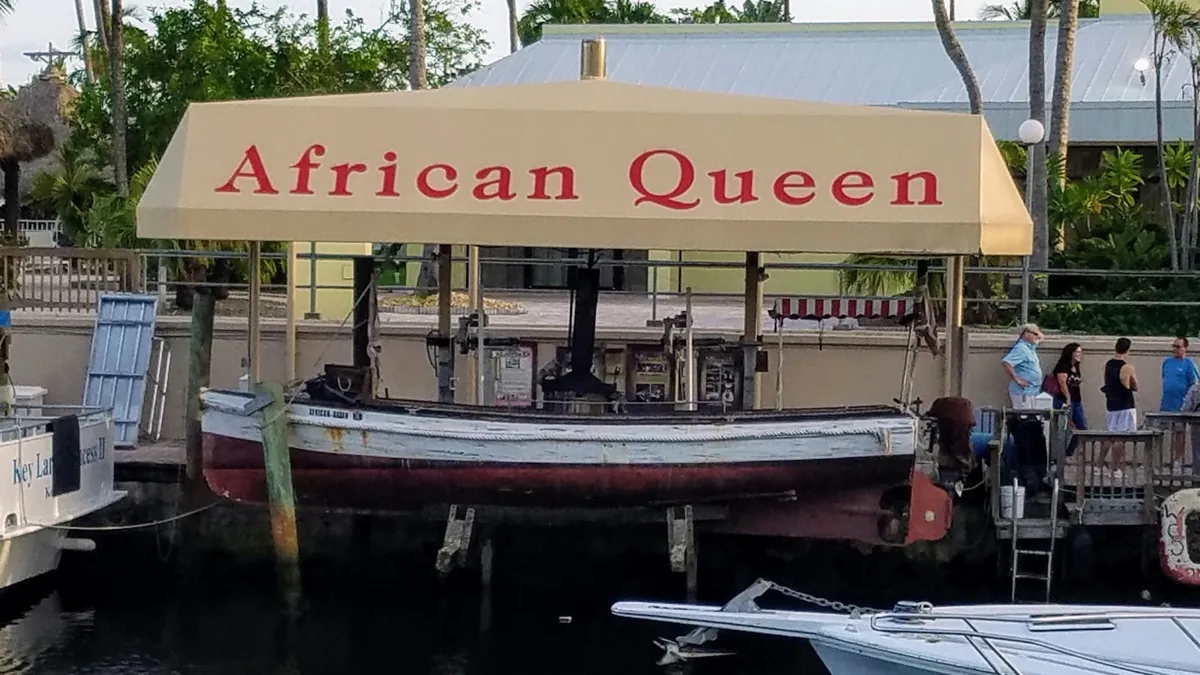
African Queen
The African Queen is a 30-foot steam launch built in 1912 by a British shipyard for the British East Africa Company. She spent decades hauling cargo and passengers on Lake Albert and the Victoria Nile in Uganda. Then John Huston needed a boat for his 1951 film. The African Queen became one of the most recognizable vessels in cinema — Humphrey Bogart won his only Academy Award pulling leeches off his legs on its deck. Katherine Hepburn poured his gin overboard. The boat survived the film, decades of neglect, and multiple restorations. She's currently in Key Largo, Florida, operating as a tourist excursion boat. You can ride on the same vessel that Bogart steered through the papyrus.
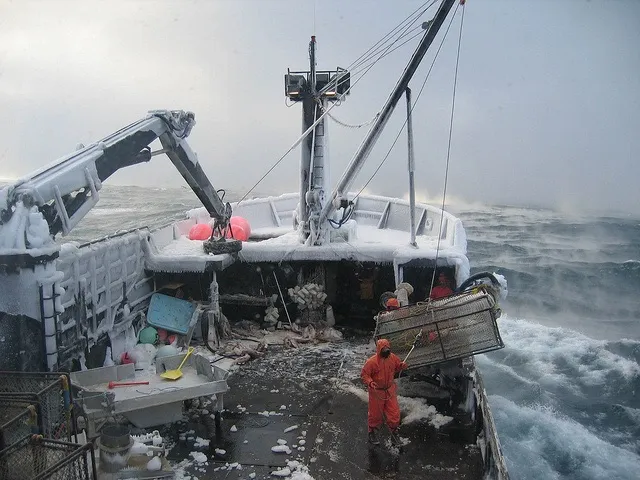
Bering Sea Crab Boat
Before Deadliest Catch premiered on Discovery Channel in 2005, almost nobody outside Alaska knew what Bering Sea crab fishing looked like. Afterward, boats like the Northwestern, Cornelia Marie, and Time Bandit became household names. The show turned a brutal, obscure commercial fishery into reality television. What it got right is that the job is genuinely insane. The Bering Sea king crab and opilio (snow crab) fisheries operate in some of the worst conditions on earth. Winter storms generate 40-foot seas. Wind chill drops to minus 40. Spray freezes on contact with the superstructure, adding tons of topside weight that can capsize a boat if not knocked off. The crews use baseball bats and sledgehammers to break ice off the rails, rigging, and wheelhouse. This is a real thing that happens on a regular basis. The fatality rate for Bering Sea crab fishing has historically been 80 times the national average for workplace deaths. Coast Guard reforms, rationalization of the fishery (switching from a short derby season to individual fishing quotas), and better safety equipment have brought the rate down, but it's still the most dangerous fishery in North America. Between 1990 and 2010, dozens of boats and over a hundred lives were lost. The economics are as extreme as the conditions. Under the old derby system, the entire king crab season was compressed into a few days. Boats raced to catch as much as possible before the season closed. Crews could earn $30,000-$80,000 for a few weeks of work. They could also earn nothing if the catch was poor, or die if the weather turned. The quota system, implemented in 2005, spread the season out and reduced the death rate. It also reduced the gold-rush paydays. Now the money is steadier but lower. The boats still go out in terrible weather because that's where the crab are.
Black Pearl
Before 2003, the pirate movie was a dead genre. After Pirates of the Caribbean, every kid in America wanted a ship with black sails. The Black Pearl did for pirate vessels what the Millennium Falcon did for spaceships. It made the vehicle a character. The ship represents freedom in its purest cinematic form. Jack Sparrow doesn't want gold or power. He wants his ship back. That's it. The entire first film is a man trying to reclaim the one thing that makes him who he is. The Black Pearl isn't transportation. It's identity. Johnny Depp's performance gets the credit, and it should. But the ship sells the fantasy. The black sails against a Caribbean sunset. The ragged rigging. The impossible speed. You believe this ship is alive because the movie treats it like one. The prop was built on a steel barge called the Sunset, dressed with a full wooden superstructure. Additional ships were constructed for later films, and digital effects expanded the Pearl's capabilities well beyond anything that floats.