Framnes Shipyard
Framnes Mekaniske Verksted in Sandefjord, Norway, built ships designed to survive where other ships couldn't go. The yard specialized in polar vessels with ice-strengthened hulls, a niche expertise rooted in Norway's whaling and Arctic exploration traditions. In 1912, Framnes built a barquentine originally named Polaris, intended for Arctic tourism cruises. That vessel was purchased by Sir Ernest Shackleton in 1914 and renamed Endurance. Endurance was built for ice. Her hull was constructed from oak and Norwegian fir planking up to 30 inches thick, with the bow sheathed in greenheart, one of the hardest woods available. The frames were closer-spaced than standard merchant construction, and the hull shape was designed to resist ice pressure by rising under compression rather than being crushed. Despite all this, the Weddell Sea pack ice eventually destroyed her in October 1915, after holding her trapped for ten months. Framnes continued building vessels through the mid-20th century, producing whaling ships, cargo vessels, and other commercial craft for Norwegian owners. The yard reflected Sandefjord's identity as a whaling port, building the specialized ships that industry required.
Heritage
The Norwegian tradition of building for polar conditions is centuries old, and Framnes was one of its finest practitioners. The yard understood ice in a way that shipbuilders from temperate climates simply didn't. Endurance's survival for ten months in pack ice before finally being crushed was as much a testament to Framnes's construction as it was to Shackleton's leadership. The wreck, discovered on the Antarctic seabed in 2022, showed the hull still largely intact after more than a century underwater.
Vessels (2)
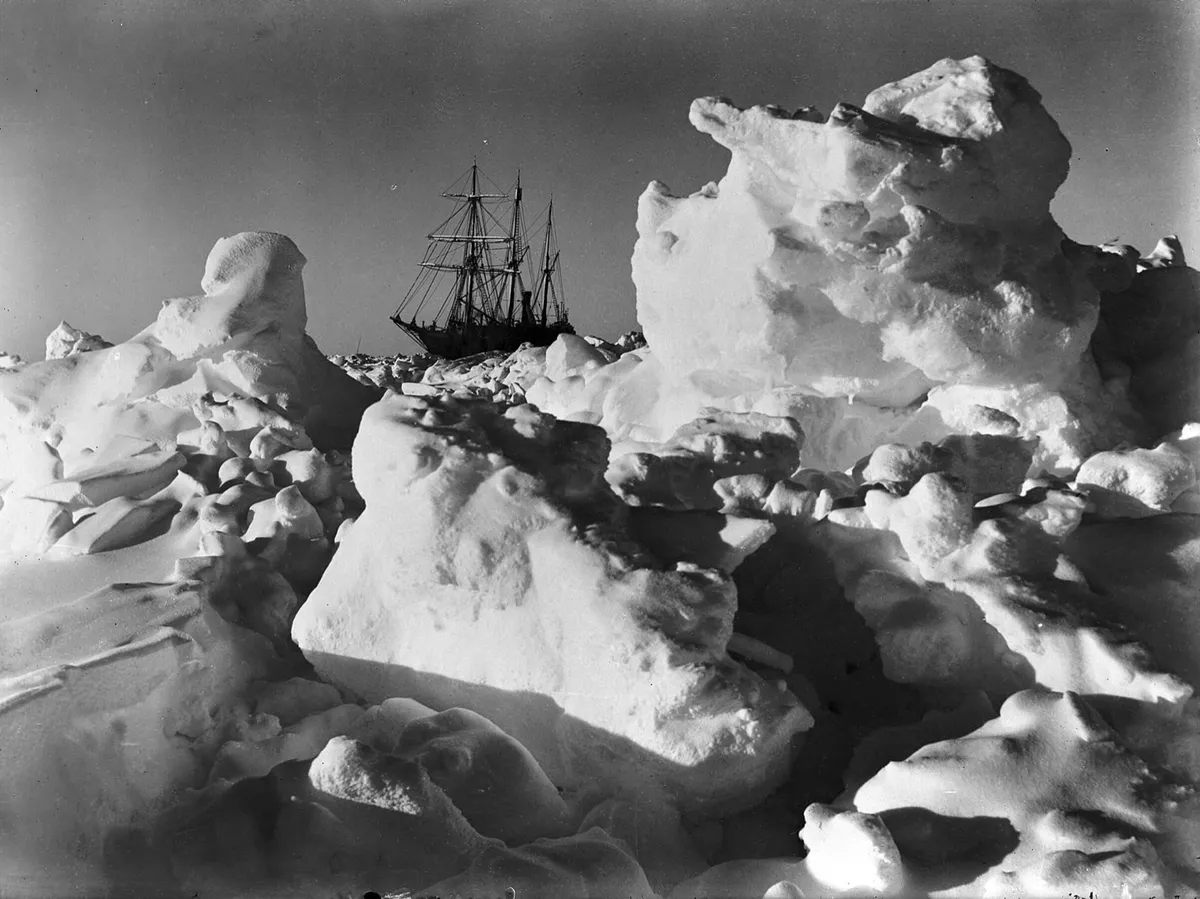
Endurance
Endurance never reached Antarctica. That's the first thing to understand. Shackleton's Imperial Trans-Antarctic Expedition was supposed to cross the continent from the Weddell Sea to the Ross Sea, roughly 1,800 miles over the pole. They didn't make it to shore. Endurance entered the Weddell Sea pack ice in December 1914 and became trapped on January 19, 1915. For ten months the crew lived aboard while the ice slowly crushed the ship around them. Frank Hurley's photographs show the hull buckling, the deck timbers splintering, the masts leaning at impossible angles. On October 27, 1915, Shackleton ordered the crew onto the ice. Endurance sank on November 21. What followed is the greatest survival story in the history of exploration. Twenty-eight men camped on drifting ice floes for five months, eating seals and penguins, watching the floe they lived on crack and shrink. When the ice broke up in April 1916, they launched three salvaged lifeboats and sailed through open Antarctic seas to Elephant Island, a desolate rock at the tip of the Antarctic Peninsula. It was the first time they'd stood on solid ground in 497 days. Shackleton then took five men in the 22-foot James Caird and sailed 800 miles across the Southern Ocean to South Georgia Island. The Drake Passage is the most violent stretch of open water on earth. The boat was open. They navigated by dead reckoning and occasional sun sights through storm clouds. They made landfall on the wrong side of the island and Shackleton, Worsley, and Crean then crossed South Georgia's unmapped mountain range on foot to reach the whaling station at Stromness. Not a single man died. All 28 survived. The Trans-Antarctic Expedition was a complete failure by its stated objective and an absolute triumph of leadership. Shackleton brought everybody home. The wreck was found in March 2022 by the Endurance22 expedition at a depth of 10,000 feet in the Weddell Sea. The ship is upright, intact, with the name "ENDURANCE" still clearly visible on the stern. The cold, low-oxygen water preserved her like no one expected.
SS Baychimo
The SS Baychimo was a perfectly ordinary cargo steamer until the Arctic decided to make her extraordinary. Built in 1914 at Framnes shipyard in Sandefjord, Norway, she spent her first years as a German trading vessel before being seized as a war reparation and handed to the Hudson's Bay Company. For a decade, she ran a routine supply route along the northern coast of Canada, hauling fur pelts out and provisions in. In October 1931, she got trapped in pack ice near Barrow, Alaska. The crew waited, hoping for a thaw. When conditions worsened, they abandoned ship and set up camp on shore. A blizzard hit. When it cleared, the Baychimo was gone. They assumed she'd sunk. She hadn't. An Inuit seal hunter spotted her 45 miles away, drifting free. The Hudson's Bay Company decided the ship was too damaged to be worth recovering. They were wrong about the damage, and spectacularly wrong about the drifting. The Baychimo became a phantom. She was spotted in 1933 by a group of Inuit who boarded her and got trapped by ice for ten days. She was seen in 1934 near the Beaufort Sea. In 1939, she was found again, still afloat, eight years after abandonment. Expeditions tried to reach her and failed. She kept showing up, drifting through the Arctic like she had somewhere to be. The last confirmed sighting was in 1969, thirty-eight years after her crew walked away. A frozen steel hull, unmanned, drifting through some of the most dangerous waters on earth for nearly four decades. The Alaskan government launched a search in 2006 but found nothing. She may have finally sunk. Or she may still be out there, locked in ice somewhere north of the charts.