Orca (Jaws)
Why it matters
Jaws invented the summer blockbuster in 1975, and the Orca is the blue-collar soul of that movie. Spielberg could have put his shark hunters on a Coast Guard cutter or a gleaming sportfisher. Instead he put them on a beat-up fishing boat captained by a man who clearly hadn't painted his hull in years.
That choice matters. The Orca tells you everything about Quint before he opens his mouth. This is a man who works for a living, who trusts wood and diesel over fiberglass and technology, and who would rather die on his own boat than live on someone else's. The vessel is too small for the job. That's the point.
The real boat was a 42-foot Nova Scotia lobster boat named Warlock, purchased for $1 and modified for filming on Martha's Vineyard. She was never meant to survive the production. She barely did.
What it was like
Three men on a boat too small for a great white shark. That's the whole movie, really.
Quint ran his boat like a charter captain who'd been doing this alone too long. Everything had a place. Nothing was comfortable. The Orca was a working platform, not a pleasure craft. Below deck was cramped, dark, and smelled like fish and diesel. The galley was an afterthought.
Brody spent most of the trip seasick and terrified, chumming the water from the stern while trying not to fall in. Hooper brought his own fancy equipment aboard and immediately got on Quint's nerves. The three of them drank, argued, compared scars, and sang "Show Me the Way to Go Home" while the boat creaked around them.
Then the shark showed up and the Orca started coming apart.
The crew
Captain (Quint)
Robert Shaw's Quint is a Nantucket fisherman who hunts sharks for bounty. He knows the Orca the way old mechanics know engines. Every sound, every vibration, every groan of the hull is a conversation. He pushes the boat past its limits because he's pushed himself past his own limits since the USS Indianapolis went down. The Orca is his last stand, and he knows it.
Chief of Police (Martin Brody)
Roy Scheider's Brody is a New York cop who moved to a beach town and can't swim. He's out of his element in every possible way. He ties knots wrong. He chums from the wrong side. He's the audience surrogate, the man who looks at the ocean and sees exactly what we see: something that wants to kill him.
Oceanographer (Matt Hooper)
Richard Dreyfuss's Hooper is a marine biologist with expensive equipment and an Ivy League education. Quint calls him a 'half-assed astronaut' and resents everything he represents. But Hooper can identify the shark, and he's willing to get in the water. He's braver than he looks, even if his gear is nicer than anyone on that boat deserves.
Patina notes
The Orca was already weathered when they bought her. That was the point. The Warlock had spent years working the waters off Nova Scotia, and the production team added more character on top of real wear. Chipped paint, rust stains, salt-crusted hardware.
During filming, the boat took real damage. The mechanical shark scenes were brutal on the hull, and continuity was a nightmare. By the end of production, the Orca was in rough shape. The sinking scene at the climax wasn't entirely acting.
Preservation reality
The original Warlock/Orca was scrapped after filming. The boat was never intended to survive the production, and the abuse it took during the shoot made preservation impractical.
A replica was built for the Universal Studios theme park in Orlando, where it sat at the Jaws ride attraction for years. That ride closed in 2012. Various replicas and tributes exist, but nothing from the original vessel survives.
Martha's Vineyard embraces the Jaws connection. You can visit filming locations, but the boat itself is gone. Like Quint, the Orca went down fighting.
Where to see one
- • Martha's Vineyard, MA (filming locations)
- • Universal Studios Hollywood (Jaws memorabilia)
Related vessels
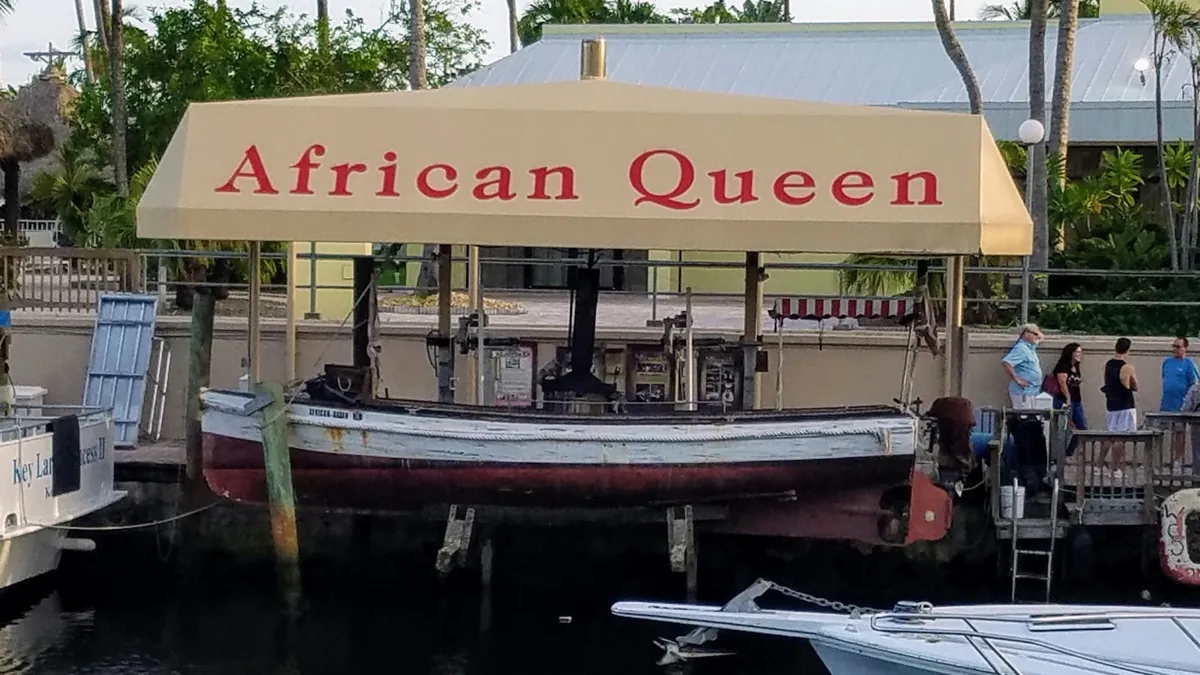
African Queen
The African Queen is a 30-foot steam launch built in 1912 by a British shipyard for the British East Africa Company. She spent decades hauling cargo and passengers on Lake Albert and the Victoria Nile in Uganda. Then John Huston needed a boat for his 1951 film. The African Queen became one of the most recognizable vessels in cinema — Humphrey Bogart won his only Academy Award pulling leeches off his legs on its deck. Katherine Hepburn poured his gin overboard. The boat survived the film, decades of neglect, and multiple restorations. She's currently in Key Largo, Florida, operating as a tourist excursion boat. You can ride on the same vessel that Bogart steered through the papyrus.
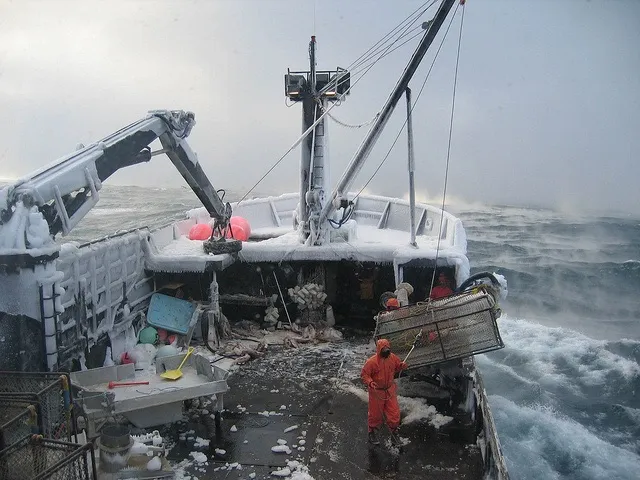
Bering Sea Crab Boat
Before Deadliest Catch premiered on Discovery Channel in 2005, almost nobody outside Alaska knew what Bering Sea crab fishing looked like. Afterward, boats like the Northwestern, Cornelia Marie, and Time Bandit became household names. The show turned a brutal, obscure commercial fishery into reality television. What it got right is that the job is genuinely insane. The Bering Sea king crab and opilio (snow crab) fisheries operate in some of the worst conditions on earth. Winter storms generate 40-foot seas. Wind chill drops to minus 40. Spray freezes on contact with the superstructure, adding tons of topside weight that can capsize a boat if not knocked off. The crews use baseball bats and sledgehammers to break ice off the rails, rigging, and wheelhouse. This is a real thing that happens on a regular basis. The fatality rate for Bering Sea crab fishing has historically been 80 times the national average for workplace deaths. Coast Guard reforms, rationalization of the fishery (switching from a short derby season to individual fishing quotas), and better safety equipment have brought the rate down, but it's still the most dangerous fishery in North America. Between 1990 and 2010, dozens of boats and over a hundred lives were lost. The economics are as extreme as the conditions. Under the old derby system, the entire king crab season was compressed into a few days. Boats raced to catch as much as possible before the season closed. Crews could earn $30,000-$80,000 for a few weeks of work. They could also earn nothing if the catch was poor, or die if the weather turned. The quota system, implemented in 2005, spread the season out and reduced the death rate. It also reduced the gold-rush paydays. Now the money is steadier but lower. The boats still go out in terrible weather because that's where the crab are.
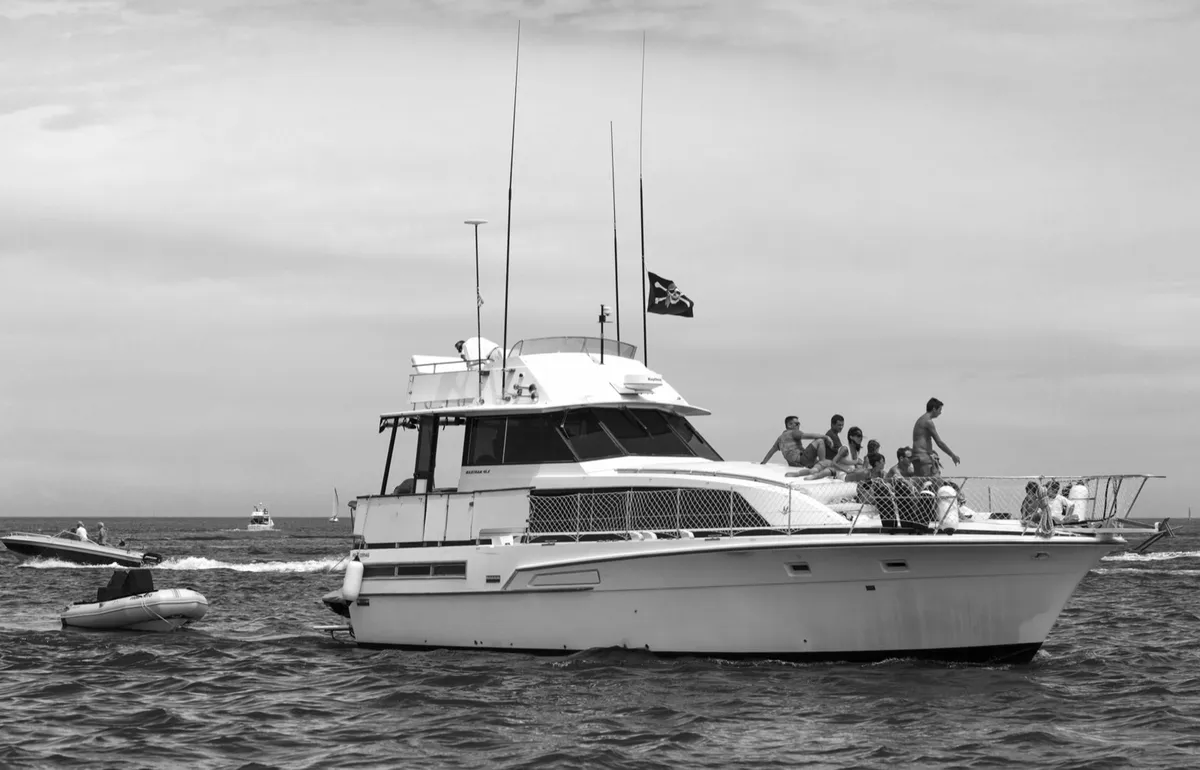
Bertram 31
Before the Bertram 31, going offshore in a small boat meant getting beaten to pieces. Ray Hunt's deep-V hull design changed that. The constant 24-degree deadrise cut through waves instead of pounding over them. Dick Bertram proved the concept by running a prototype in the 1960 Miami-Nassau race in rough seas — while flat-bottom boats were turning back, the Bertram kept running. The sportfishing world noticed. Within a decade, every serious sportfishing boat was a deep-V, and the Bertram 31 was the benchmark. It's the hull design that made offshore fishing accessible to anyone who could handle a boat.